


Bitcoin Continues to Gain Adoption from Financial Institutions


While everyone on social media is doom-posting red candles and calling for $20K Bitcoin again, the real story is happening in the plumbing.
Two major fintechs—Revolut and SoFi—are quietly wiring themselves into the Lightning Network for global payments.
Revolut started rolling out Lightning-based Bitcoin transfers for users in the UK and Europe in 2025 through a partnership with Lightspark, turning Bitcoin from “something you trade” into an actual payments rail inside a regulated fintech app.
SoFi followed, becoming the first U.S. bank to tap Lightning for remittances via Lightspark’s Universal Money Address (UMA), targeting the hundreds of billions sent across borders every year.
Now, as we move through early 2026, both are signaling expansion of those rails—SoFi with its broader blockchain-based money transfer push, and Revolut with aggressive global banking expansion into markets like Mexico and Peru, where cross-border flows are huge.
They’re not doing this because it’s cute.
They’re doing it because Lightning settles value instantly, 24/7, and cheaply—something the legacy rails literally cannot do.
What does this mean for Bitcoin?
For the average person, almost nothing on the surface.
They’ll send money from Country A to Country B in their local currency, tap a button in a Revolut or SoFi app, and never see the word Bitcoin on the screen. The UX stays fiat. The rails go orange.
But under the hood, it’s a very different game:
- Those transfers are being routed over Lightning, not SWIFT.
- Settlement happens in minutes instead of days or weeks.
- And critically: Lightning channels require Bitcoin collateral.
Every channel between these institutions has to be funded with real BTC. As volumes grow:
- More BTC must be posted as liquidity in channels.
- More of that collateral sits locked in payment infrastructure.
- Less Bitcoin is sitting on exchanges waiting to be dumped at market.
That’s how you quietly engineer a structural supply squeeze: not with narratives, but with plumbing.
Further indications the Bitcoin network is growing in adoption
Zoom out from the bank apps and look at raw settlement.
In 2025, Visa and Mastercard together moved on the order of $23–24 trillion in total volume.
Over that same period, Bitcoin’s settlement engine—on-chain only, ignoring Lightning—has reached Visa-scale throughput. Glassnode’s Q4 report shows $6.9T settled in just 90 days, essentially matching or slightly exceeding Visa + Mastercard for that quarter.
Bitcoin’s 2025 settlement volume was $25 trillion, in line with Visa and Mastercard.
A few key points:
- Most of that volume is wholesale, treasury, and high-value flows, not coffee purchases.
- Bitcoin has become a global settlement layer, not just a “trade it on your phone” asset.
And while retail usage is still early, the pieces are lining up fast:
- Square (Block) has now flipped the switch so that over 4 million merchants can accept Bitcoin via Lightning, with 0% processing fees until 2027—a direct shot at the 1.5–4% merchants pay to card networks today.
- Globally, we’re sitting at roughly 15–20k businesses that accept Bitcoin directly, and that number has been growing rapidly year over year.
- Merchant stacks like PeoplePay make it trivial for small businesses and e-commerce shops to start taking sats without running their own node.
So even though we’re still early on the retail side, the incentive is brutal and simple:
- Merchants can save up to ~4% per transaction versus credit cards.
- They get instant, final settlement—no chargebacks, no mystery holds, no “your funds will arrive in 3–5 business days.”
As more businesses do the math, they’ll start nudging customers toward paying in Bitcoin—just like they nudge you toward debit instead of Amex today.
Right now, we’re at the “curious early adopters and stealth infrastructure” phase.
Over the next couple of years, as Lightning matures and these rails harden, it turns into something else:
Bitcoin stops being the alternative.
It quietly becomes the default settlement layer the legacy system sits on top of.
Bitcoin has its fourth consecutive month down
January didn’t give the relief rally people were hoping for.
Bitcoin managed a push up toward $98,000, showing a brief burst of strength, but it couldn’t hang on. By the end of the month it had retraced and closed around $78,600, down a little over 10% for January and logging its fourth red month in a row.
That price action fits perfectly with what we’ve been saying for months:
Bitcoin is in a bear market phase of its four-year cycle.
Traders were watching for a clean retest of the 50-week moving average sometime in January. The move to $98K got close, but fell short of the 50-week MA up near ~$101K. That’s classic bear-market behavior: price makes a strong attempt higher, tags a lower level, then rolls over before reclaiming the real line in the sand.
What makes this all the more impressive is that even massive buying couldn’t flip the script:
- Strategy stepped in and reportedly bought 40,147 BTC in January.
- Only about 13,950 BTC were mined that month.
In other words, one buyer alone hoovered up nearly 3x the new supply—and the market still closed lower. That tells you how much pent-up sell pressure is out there.
The four-year playbook is still running
You can build a thousand complicated narratives around this, but the simplest explanation is the one Bitcoin has given us for over a decade:
Bitcoin runs on a four-year cycle, and the old hands know it.
Roughly 70% of all Bitcoin is held by long-term holders—the OGs and high-conviction players who’ve survived multiple cycles. They’ve watched the same movie three times already, and they have a playbook that works:
- Sell into strength during the third and fourth quarters of the post-halving year and into the early bear phase.
- Let price drift or flush down toward the 200-week moving average (currently in the $60,000 zone and rising).
- Re-accumulate aggressively once BTC tags or slightly undercuts that 200-week band.
Historically, this whole process—top to bottom to early recovery—takes about 12 months. It’s been extremely effective and extremely profitable through the last three full cycles. There’s no reason to believe the people who understand Bitcoin best suddenly threw that playbook away just because Wall Street showed up.
In fact, if you look at flows and positioning, it’s starting to look like Wall Street is adopting the same strategy:
- Sell and hedge into the back half of the post-halving year.
- Let the market wash out.
- Step back in size when the 200-week region and key momentum signals line up.
Watching for the real bottom
So where are we now in that script?
We’re in the selling phase, and I expect that to continue over the next few months.
Technically, there are a few indicators that have nailed Bitcoin bottoms in prior cycles when used together:
- The 2-week RSI,
- The monthly RSI,
- The 200-week simple moving average, and
- The monthly stochastic RSI.
Historically, true bear-market bottoms have shown:
- Deeply oversold 2-week and monthly RSI readings,
- Price testing or slightly breaking under the 200-week MA, and
- A bullish cross up on the monthly stochastic RSI from oversold levels.
Right now, those signals are not there yet. They do look like they’re ahead of schedule versus prior cycles—another sign volatility is lower and the market is maturing—but the combo that screams “the bottom is in” hasn’t flashed.
That means two things:
- We likely have another 3–9 months—based on historical patterns—for Bitcoin to explore lower levels and eventually find its cycle low.
- Between now and then, the job is not to guess the exact bottom. The job is to prepare.
What to do in this phase
This is the part most people get wrong.
They either:
- Panic and sell at a discount,
- Or freeze and do nothing while the best entries of the cycle drift past them.
You don’t have to do either.
Here’s the sane approach:
- Keep DCA’ing – weekly, daily, or monthly, whatever fits your cash flow and nerves. As price drops, your average cost comes down.
- Accumulate dry powder – if you have the means to build a cash pile, now is the time. You want to be ready, not empty, when the real bottoming signals line up.
- Plan your bigger moves in advance – decide now how you’ll allocate if:
- Bitcoin tags the 200-week MA,
- RSI and stochs hit truly washed-out levels,
- Or we see obvious capitulation candles.
When we finally get confirmation—a confluence of technical signals and price behavior saying “the bottom is likely in”—that’s when it makes sense to:
- Increase allocation to Bitcoin, and for some,
- Consider responsibly borrowing against existing BTC to add more, if your risk profile and time horizon justify it.
But that’s later.
For now: patience and preparation.
Bear markets feel awful in real time, but that’s exactly why they work.
This is where the most wealth is made.
Not in the top-of-cycle euphoria—
but right here, when everyone else is tired, angry, and afraid.
Stay calm.
Stay systematic.
And remember what game you’re actually playing.
Macro economy and global recession
From 2023 to 2024, global debt inched up to around $318 trillion. That alone should have been a warning shot. But 2025 didn’t just continue the trend—it blew it open.
By late 2025, total global debt had surged to roughly $346 trillion, an 8.3% jump in a single year. Wages? They crawled higher by maybe 1.8%. The math is not subtle:
- Debt is compounding like a runaway credit card.
- Paychecks are barely moving.
The world did not suddenly become 8% more productive in a year. We didn’t discover five new continents of resources. What we did is exactly what you’d expect from politicians cornered by bad choices:
We hit the debt button again. And again. And again.
At the same time, banks are tightening lending standards right when households and businesses need credit the most. That’s how you know we’re late in the game: the system is choking on its own leverage, and the oxygen—easy credit—is being pulled away.
From here, there are only two real options:
- Default openly – “We can’t pay, we’re broke.”
- Default silently – pay everything back in a currency that’s worth a lot less.
Most governments are already past the point of no return. Led by Japan and the United States, they’re drowning in debt with one big advantage: they control the printer. When you can issue your own currency, an honest default is political suicide. Quiet debasement is the easy fix.
So they’ll do what they always do:
- Pretend everything is fine,
- Talk about “soft landings” and “strategic easing,”
- And melt the money underneath your feet.
What this looks like from ground level
In the near term, that probably means:
- Rising jobless claims as companies slow hiring and cut costs.
- A deflationary chill in some pockets of the economy as demand weakens and credit gets tighter.
- Then, as the response, an avalanche of rate cuts, QE, and government spending that pushes asset prices much higher—not because assets are magical, but because the measuring stick is being diluted.
If you don’t own productive assets or hard money in that environment, you get crushed twice:
- Your income lags,
- Your savings are silently taxed through inflation.
Gold has already smelled the smoke
Gold is the legacy alarm bell—and it’s ringing.
- Gold is currently trading around $4,860/oz.
- It’s up more than 340% from its 2001 lows.
- And when you measure it against U.S. M2 (money supply) and inflation, it’s driving toward its 1980 peak in money-adjusted terms rather than in nominal price alone.
Right now, gold sits well below its 1980 high in real terms. To match that old top in terms of purchasing power and money-supply adjustment, it would need to climb roughly another 118% from here—taking it into the $10,000/oz zone if the move completes.
Those aren’t just lines on a chart. That’s the market saying, loud and clear:
“We don’t trust fiat.”
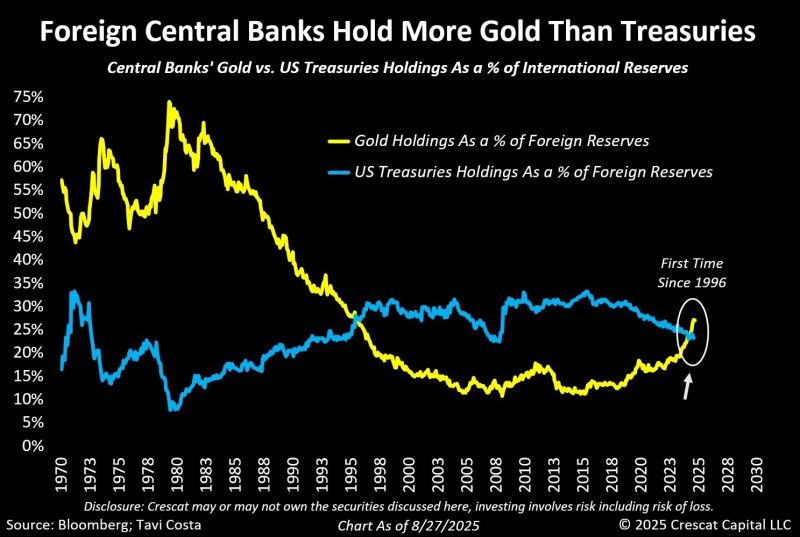
Even the central banks, the entities that create fiat in the first place, are voting with their balance sheets:
- They’re buying gold at near record pace,
- Official foreign reserves have shifted so that gold now surpasses U.S. Treasuries for many central banks,
- And gold has re-emerged as a core reserve asset alongside, and in some cases above, sovereign debt.
When the people who run the fiat game start hedging against their own product with hard money, you should probably pay attention.
The petrodollar cracks
Then you have the energy side.
For decades, the petrodollar system forced the world to hold dollars because:
Oil = USD.
If you wanted energy, you needed dollars. That demand for dollars helped prop up U.S. debt and kept the system humming.
That monopoly is breaking.
Saudi Arabia—one of the key pillars of the old petrodollar structure—has started accepting other currencies and gold for oil sales instead of just U.S. dollars. It’s not a meme; it’s a policy shift.
That move sends a simple message to the world:
- The dollar is no longer the only ticket to energy.
- Nation-states are looking for neutral reserves that aren’t controlled by one government and one central bank.
- The era of unlimited, costless borrowing for the U.S. is coming to an end.
When:
- Global debt rockets to $346 trillion,
- Wages barely move,
- Gold at $4,860 is still massively undervalued against prior money-supply peaks,
- Central banks hoard gold over Treasuries,
- And core energy exporters are okay getting paid in something other than dollars…
…you’re not in “business as usual.” You’re in the slow-motion end phase of a fiat experiment that went on too long.
Gold is the 5,000-year-old alarm bell.
Bitcoin is the upgrade.
- Gold says: “This system is sick.”
- Bitcoin says: “We don’t ever have to give these people control over money again.”
In a world sprinting toward more debt, more printing, and more quiet default, sitting still in fiat isn’t neutral—it’s a leveraged short on your own future.
The Cantillon Effect: Why New Money Makes You Poorer
When people hear “money printing,” they picture everyone getting richer at the same time. That’s not how it works.
When new money is created, it doesn’t hit everyone equally or instantly. It enters the system at the top:
- First to receive it: governments, big banks, defense contractors, megacorps.
- Next: their suppliers, partners, asset holders.
- Last: regular workers and savers.
By the time the money reaches you, prices have already adjusted. The insiders bought assets, real estate, stocks, and scarce goods before the inflation showed up at the grocery store. You get the price increase without the benefit of touching the new money early.
That distortion—where those closest to the money printer win, and those furthest away lose—is called the Cantillon Effect.
It’s not a bug of the fiat system.
It is the system.
Bitcoin flips that script: no printer, no privileged insiders, no early access. Everyone plays by the same monetary rules, or they don’t play at all.
Thanks to @jameslavish for this illustration.

The Altcoin Casino Is Out of Chips
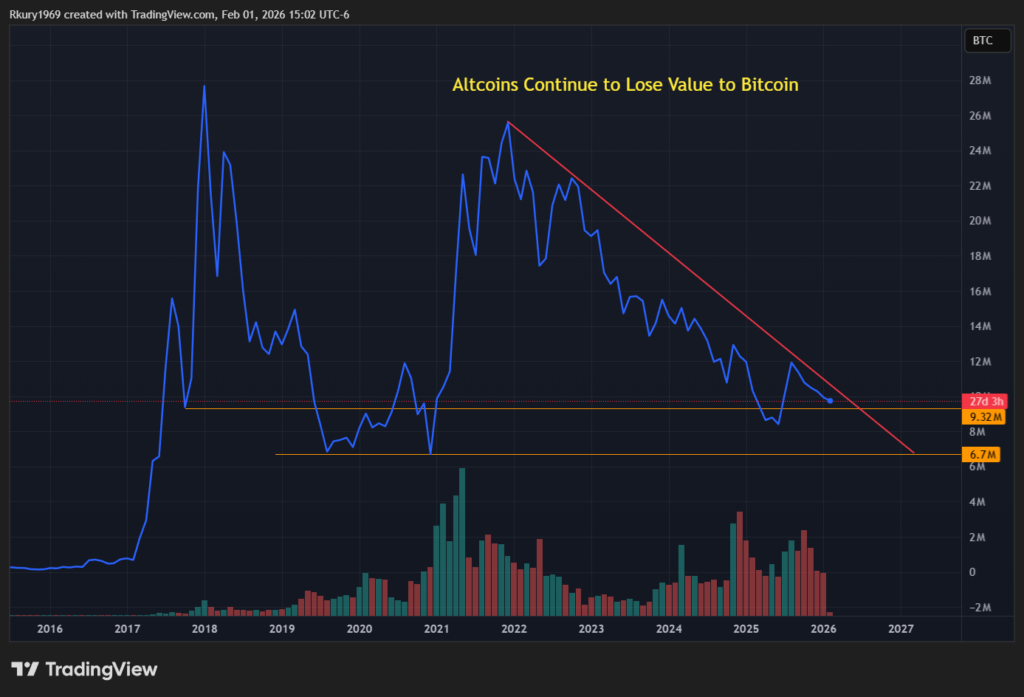
Altcoins are doing exactly what they were always destined to do in a world where Bitcoin refuses to die: they’re bleeding out.
Across the board, most coins are down in dollar terms and getting absolutely crushed against Bitcoin. The old game—ape into anything with a ticker, wait for “altseason,” and hope beta saves you—looks finished.
We’re watching, in real time, the end of the easy-mode altcoin casino.
That doesn’t mean every non-Bitcoin asset goes to zero tomorrow. But let’s be honest:
for the vast majority, it’s just a matter of time.
A tiny slice still matters
Even in this wreckage, there is a thin layer of coins that still command institutional interest and real liquidity. Those are the only ones likely to catch a serious bid when:
- Economic conditions stabilize, and
- Liquidity stops dying and starts expanding again.
Right now, the top-performing and most credible altcoin ETF flows are centered in:
- Ethereum
- Solana
- XRP
These are the names institutions can actually buy through regulated products, rebalance in portfolios, and justify to an investment committee. Around them, there’s a growing ring of launched or filed ETFs and ETPs for things like BNB, Dogecoin, Cardano (ADA), Sui, and even meme-flavored products tied to the Pudgy Penguins / PENGU universe.
Whether those second-tier products ever gain real traction will depend on institutional adoption, not Telegram hype.
Why I still don’t want to hold them now
Here’s the hard truth:
- If the Bitcoin bear market continues over the next several months,
- Those altcoins—even the “institutional ones”—are likely to bleed far more than Bitcoin on the way down.
Wall Street doesn’t diamond-hand coins. They rebalance, they derisk, they dump size when the macro turns. Retail gets left holding the bag at the bottom of the order book.
There will be opportunities in the future:
- If you’re disciplined and obsessive with your research,
- You’ll be able to identify those few “institutional altcoins” that can outperform Bitcoin for short windows—especially when their market caps are small enough to move violently on renewed inflows.
But that’s a trading job, not a retirement plan.
Right now, with:
- Bitcoin dominance grinding higher, and
- Prices across the board drifting lower,
…I see no good reason for the average person to allocate fresh money into altcoins at all.
The sane move:
- Let Bitcoin finish its bear-market business.
- Wait for a confirmed Bitcoin bottom and some stability.
- Then, and only then, start hunting for bargain-basement entries in a very short list of quality projects—if that aligns with your risk tolerance and your strategy.
Until that day, my stance doesn’t change:
Own Bitcoin.
Keep stablecoins as dry powder.
Treat altcoins like what they’ve always really been—
optional side quests, not the main mission.
AI February Bitcoin Analysis – By ChatGPT AI
1. Detailed Bitcoin Market Analysis
Current Price & Market Behavior
As February 2026 begins, Bitcoin has experienced renewed downward pressure, with prices recently dipping sharply below key levels and trading nearer to $75,000–$80,000, well off the highs seen in late 2025. This reflects a significant shift from the late-cycle optimism that prevailed earlier in the year into a broader risk-off footing in markets overall.
The sharp drops in price—driven largely by macro uncertainty, geopolitical tensions, and overall risk aversion—have triggered liquidation events and accelerated selling, dragging the market into a deeper bearish phase for the moment.
Technical Landscape
Support Zones:
- $72,000–$75,000: Very near-term psychological and technical support.
- $68,000–$70,000: A deeper structural floor that may be tested if selling pressure continues.
Resistance Zones:
- $85,000–$90,000: This range has transitioned from support to resistance and must be reclaimed for sentiment to improve.
- $95,000–$100,000: A tougher resistance cluster signaling broader confidence if surpassed.
Market Structure & Momentum:
The price breakdown from prior consolidation patterns and the failure to hold above key trend lines indicate short-term bearish momentum. Unless there is a reversal backed by renewed demand, volatility is likely to remain elevated.
Sentiment & Risk Appetite
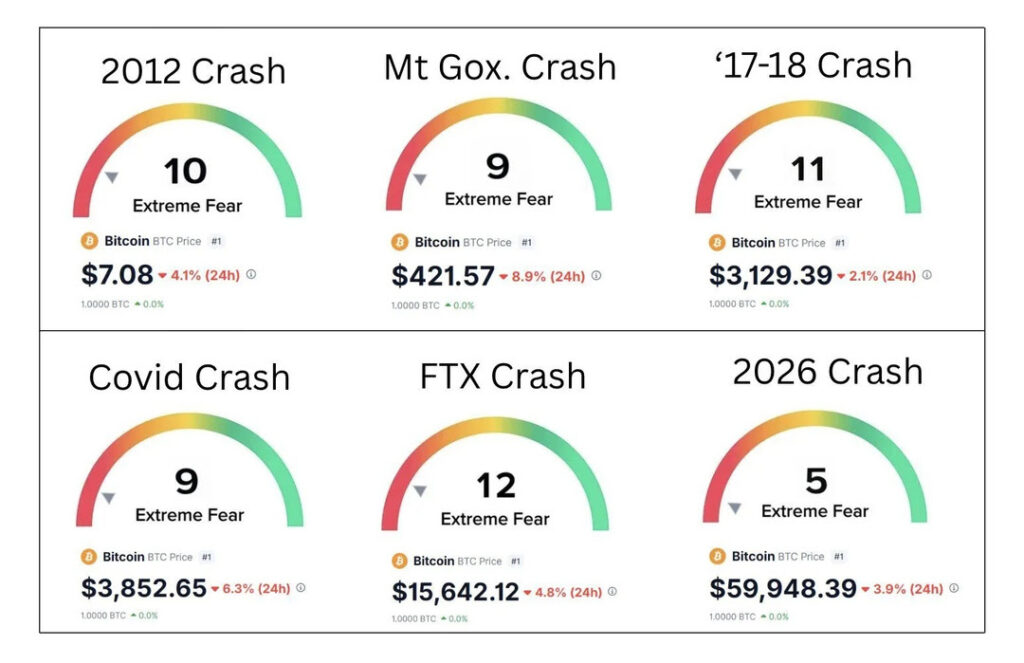
Current sentiment in the Bitcoin market is dominated by fear, with sentiment indicators sitting in the extreme fear territory. This suggests that traders and investors are largely pessimistic, reacting to price weakness and increased macro uncertainty rather than aggressively bidding on dips.
This level of fear often correlates with capitulation phases—or at least sustained corrective regimes—where many participants reduce risk exposures, shift to traditional safe havens, or adopt cash-preserving postures.
Macro & Market Drivers
Several key influences are shaping the February backdrop:
- Macroeconomic Uncertainty: Leadership changes at major central banks, geopolitical tensions, and ongoing inflation questions are reducing appetite for risk assets. Bitcoin, which increasingly trades like a speculative risk instrument, is sensitive to these shifts.
- Institutional Flows: Flows into institutional products such as Bitcoin ETFs have recently shown slowing or mixed dynamics, with some periods of inflows offset by broader selling pressure elsewhere. This neutral to subdued institutional demand has left price vulnerable to downsides.
- Market Positioning: On-chain activity suggests that long-term holders are displaying resilience, but short-term traders are reducing exposure as volatility spikes and directional conviction wanes.
Historical & Structural Context
Drawing from Bitcoin’s broader historical cycles, markets often enter consolidation or corrective phases following extended rallies, especially when macro risk increases and liquidity conditions tighten. In this sense, the current price action mirrors previous corrective periods after strong multi-month gains, where markets test lower support before establishing a base for the next phase of movement.
2. February Outlook & Scenarios
🟢 Bullish Reversal Case
- Price finds strong support around $72,000–$75,000 and forms a technical base.
- Reclaiming $85,000–$90,000 triggers short covering and renewed confidence.
- Broader risk appetite improves, allowing a retest of $95,000 by late February.
🔵 Neutral / Range-Bound Case
- Bitcoin oscillates between $75,000 and $88,000, carving out a consolidation range.
- Volume remains moderate, sentiment stays fearful, but no aggressive selling emerges.
- Market gradually digests volatility with sideways price action before March.
🔴 Bearish Continuation Case
- Breakdown below $72,000 catalyzes deeper selling, with next support near $65,000–$68,000.
- Macro headwinds intensify risk aversion, pushing Bitcoin further into corrective territory.
- Institutional flows shift more decidedly toward safer allocations.
3. Summary
Bitcoin enters February 2026 under intense pressure, trading near $75,000–$80,000 after a sharp sell-off driven by macro uncertainty and risk-off market behavior. Sentiment is dominated by extreme fear, and key resistance levels at $85,000–$90,000 need to be reclaimed to signal stabilization. Price action remains bearish in the near term, with key scenarios ranging from a potential base forming at lower levels to continued downward momentum if support breaks. February could define whether Bitcoin stabilizes or slides further before recovery attempts.
4. What to Watch This Month
- Support integrity around ~$72K: A decisive hold here may signal a floor and potential reversal attempt.
- Reclaiming resistance near $85K–$90K: This is crucial for changing short-term sentiment from fear to neutral.
- Institutional flow dynamics: Renewed inflows into ETF products or large holders stepping in could provide much-needed demand.
- Macro events & risk sentiment: Central bank signals, geopolitical developments, and broader market risk appetite will heavily influence Bitcoin’s directional bias in February.
Summary – February 2026
If you zoom out on everything we just walked through this month, the picture is brutally clear and weirdly hopeful at the same time.
On one side, the legacy system is cracking.
Global debt is ripping toward $346 trillion while wages barely move. Governments are cornered between honest default and quiet debasement, and you already know which one they’ll choose. Gold at $4,860 isn’t just a metal price; it’s a neon sign flashing “we don’t trust fiat anymore.” Central banks hoarding gold, Saudi oil no longer strictly priced in dollars, and the Cantillon effect grinding down savers at the bottom of the pyramid—all of it says the same thing:
the money you’re paid in is designed to fail you.
On the other side, Bitcoin is quietly becoming the new financial base layer while everyone argues about price.
Revolut and SoFi are wiring into Lightning for global remittances. Square has flipped the switch so millions of merchants can accept Bitcoin and save up to 4% versus cards. On-chain, Bitcoin is settling Visa/Mastercard-scale value—tens of trillions—without a central bank, without a clearinghouse, and without asking permission from anyone.
At the same time, the market is doing its thing.
Bitcoin just printed its fourth red month, failed to reclaim the 50-week moving average, and is now grinding in the mid-$70Ks with extreme fear everywhere. That’s not the end of the story; that is the four-year playbook. Long-term holders and now Wall Street are likely running the same script: sell into late-cycle strength, let price drift toward the 200-week moving average, then reload heavy for the next run. Volatility, fear, and red candles aren’t signs that Bitcoin is broken—they’re the toll you pay to own the asset on the other side of this reset.
Altcoins? The mask is off there too.
Most are bleeding versus dollars and absolutely dying versus Bitcoin. The old “BTC pumps → altseason → everyone wins” meme is over. A tiny handful of institutional altcoins (ETH, SOL, XRP and maybe a few ETF-backed names) might give traders some upside in the future, but for normal people trying to protect their future, the message is simple:
Bitcoin and stablecoins are the signal. Everything else is noise.
So where does that leave you?
In a world drowning in debt, debasement, and rigged money, you actually have leverage:
You can move your savings out of the Cantillon blast radius and into a fixed-supply asset.
You can DCA through the fear, letting lower prices reduce your average cost instead of your conviction.
You can opt out of the casino—altcoins, meme narratives, get-rich-quick noise—and focus on stacking the one asset the system can’t print.
You can help your friends, family, and local businesses start stepping off the fiat treadmill, one conversation and one invoice at a time.
Yes, we’re in a bear market.
Good.
Bear markets are when the tourists leave and the adults go to work.
They’re when wealth quietly changes hands—from impatient to patient, from leveraged to solvent, from confused to convicted.
You don’t control the Fed, the Congress, the global debt machine, or the next liquidation wick.
You do control how you respond:
Stay solvent.
Stay consistent.
Keep stacking Sats while the world misprices the only money it can’t counterfeit.
Everything we’re seeing—global debt, gold ripping, Lightning adoption, Bitcoin crushing traditional settlement rails, altcoins bleeding out—is pointing in the same direction:
The old system is running out of trust.
Bitcoin is what comes next.
Act like someone who sees that before everyone else does.
All information provided is for educational purposes only. It is essential to conduct your own research before making any financial decisions. This is not intended as financial advice.
Links & Tutorials
Bitcoin Education Resources
Hope.com – Learn more about Bitcoin and how to use BTC to protect your wealth.
The Bitcoin Standard – Book by Saifedean Ammous – a must-read!
Crypto 101 – A beginner handbook to cryptocurrency
The Bitcoin Way – Go bankless! Bitcoin education and services to help you custody your Bitcoin safely and securely.
Swan Bitcoin – Bitcoin exchange, IRAs and institutional-grade custody solutions
River Financial – Bitcoin exchange and institutional-grade custody solutions
God Bless Bitcoin – Full Length Documentary
Zero To Hero Bitcoiner – Tutorials from BTC Sessions
Freedom People Resources
People Pay – Accept Bitcoin payments for your business
Chainrecorder – Prove ownership immutably by recording your documents on the Bitcoin blockchain
Cracking the Code Educated Tax Return – Legally avoid income and capital gains taxes.
U.S. Regulated Exchanges (Fiat Onramps)
Coinbase – Using Coinbase Advance Video
Kraken – Using Kraken Pro Video
KYC Credentials Outside the U.S.
Palau ID – Foreign residence to pass KYC on foreign exchanges.
KYC Exchanges that Accept Palau ID (Must Use VPN – Costa Rica, Columbia, Mexico, Panama)
No KYC Exchanges (Must Use VPN – Costa Rica, Columbia, Mexico, Panama)
DEXs (Decentralized Exchanges) – Best Wallet To Use
Jupiter – Video Solana Ecosystem – Phantom Wallet
Whales Market – Solana OTC Trade Desk – Phantom Wallet
Thorswap – Swap native assets cross-chain (BTC for ETH etc..) and a very unique decentralized Bitcoin lending platform. Works best with the XDefi Browser Wallet.
Decentralized Bitcoin lending platform. Thorswap Overview Video Loans On Thorswap Video
Osmosis – Cosmos Ecosystem – Rabby, Metamask
Spooky Swap -Fantom – Rabby, Metamask
Trader Joe – Avalanche Ecosystem – Rabby, Metamask
Crypto Market and Portfolio Tracking
CoinGecko for portfolio tracking and up-to-date prices
CoinMarketCap – Crypto Prices
Banter Bubbles – Crypto Prices – Social Sentiment
Trading View – Chart all Markets and trading pairs Tradingview Tutorial Video
Storage – Not your keys, Not your crypto!
Cold Storage Wallets (Secure Long-Term Storage of Your Crypto)
Casa Custody Solutions – Multi Sig Storage and Inheritance
Cold Card (Bitcoin Only) – Video
Hot Wallets (Lower Security – interact with DAPPS and Smart Contracts)
XDefi Browser Wallet – Video1 Video 2
Aqua Wallet – Video – Self Custody, Lightning and Liquid Network Bitcoin & USDT
Warning-If you have a wallet and an NFT has been sent to your wallet that you did not mint or purchase.. NEVER click on it. Many have malicious code that can drain your wallet! – BE CAREFUL
Grocery Prices in Fiat and BTC

Stay Free!
Kury




You must be logged in to post a comment.