


Bitcoin Continues to Infiltrate the Financial System


While everyone seems to be obsessed with whether Bitcoin is “entering a bear market,” the real story is happening in boardrooms and product decks. Retail is arguing about candles; Wall Street is quietly wiring Bitcoin into the plumbing of the global financial system.
From “Pet Rock” to Product Line
Take JPMorgan. This is the same bank whose CEO, Jamie Dimon, spent years calling Bitcoin “a fraud” and a “pet rock,” threatening to fire any employee caught trading it. Now his bank is rolling out Bitcoin access and Bitcoin-linked products for clients.
They’re offering exposure to Bitcoin via ETF-linked notes and structured products, letting traditional clients hold “safe,” familiar wrappers that are ultimately tied back to BTC. At the same time, they’re exploring crypto custody and crypto-backed lending — because once a new form of pristine collateral shows up, banks aren’t going to just ignore it forever.
You don’t pivot from “I’ll fire you” to “here’s a product sheet” unless you see where this is going.
Strategy vs. Wall Street: The First Bitcoin Bank War
On the other side you’ve got Michael Saylor’s company — now literally rebranded as Strategy (MSTR) — which has transformed from a boring enterprise software vendor into a Bitcoin development / treasury company publicly traded on Nasdaq.
Strategy holds over 3% of the entire Bitcoin supply — hundreds of thousands of coins on one corporate balance sheet. That’s not a “crypto bet” anymore; that’s a monetary strategy. It’s effectively a Bitcoin holding company with a software business attached.
That kind of position puts Strategy in direct competition with Wall Street. If you want “Bitcoin exposure” in your brokerage account, you don’t have to buy a bank product — you can just buy MSTR and ride along with Saylor.
No surprise, then, that the banking crowd keeps taking shots at it: research reports warning about index removal, tighter margin requirements, and aggressive short interest. It’s not just about “risk management”; it’s about who gets to sell the cleanest, most scalable Bitcoin proxy to the world.
ETFs: Bitcoin Wrapped for Wall Street
Then you’ve got the spot Bitcoin ETFs — Wall Street’s favorite way to pretend nothing changed while everything changed.
In the U.S. and abroad, spot Bitcoin ETFs have pulled in tens of billions of dollars, locking up hundreds of thousands of BTC in regulated vehicles that look and feel like any other ticker on a wealth manager’s screen.
This is the next phase of “adoption” nobody posts memes about: your retirement account now quietly owns Bitcoin, even if you’ve never downloaded a wallet in your life.
Corporate Treasuries: Seven Figures of BTC, On the Books
Here’s where your “this is all just speculation” friend completely loses the plot: public companies now verifiably hold more than 1,000,000 BTC on their balance sheets. That’s north of 4–5% of the entire Bitcoin supply sitting in corporate treasuries.
- Strategy alone accounts for over 3% of all BTC, making it the clear leader.
- The rest is spread across hundreds of public companies worldwide — from Bitcoin-native firms to regular corporates that decided holding melting fiat reserves was the bigger risk.
That’s not a rumor; those are audited financial statements and regulatory filings. “Corporate Bitcoin treasury” is now a real asset class.
Credit Markets: Bitcoin as Collateral
At the same time, Bitcoin has slipped into the credit stack:
- Dedicated lenders and fintechs are issuing Bitcoin-backed loans and Bitcoin-backed mortgages, letting people borrow against their BTC instead of selling it and triggering tax events.
- Multi-sig custody structures and institutional custodians are normalizing Bitcoin as collateral that can sit in between borrower and lender just like real estate or securities.
Ten years ago, your bank would’ve laughed you out of the branch for suggesting Bitcoin as collateral. Now it’s a line item in credit risk models.
Coinbase: The Prototype Bitcoin Bank (With a Trap Door)
Meanwhile, Coinbase is quietly assembling the pieces of a Bitcoin-centric neobank:
- They pay yield on USDC, turning it into a kind of crypto money-market account.
- Their new Coinbase One Card (AmEx network) offers up to 4% back in Bitcoin on every purchase for Coinbase One members.
On the surface, that sounds like “free sats.” But dig into the fine print:
- Rewards start at 2% and only scale up as you hold more assets on Coinbase.
- Third-party reviews and Coinbase’s own materials show the top 4% BTC-back tier kicks in only when you park a very large six-figure balance — around $200,000+ in assets — on the platform, plus maintain a paid Coinbase One subscription.
Much like how banks trap depositors with teaser rates, Coinbase structures this so that anyone chasing the full 4% has to keep a massive, effectively millionaire-scale balance locked inside their walled garden. It’s banking psychology with a Bitcoin skin.
Custody, yield, a credit card, and the ability to spend and borrow against your stack — that’s a bank in everything but name.
The Punchline
Add it all up:
- Strategy alone holding over 3% of all Bitcoin,
- Public companies verified to hold more than 1,000,000 BTC,
- Spot ETFs warehousing hundreds of thousands of coins for retirement accounts,
- Banks experimenting with Bitcoin-linked notes, custody, and BTC-backed credit,
- Coinbase acting like a Bitcoin bank with yield, cards, and tiers that reward big captive balances…
This isn’t a side quest anymore.
Bitcoin isn’t begging to be let into the financial system — it’s already inside, rewriting balance sheets, product menus, and collateral frameworks from the top down.
The real question now isn’t “Will institutions adopt Bitcoin?”
It’s: How long do individuals want to wait while Wall Street front-runs them on the hardest asset on earth?
What Does This Mean for Bitcoin?
If the last decade was Bitcoin’s discovery phase, 2024–2025 is the monetization phase. The asset isn’t acting like a tiny tech stock anymore; it’s starting to look like what it actually is: a new base layer for global savings and collateral.
Volatility: From Rollercoaster to Freight Train
Bitcoin hasn’t suddenly become “safe,” but the character of the moves is changing.
Data from multiple studies shows Bitcoin’s volatility has been grinding down over time:
- One-year annualized volatility that used to live well above 100% is now printing in the ~50% range.
That still blows stocks and gold out of the water, but it’s a different beast than 2013 or 2017. In practice that means:
- Crashes are still brutal, but they’re shallower and shorter.
- Blow-off tops still rip, but they’re less cartoonish.
- The long-term path still trends up and to the right.
That’s exactly what you’d expect when Bitcoin graduates from a toy for cypherpunks to a global macro asset held by ETFs, corporates, and banks. The more hands that own it, the harder it is to whip around — but the harder it is to kill.
The Bond Monster: Hundreds of Trillions vs. 21 Million
Now zoom out to the thing Bitcoin is quietly attacking: the global bond and credit machine.
Conservative estimates put the cash bond market (sovereign + corporate and related segments) around $140–170 trillion today.
But that’s just the boring part.
If you widen the lens to the full rates stack — sovereign and corporate bonds, securitized products, and the interest-rate derivatives built on top of them — you’re staring at a notional market that rockets well into the hundreds of trillions of dollars, with one recent LSEG estimate putting the global rates market alone near $687 trillion notional.
That’s the pond.
Bitcoin is the drain.
Once you introduce Bitcoin-backed bonds and Bitcoin-linked credit products into that world, even a 1–2% allocation over the next decade is trillions of dollars that has to anchor itself to the same fixed 21 million coins. You don’t need every bond investor to “get” Bitcoin. You just need a small percentage of that super-tanker to tilt five degrees toward hard money.
Bitcoin Mortgages: Plugging Real Estate Into the Chain
Now layer on Bitcoin-backed mortgages and BTC-secured credit.
Mortgages and housing finance sit on top of tens of trillions of dollars of property worldwide. If Bitcoin becomes a normal, boring piece of mortgage collateral — “post your BTC, get your house, don’t sell your coins” — then:
- Every loan is another demand pipe to the network.
- Every repayment cycle is another proof that BTC can sit beneath real-world assets without a central bank in the loop.
Over a decade, a trickle of Bitcoin-mortgage products can turn into a structural bid for BTC that never shows up on crypto Twitter, but absolutely shows up in the price.
“Financialization” vs. Freedom
Bitcoin OGs are right to be suspicious of “financialization”:
- Paper Bitcoin,
- rehypothecation,
- synthetic exposure with no coins underneath.
All the same games that blew up the fiat system are now marching toward Bitcoin. That’s the bad news.
The good news is Bitcoin doesn’t need permission to be used or misused. A permissionless monetary network will inevitably get wired into the global financial system — good actors, bad actors, and everything in between.
The critical difference from fiat:
At the base layer, nobody can print more.
You can build 10 layers of leverage on top of BTC if you want; the protocol still only hands you 21 million. If you don’t like the circus, you unplug from it: hold your keys, run your node, live on layer zero.
Bitcoin Still Doing the Job Satoshi Gave It
While banks and Wall Street are slicing Bitcoin into products, the places that actually need it are using it exactly as designed.
- El Zonte (“Bitcoin Beach”) in El Salvador is running what’s widely recognized as the world’s first full Bitcoin circular economy — almost every business accepts sats for real goods and services.
- Lugano’s Plan ₿ is turning a Swiss city into a Bitcoin hub where hundreds of merchants accept BTC and Tether for everyday spending — taxes, coffee, whatever.
These aren’t price charts; they’re parallel economies.
People are:
- Getting paid in sats,
- Saving in sats,
- Spending sats in their local community.
As Bitcoin’s market cap grows and its volatility continues to cool, it becomes more realistic for normal people to think in BTC and actually use it as money, not just a long-term savings technology.
So What’s the Outlook?
Put it all together:
- Volatility is still wild, but trending down as adoption moves up.
- The bond and credit complex is a multi-hundred-trillion-dollar debt ocean now brushing up against a 21 million-coin rock.
- Bitcoin is sneaking into mortgages, corporate treasuries, structured notes, and ETFs — all the boring pipes where the real money lives.
- On the ground, Bitcoin continues to be peer-to-peer digital cash and an escape hatch from broken currencies.
So what does this mean for Bitcoin?
It means the game has flipped.
Bitcoin is no longer asking the legacy system for a seat at the table.
The legacy system is quietly being rebuilt on top of Bitcoin, one bond, one mortgage, one circular economy at a time.
Until the day people are comfortable earning, pricing, and spending directly in sats, Bitcoin will remain the apex savings technology — arguably the best store of value and defense against currency debasement that regular people have ever had access to.
Bitcoin Market – November Recap
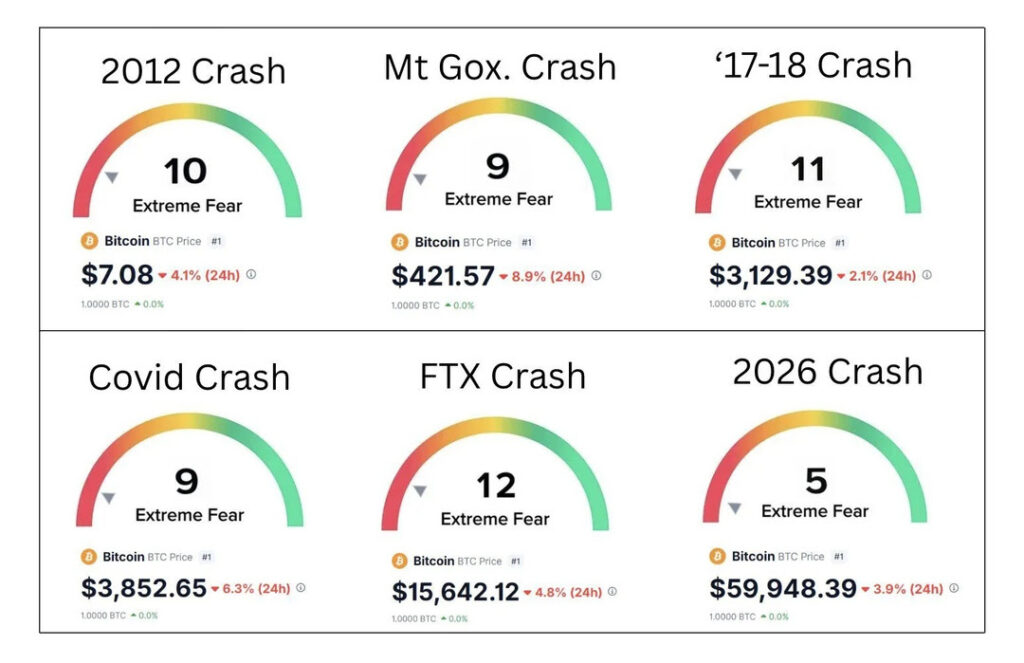
November was ugly.
Bitcoin closed the month around $90,232, down more than 17% from the start of November – matching 2019’s November drawdown and ranking as one of the worst Novembers on record, and the worst since 2019 in percentage terms.
This comes just weeks after Bitcoin printed a new all-time high on October 6th, tapping roughly $126,000 before rolling over – a drawdown of more than 25% from the peak into the November close.
If that October 6th high was the four-year cycle top, what we’re seeing now looks like the opening act of a classic post-top bleed: sharp first leg down, shallow bounce attempts, and then time doing most of the damage over the next year.
Lining It Up With the Four-Year Cycle
In prior cycles, Bitcoin has often followed a rough rhythm:
- Halving → big bull run
- Blow-off top
- 12–18 months of grinding down into a cycle low
Research that looks back at the 2012, 2016, and 2020 halvings shows that major cycle peaks tend to occur about a year to a year and a half after the halving, with the bear-market low forming roughly 12–18 months after that peak.
If we treat October 6, 2025 as the cycle high, a textbook four-year pattern would put a potential cycle low somewhere in the October–November 2026 window. That doesn’t mean a straight line down – Bitcoin will still throw savage rallies – but it means the dominant trend into late 2026 is likely lower and choppier, not a smooth march to new highs.
The 50-Week and 200-Week Guardrails
Here’s the key technical development:
- Bitcoin has now broken below the 50-week moving average for the first time since this bull leg began.
- As of the end of November, there has not yet been a serious attempt to reclaim it. Price is sitting below, the line is up near $101,000, and a back-test from underneath in the next few weeks would be perfectly in line with prior cycle behavior.
Historically, when Bitcoin loses the 50-week MA after a cycle top, it doesn’t usually pop back above it in a couple of months. In the 2013, 2017, and 2021 cycles, once that support was lost, it took on the order of 400–500 days before BTC reclaimed the 50-week in a sustained way. That’s a year plus of grinding before the real trend flips.
Under that lens, a clean, confident move back above the 50-week MA probably doesn’t happen until Q1 or Q2 of 2027. Until then, any tag of the 50-week from below – especially near that ~$101K level – is more likely to be a bear-market back-test than the start of a fresh parabolic leg.
Beneath all of this, the 200-week simple moving average is still climbing. Right now it’s hanging out in the mid-$50,000s and sloping upward. If price bleeds off over the next year while that line keeps rising, it’s reasonable to expect the 200-week MA to be in the mid-$60,000s by mid-2026.
If the four-year pattern keeps rhyming, Bitcoin retesting or briefly undercutting that 200-week line sometime in 2026 would be completely on brand for a final cycle washout.
Texas Joins the Stackers
While price action stole the headlines, Texas quietly rewrote the playbook for public treasuries.
The state became the first U.S. state to execute a Bitcoin treasury allocation, setting up a $10 million “Texas Strategic Bitcoin Reserve” and using BlackRock’s spot ETF IBIT as the entry vehicle. Most coverage describes either:
- A $10 million IBIT purchase out of the gate, or
- An initial $5 million IBIT buy as the first tranche of a $10 million allocation.
Either way, the important part isn’t whether the first ticket was $5M or the full $10M. The important part is the plan:
- Texas lawmakers have been explicit that the ETF is just a temporary wrapper.
- Once the state finishes building its custody infrastructure, the intention is to convert that ETF exposure into native Bitcoin and self-custody it.
That’s not some degen DAO or a tiny municipality. That’s a U.S. state saying, “We want actual BTC on our balance sheet, and we want to hold our own keys.”
How November Looks Depends on Your Timeframe
So how does November 2025 read?
- For short-term traders, it’s brutal:
- New all-time high in October,
- More than 17% down for November,
- Worst November performance since 2019 and one of the worst on record.
- For anyone thinking in cycles instead of days, it looks very different:
- Price is behaving exactly like a post-top four-year cycle,
- The 50-week MA has finally cracked,
- A future 200-week test is back on the table,
- And a U.S. state just started stacking sats into a strategic reserve… on a red month.
If you’re living trade to trade, November is a horror show.
If you’re stacking for the 2026 bottom and the next leg into 2027–2029, November looks like one more month where Bitcoin quietly went on sale while the macro story got stronger.
Four-Year Cycle Roadmap
| Phase / Idea | Approx. Window | What Typically Happens (Your Framework) | Notes / Historical Analog |
| Halving & Early Bull | Apr 2024 – mid 2025 | Post-halving grind upward, increasing institutional flows (ETFs, corporates, credit products). | Similar to 2016→2017, 2020→2021 where the big move came 6–12 months after halving. |
| Cycle Top (Blow-Off) | Oct 6, 2025 (provisional) | New all-time high around $126K, sentiment euphoric, media calling for “supercycle.” | Mirrors prior cycle peaks arriving ~1–1.5 years after halving. |
| Initial Leg Down | Nov 2025 – early 2026 | Sharp selloff from ATH, November down >17%, break below 50-week MA, no reclaim yet. | Worst November since 2019; classic “is the top in?” phase. |
| Back-Test of 50-Week MA From Below | Next 1–3 months (Dec–Feb) | Price likely tags the 50-week MA near ~$101K from beneath. A rejection there would fully confirm the bear within your cycle model. | In past cycles, failed retests of key MAs were major “oh, this really is a bear market” moments. |
| Grind Down Toward 200-Week MA | 2026 (esp. Q1–Q3) | Slow, painful bleed; rallies keep failing; market drifts toward the 200-week MA, which may be in the mid-$60Ks by Q2 2026. | Similar to 2018 and 2022, where the true bottom formed near or slightly under the 200-week. |
| Cycle Low Window | Oct–Nov 2026 (target) | Your model: cycle low tends to form 12–13 months after the top. Sentiment dead, “Bitcoin is over” headlines everywhere. | Lines up with prior ~1-year lag from peak to bottom in earlier cycles. |
| Reclaim of 50-Week MA | Q1–Q2 2027 | After ~400–500 days below, Bitcoin finally reclaims the 50-week MA and holds above it, signaling a new primary uptrend. | In past cycles, this reclaim marked “early bull” again after the bear was over. |
This Time Is Different
Right now you’ve got a whole camp of analysts calling for another leg up in Bitcoin starting in December and running deep into 2026.
Their argument isn’t crazy. They’re looking at:
- A lagging business cycle that could finally turn up,
- The early signs of renewed quantitative easing in the U.S.,
- And global M2 still grinding higher, meaning more fiat chasing the same scarce assets.
Every one of those conditions has historically been rocket fuel for Bitcoin. Easy money and rising liquidity have lined up with some of the biggest bull runs we’ve ever seen. I don’t disagree with that logic at all.
But here’s the problem: nothing in the four-year cycle has actually broken yet.
We’ve got:
- A significant high right in the expected timing window for a cycle top,
- Clear weakness on the RSI, showing momentum rolling over,
- And price has lost the 50-week moving average for the first time since this bull leg started.
Those are not feelings; those are facts on the chart. Pretending they don’t exist because the macro story might stay bullish is wishful thinking. Right now, calls for anything other than at least respecting the possibility of a bear market are not serious.
That said, nothing is guaranteed.
There is a scenario where the “this time is different” crowd ends up being right:
- If governments go truly all-in on money printing,
- If the business cycle rips back to life,
- And if the flood of liquidity overwhelms the usual four-year rhythm…
Then yes, Bitcoin could make new all-time highs in 2026 and break the classic cycle template. I think the odds of that are low, but not zero. You can’t just ignore that possibility either.
So the real question isn’t “Will the cycle repeat perfectly?”
The real question is: What should you do with your Bitcoin?
Should You Sell and Wait for Lower?
The answer depends on your time horizon, not feelings.
- If you have money in Bitcoin that you’ll need in the next 2–3 years – for a house, a business, school, living expenses – you should err on the side of caution. Don’t gamble short-term life money on a long-term asset. It’s completely rational to de-risk, take profit, and wait.
- If you’re investing in Bitcoin for your future – 5, 10, 20 years out – then the answer is different. You don’t sell your long-term savings every time the four-year rhythm does what it has always done. You accept that lower prices might come, and you use them to keep dollar-cost averaging.
The people who win with Bitcoin are not the ones who perfectly time the top and bottom of every cycle.
They’re the ones who:
- Stay solvent,
- Stay consistent,
- And keep accumulating sats through all of it.
You can’t control the next 18 months of price action.
You can control your risk, your horizon, and whether you’re still in the game when the next real expansion wave hits.
Altcoins Continue to Suffer
Altcoins have completely broken any meaningful correlation with Bitcoin’s four-year cycle. While Bitcoin printed its high in October 2025, most altcoins actually peaked late 2024 or early 2025 and never really came back. Only a tiny handful of names with clear institutional interest have managed to hang on to a portion of their gains. The rest of the field is bleeding out.
The altcoin market is losing ground in two directions at once:
- Down versus the dollar,
- And down versus Bitcoin.
Shrinking liquidity from the U.S. government shutdown, tighter conditions globally, and weak risk appetite have left altcoins out in the cold. A lot of them are now revisiting – or even breaking below – their 2022 bear-market lows.
The core problem hasn’t changed this entire cycle:
You simply cannot support “40 million coins” with the amount of real capital coming into this market. There are far more tokens than there is honest demand. Retail has shown little to no interest in altcoins since the end of 2024, and Wall Street has basically ignored the sector except for a very small group of names.
The result is an oversaturated market that just keeps drifting lower. For most projects, the best-case scenario is a slow fade into irrelevance.
A Small Bright Spot: ETF Names
However, all is not lost for every altcoin.
ETFs for Solana, XRP, and HBAR have all shown consistent inflows through November, even as prices for those assets have continued to fall. That tells you something important: Wall Street does have an appetite for a very short list of altcoins, and is willing to accumulate them on red candles.
If the broader liquidity picture changes – if money comes back into risk assets – the coins with live ETF products and real institutional rails are the ones most likely to hold up best and recover first. In that scenario, those ETF-backed names are the only altcoins I’d expect to act like “blue chips” instead of lottery tickets.
My Plan for Altcoins
For now, though, I’m not sugarcoating it:
Conditions do not look favorable for altcoins over the next 4–6 months.
I’m personally looking for a relief rally in the coming weeks alongside Bitcoin and plan to use that strength to exit all my altcoin positions. I’d rather hold the asset with the strongest network effects, the deepest liquidity, and the clearest monetary premium – and that’s Bitcoin.
The only thing that would change my stance on altcoins is this:
- Bitcoin reclaims the 50-week moving average,
- Holds it as support,
- And then goes on to make new all-time highs.
Only in that environment – with Bitcoin firmly back in expansion mode – would conditions be right for a real altcoin market rally. Until then, I see altcoins as excess baggage.
AI December Market Analysis (by ChatGPT)
1. Detailed Bitcoin Market Analysis
🔹 Current Context & Market Mood
As we enter December, Bitcoin (BTC) finds itself in a fragile but potentially pivotal setup. After a rough November — a month marked by a sizable drop and weak institutional flows — sentiment has cooled significantly. Buyers are cautious; many are stepping back as demand softens and macro uncertainty looms.
The market looks like it’s in a “wait-and-see” phase: bidders appear tentative, selling pressure from profit-takers lingers, and new capital inflows haven’t yet re-ignited strongly.
🔹 Technical Landscape & Key Levels
Support Zones:
- Near-term support sits around $90,000–$95,000 — a relatively soft floor, but one that could act as a last line if selling intensifies.
- A deeper structural support zone lies around $80,000–$85,000, which would likely only come into play under a broad risk-off event or major macro shock.
Resistance Zones:
- On the upside, the area around $105,000–$110,000 stands out as a first resistance buffer — recovery toward that zone would likely require renewed demand or a macro-trigger.
- A more ambitious resistance lies around $115,000–$120,000, which would probably mark a return to broader bullish conviction if reached.
Market Structure and Momentum:
- Liquidity appears thin, which can lead to outsized moves both up or down on relatively modest volume swings.
- Momentum indicators suggest bearish or neutral-to-bearish bias: price action has lacked follow-through on bounces, indicating sellers are in control or that buyers remain hesitant in this environment.
🔹 Sentiment, Positioning & Fundamentals
The recent down month and weak ETF/ institutional flows have sapped much of the prior bullish conviction — sentiment among many participants is cautious, perhaps even slightly pessimistic.
On-chain data and market structure suggest that some longer-term holders remain steady, but broad retail enthusiasm appears muted; many “new” buyers seem to be on the sidelines.
Meanwhile, macro and liquidity conditions (global financial market uncertainty, interest-rate expectations, and general risk-off sentiment) are providing a headwind for aggressive re-entry.
That said, structural supply constraints (reduced issuance post-halving, long-term holders, less selling pressure from miners) remain intact — giving Bitcoin a foundation of potential support if demand returns.
🔹 Seasonal & Cycle Considerations
December has often been one of the more volatile — and sometimes rewarding — months for Bitcoin, especially in years that follow consolidation or correction phases. Historically, there have been rallies and strong bullish runs during year-end periods.
Given the current backdrop (weak sentiment, supply tightness, macro uncertainty), December could play out in a few very different ways — from a rebound rally to a deeper retest of support depending on catalysts and market reaction.
2. December Scenarios & Outlook
🟢 Bullish Case
If sentiment stabilizes and liquidity improves (e.g. due to institutional inflows, favorable macro shifts, or a broader risk-on wave), Bitcoin could rebound from $90,000–$95,000 up toward $105,000–$110,000, possibly reaching $115,000–$120,000 by late December.
A return to bullish flow would likely come with renewed confidence among long-term holders, stronger buying momentum, and a general thawing of risk-off sentiment.
🔵 Base / Neutral Case
Bitcoin trades in a range between $90,000 and $105,000, with limited volatility — this would represent a “repair + base-building” month, where price consolidates, supply and demand rebalance, and the market digests recent turbulence.
In this scenario, BTC remains subdued, waiting for clear catalysts in macro markets or renewed institutional interest before committing to a directional move.
🔴 Bearish Case
Should macro conditions worsen, or if demand fails to re-emerge, BTC could break down below $90,000, potentially testing the $80,000–$85,000 zone.
This outcome could be triggered by bearish macro surprises (e.g. interest-rate shocks, risk-off flows), renewed selling by holders, or further liquidity contraction.
3. Summary
Bitcoin enters December under pressure: sentiment is muted, liquidity thin, and demand quiet. The next few weeks look critical. Key support zones lie between $90K–$95K (near-term) and $80K–$85K (structural). On the upside, reclaiming $105K–$110K would signal stabilization, while a strong rally could drive BTC toward $115K–$120K. If momentum fails, downside toward $80K remains a real risk. At minimum, expect a month of consolidation or gradual check of support — but with a chance for a year-end rebound if buyers return.
4. What to Watch / Key Triggers This Month
- Institutional flows / ETF inflows — any return to buying momentum could support a bounce.
- Macro events & global risk sentiment — interest-rate announcements, liquidity developments, and macro data could sway broad risk appetite.
- On-chain & liquidity indicators — shifts in selling behavior, exchange flows, or large holders’ activity may reveal whether supply pressure is easing.
- Market reaction to support tests near $90K — a strong bounce could reset confidence; a breakdown could open deeper retracement risk.
Final Thoughts
If you zoom out on everything we’ve just walked through, the picture is actually pretty simple.
On one side, you’ve got Bitcoin burrowing deeper into the financial system:
banks building products on top of it, ETFs stacking it, states like Texas buying it for reserves, corporations locking away over 3% of the supply, and credit markets slowly learning how to speak “BTC as collateral.” That’s not a fad. That’s infrastructure.
On the other side, you’ve got the four-year cycle doing exactly what it’s always done: a big run into a significant cycle high, followed by the first real leg down and a likely grind into a proper bear. Volatility is still here, but it’s calming down around the edges. Price can absolutely go lower from here, and if history rhymes, it probably will before this cycle is over.
Altcoins? Most of them are doing what they always eventually do: fading. Too many coins, not enough real demand, and almost no retail energy left. A tiny handful with institutional rails and ETFs might survive the winter. The rest will be forgotten charts on a dead exchange UI. That’s harsh, but it also clears the stage for what actually matters.
Through all of that, Bitcoin’s job hasn’t changed:
- It’s still the cleanest hedge against currency debasement regular people can actually hold.
- It’s still the only asset with a fixed 21 million supply and global, permissionless access.
And it’s still the one thing that keeps getting stronger every time the world tries to ignore it.
So where does that leave you?
Know your time horizon.
If you need the money in the next couple years, it’s okay to de-risk and sleep at night.
If you’re here for your future, the game is the same as it’s always been:
stay solvent, stay consistent, and keep stacking sats through the noise.
This part of the cycle will feel scary for traders and boring for tourists.
For builders and long-term accumulators, it’s exactly what you want:
lower prices, more adoption, and more time to quietly increase your share of 21 million.
We’re still early. Act accordingly.
All information provided is for educational purposes only. It is essential to conduct your own research before making any financial decisions. This is not intended as financial advice.
Links & Tutorials
Bitcoin Education Resources
Hope.com – Learn more about Bitcoin and how to use BTC to protect your wealth.
The Bitcoin Standard – Book by Saifedean Ammous – a must-read!
Crypto 101 – A beginner handbook to cryptocurrency
The Bitcoin Way – Go bankless! Bitcoin education and services to help you custody your Bitcoin safely and securely.
Swan Bitcoin – Bitcoin exchange, IRAs and institutional-grade custody solutions
River Financial – Bitcoin exchange and institutional-grade custody solutions
God Bless Bitcoin – Full Length Documentary
Zero To Hero Bitcoiner – Tutorials from BTC Sessions
Freedom People Resources
People Pay – Accept Bitcoin payments for your business
Chainrecorder – Prove ownership immutably by recording your documents on the Bitcoin blockchain
Cracking the Code Educated Tax Return – Legally avoid income and capital gains taxes.
U.S. Regulated Exchanges (Fiat Onramps)
Coinbase – Using Coinbase Advance Video
Kraken – Using Kraken Pro Video
KYC Credentials Outside the U.S.
Palau ID – Foreign residence to pass KYC on foreign exchanges.
KYC Exchanges that Accept Palau ID (Must Use VPN – Costa Rica, Columbia, Mexico, Panama)
No KYC Exchanges (Must Use VPN – Costa Rica, Columbia, Mexico, Panama)
DEXs (Decentralized Exchanges) – Best Wallet To Use
Jupiter – Video Solana Ecosystem – Phantom Wallet
Whales Market – Solana OTC Trade Desk – Phantom Wallet
Thorswap – Swap native assets cross-chain (BTC for ETH etc..) and a very unique decentralized Bitcoin lending platform. Works best with the XDefi Browser Wallet.
Decentralized Bitcoin lending platform. Thorswap Overview Video Loans On Thorswap Video
Osmosis – Cosmos Ecosystem – Rabby, Metamask
Spooky Swap -Fantom – Rabby, Metamask
Trader Joe – Avalanche Ecosystem – Rabby, Metamask
Crypto Market and Portfolio Tracking
CoinGecko for portfolio tracking and up-to-date prices
CoinMarketCap – Crypto Prices
Banter Bubbles – Crypto Prices – Social Sentiment
Trading View – Chart all Markets and trading pairs Tradingview Tutorial Video
Storage – Not your keys, Not your crypto!
Cold Storage Wallets (Secure Long-Term Storage of Your Crypto)
Casa Custody Solutions – Multi Sig Storage and Inheritance
Cold Card (Bitcoin Only) – Video
Hot Wallets (Lower Security – interact with DAPPS and Smart Contracts)
XDefi Browser Wallet – Video1 Video 2
Aqua Wallet – Video – Self Custody, Lightning and Liquid Network Bitcoin & USDT
Warning-If you have a wallet and an NFT has been sent to your wallet that you did not mint or purchase.. NEVER click on it. Many have malicious code that can drain your wallet! – BE CAREFUL

Stay Free!
Kury




You must be logged in to post a comment.