


Bitcoin – IT’s Everywhere You Want To Be


There has never been a monetary network like this.
Bitcoin does not close. It does not limit withdrawals. Your funds cannot be frozen. No government can confiscate it in transit. No bank can tell you to come back Monday. The network runs twenty-four hours a day, seven days a week, three hundred and sixty-five days a year — and all you need to access it is a mobile device and an internet connection. Every other monetary system in the world — every bank, every brokerage, every wire transfer service — operates on a schedule set by someone else, subject to rules written by someone else, enforced by someone else. Bitcoin operates on math. It does not care what time it is. It does not care where you are. It does not care who you are.
That is not a feature. That is a revolution.
This Isn’t Your Parents’ Money Market — Bitcoin Preferred Stocks Are Paying 12%
Something new is being built on top of Bitcoin’s balance sheet. Not an ETF. Not a futures contract. Not another Wall Street wrapper designed to give you exposure while keeping the asset as far from your hands as possible. This is different. This is a class of Bitcoin-backed yield products — monthly income, paid in dollars, backed by the hardest money ever created — and two of the most important instruments in this space right now are Strategy’s STRC and Strive’s SATA.
If you are reading this blog, you already know Bitcoin is the greatest store of value in human history. Twenty-one million coins. Absolute scarcity. Unstoppable network. But here’s the question that more and more investors are asking: can Bitcoin’s balance sheet generate yield? The answer, it turns out, is yes — and STRC and SATA are two of the first real attempts to do it at scale.
But before you put a dollar into either one, you need to understand exactly what you are buying, exactly how they differ, and exactly where the risks live. Because these are not savings accounts. They are not FDIC insured. They are unsecured corporate equity instruments tied to Bitcoin’s price — and the difference between understanding that and not understanding it could cost you real money.
What These Products Actually Are
Both STRC and SATA are perpetual preferred stocks. A company raises capital by selling you shares at $100 par value, uses that capital to buy Bitcoin, and pays you a monthly dividend out of its treasury operations. The dividend is variable — it resets monthly — and both instruments are designed to trade as close to that $100 par value as possible.
The yield is classified as Return of Capital, not ordinary income, which means you do not owe income tax on those dividends when you receive them. Instead, your cost basis in the shares drops by the dividend amount each month, deferring your tax obligation until you sell. That is a meaningful structural advantage — but it is not permanent. At SATA’s 12.75% yield, your basis hits zero in roughly 8 years. At STRC’s 11.5%, closer to 9. Once that basis is gone, every dollar of dividend you receive becomes a taxable capital gain.
Strategy’s STRC — The Standard
Let’s start with Strategy, because everything else in this space exists in its shadow.
Michael Saylor’s company holds 738,731 Bitcoin — more than 3% of every Bitcoin that will ever exist — on a single corporate balance sheet. That is not a bet. That is a monetary strategy executed at a scale that no other institution on earth has matched. When Strategy issues STRC, they are allowing you to participate in the yield generated by the world’s largest Bitcoin treasury.
STRC currently yields 11.5% annually, paid monthly. It is engineered to maintain a $100 par value through a variable monthly rate — think of it as a short-duration, Bitcoin-backed credit instrument that resets its yield every 30 days to stay anchored at par. And because Strategy has the deepest, most liquid Bitcoin treasury in existence, STRC trades with institutional-grade volume — over $400 million in daily transactions. That liquidity is not a footnote. In a stress scenario, liquidity is everything.
This is the gold standard. Every competitor in this sector is benchmarking themselves against what Strategy built.
Strive’s SATA — The Challenger
Strive is younger, smaller, and hungrier. Founded by Vivek Ramaswamy, the company currently holds 13,311 Bitcoin and is building itself into a structured finance firm focused entirely on Bitcoin accumulation. SATA is their preferred stock — and right now, it offers the highest yield in its class at 12.75% annually, paid monthly at $1.0625 per share.
On March 11, 2026, Strive made several moves that every SATA investor needs to understand. They raised the dividend by 25 basis points. They tightened the target trading range from $95–$105 all the way down to $99–$101, and committed to never issuing new SATA shares below $100. They added 179 Bitcoin to their treasury. And they expanded their dividend reserve to cover 18 months of payments — 12 months in cash and 6 months in a new asset class they added to the reserve.
That new asset class is where this gets interesting.
The Move That Defines the Risk
Strive deployed $50 million of its corporate treasury to purchase 500,000 shares of Strategy’s STRC.
Read that again slowly.
Strive — SATA’s issuer — is now using its competitor’s preferred stock as part of its own dividend reserve. When you stack the full picture — Bitcoin holdings, STRC shares, and cash — Strive’s aggregate reserves cover over 19 years of SATA interest payments as of March 9, 2026. That headline sounds bulletproof.
But here is what that move actually created.
When Strive converted $50 million in cash into STRC shares, they traded a pure cash reserve for a Bitcoin-correlated equity position. STRC is not cash. Its stability is a function of Bitcoin’s price and Strategy’s continued operational health. By nesting STRC inside SATA’s reserve, Strive has created a layered dependency structure that looks like this:
- SATA’s stability depends on Strive’s health
- Strive’s reserves are now partially STRC
- STRC’s stability depends on Strategy’s health
- Strategy’s health depends on Bitcoin’s price
If Bitcoin drops hard and stays down, the pressure does not stop at Strategy. It flows through STRC, directly into Strive’s reserve, and then into SATA’s ability to maintain its dividend and its $100 par value. Buying both SATA and STRC and calling it diversification is not diversification — it is two instruments sharing the same single point of failure, with one nested inside the other.
This is not a dealbreaker. It is a design reality that you must price into your decision.
The Risk Breakdown
Scale. Strategy’s 738,731 BTC treasury can absorb shocks that would critically damage a smaller issuer. STRC is built with approximately a 5x collateral ratio and includes structural redemption mechanics designed to act as a price floor. Strive’s 13,311 BTC treasury is meaningful — but it operates on a fundamentally different scale. When Bitcoin sold off in recent months, SATA traded as low as $96.22 — a 4% principal loss if you needed to sell that day. STRC held closer to par. The market is already telling you something with that gap.
Liquidity. STRC trades with institutional volume. SATA trades in a retail-dominated market. In a real Bitcoin winter, that difference can determine whether you exit near $100 or significantly below it.
Dividend Safety. Both dividends are discretionary. The Board of Directors of either company can suspend payments at any time — no justification required. Higher yield is always a market signal about higher perceived risk. SATA’s premium over STRC is not free money. It is compensation for the additional risk you are accepting.
Credit Position. As preferred shareholders, you sit behind every bondholder and lender in the capital structure. These are equity instruments with equity-level downside. In a liquidation scenario, preferred shareholders historically recover cents on the dollar — if anything at all. Do not confuse a $100 par value with a guarantee.
How to Think About Allocation
There is no universal right answer here. There are trade-offs, and your allocation should reflect what you are actually optimizing for.
The Balanced Approach — 70% STRC / 30% SATA
This is the most intelligent construction for most investors. The majority of your position sits in STRC — institutional grade, par-stable, massive collateral base. A smaller allocation to SATA layers in additional yield without overexposing you to a smaller issuer. On $100,000, this generates roughly $980–$990 per month in combined income.
Here is what makes this framework especially compelling: it is essentially the same structure Strive itself adopted for its own treasury. When an issuer uses the competing product to backstop their own reserves, they are telling you exactly which instrument provides the bedrock. Follow the smart money — especially when the smart money is the issuer.
The Conservative Approach — 100% STRC
If getting your $100,000 back matters to you — if exit liquidity near par is a priority — then STRC is the cleaner position. Strategy’s scale, institutional liquidity, and engineered par-stability mechanics make this the most defensible allocation if Bitcoin enters a prolonged drawdown.
The Yield-Maximum Approach — 100% SATA
Maximum cash flow. On $100,000, SATA generates approximately $1,062.50 per month versus STRC’s ~$958.33. But SATA is currently trading below par, its reserves are partially nested inside a competitor’s product, and its smaller collateral base makes it more vulnerable to price shock. If you go this route, go in with open eyes.
The Power Move: Using Your Dividend to Stack Sats
Here is where this strategy gets really interesting — and where most people stop thinking too soon.
The dividend from STRC or SATA does not have to sit in your brokerage account collecting dust. It does not have to go back into more preferred shares. It does not have to pay your cable bill. The most powerful thing you can do with that monthly cash flow is turn it into an automatic, disciplined Bitcoin accumulation engine.
Think about what that looks like in practice. On a $100,000 position in STRC, you are receiving roughly $958 every single month. On SATA, closer to $1,062. That is real capital — hitting your account on a schedule, whether Bitcoin is at $50,000 or $150,000 — that you can deploy directly into spot Bitcoin every month without thinking about it. No emotion. No market timing. No waiting for the perfect entry that never comes. Just consistent, automated accumulation of the scarcest asset in human history.
This is dollar-cost averaging at its finest, and the beauty of it is that the preferred stock is funding the strategy for you. Your capital base stays intact at par — or close to it — while the yield quietly converts fiat income into hard money month after month. In a down market, your fixed dollar dividend buys more Bitcoin. In an up market, you are still accumulating. The math works in your favor in both directions.
Zoom out and look at what you have built: a Bitcoin-backed instrument generating yield, and that yield continuously purchasing more Bitcoin, which strengthens the very collateral base that backs the instrument paying you. That is not just a yield strategy. That is a compounding Bitcoin accumulation machine — and it is one of the most elegant expressions of what this new financial system makes possible.
Your parents put their idle cash in a money market and earned 3% to stay flat against inflation. You are earning 11 to 12% — backed by the hardest asset ever discovered — and reinvesting every dollar of it into more of that asset. That is not the same game. That is not even the same sport.
The Bottom Line
A new financial system is being built — one where Bitcoin is not just an asset you hold and pray on, but the collateral layer underneath a new class of yield-generating instruments. STRC and SATA are early, real expressions of that system. They are genuinely innovative. They are also genuinely risky in ways that require your full attention.
Strategy is the institution that proved this model works at scale. Strive is the challenger trying to out-yield and out-innovate the standard bearer. The fact that Strive itself went to Strategy’s product to backstop its own reserves tells you everything you need to know about the hierarchy here.
Know what you own. Know the risks. Size your position accordingly.
And remember — none of this replaces the base layer. There is still nothing in finance with the properties of Bitcoin itself: fixed supply, no counterparty, no board of directors that can vote to stop paying you. STRC and SATA are built on top of that foundation. The foundation is still the most important thing you can own.
Bitcoin Reversal — Is April the Turning Point?
Let’s talk about where Bitcoin actually stands right now — not the headlines, not the fear, not the noise. The data.
Bitcoin has repeating patterns. The most powerful and consistent of them is the four-year cycle, driven by the halving — the built-in supply reduction that has governed every major Bitcoin bull and bear market since the beginning. The rhythm is not a theory. It is a documented, repeatable market structure: roughly 35 months of appreciation, followed by roughly 12 months of contraction. We have seen it play out three times now with remarkable consistency. And as of the close of March, we are approximately six months into the contraction phase of cycle four.
If history holds, the final bottom does not arrive until October.
I am about 80% convinced this cycle ends the same way the others did. But that other 20%? It deserves serious attention right now — because something is different about this particular moment, and the signals are too compelling to dismiss.
What the Charts Are Telling Us
Bitcoin just closed March in the green — barely, but green — ending a brutal five-consecutive-month losing streak. That alone is worth noting. But it is not just that March closed positive. It is how it closed.
The monthly candle printed what technical analysts call an inverse hammer — a candlestick pattern that historically signals a potential exhaustion of selling pressure and the beginning of a reversal. These are not guarantees. Nothing in markets is a guarantee. But in context, alongside everything else happening on the chart right now, it carries real weight.
The two-week RSI is flashing conditions that have historically accompanied major cycle lows. Long-term holders — wallets that have held Bitcoin for over a year without moving — dramatically slowed their distribution through March. At the peak of the selling pressure, these wallets were offloading hundreds of thousands of Bitcoin per month. By early March, that figure had collapsed by nearly 87%. When the most convicted holders in the market stop selling, the market tends to notice.
Add to that the price structure itself: Bitcoin dropped hard to the $60,000 level, found buyers, and has stubbornly refused to break below $66,000 in the weeks since. That is not the behavior of an asset in free fall. That is an asset negotiating its floor.
The Institutional Signal
Here is the data point that changes the conversation entirely.
Strategy — the world’s largest corporate Bitcoin holder — purchased approximately 45,000 Bitcoin in the past 30 days, its most aggressive accumulation pace since April 2025. Their total treasury now stands at 762,099 BTC, acquired for approximately $57.7 billion. To put that in perspective: one company has now accumulated more than 3.6% of all Bitcoin that will ever exist. And through March, they were buying every single week — 13 consecutive weeks of purchases without a pause.
They did pause in the final week of March for the first time — a development worth monitoring. But the broader trend of the month is unmistakable. While retail sentiment was fearful and the headlines were negative, Saylor was accumulating at a historic pace. That is not the behavior of someone who believes lower prices are coming. That is the behavior of someone who believes these prices are a gift.
Simultaneously, Bitcoin ETF inflows — which had been negative for months — began showing signs of stabilization and recovery through mid-March, with approximately $1.3 billion in net inflows recorded. When the two most powerful institutional demand mechanisms in the Bitcoin market start moving in the same direction at the same time, it is a signal worth taking seriously.
Two Roads Ahead
Let me be direct with you. The technical picture right now is genuinely mixed — and anyone telling you they know exactly what happens next is either lying or selling something.
There are still chart patterns pointing to one more leg down. A significant confluence of technical support — and resistance overhead — sits in the $48,000 to $52,000 range. Multiple indicators suggest that if Bitcoin loses the $62,000 floor decisively, that zone becomes the next destination. This is the base case in traditional cycle analysis, and it cannot be dismissed.
But there is a credible alternative. If ETF inflows continue to recover, if companies like Strategy and Strive keep raising capital and accumulating, and if institutional demand continues to absorb the available supply — the drop to $60,000 may have already been the low. It happened. It was sharp. It was painful. And the market bought it.
I am not willing to bet on that being the bottom. But I am absolutely willing to acknowledge it as a real possibility — and position accordingly.
What April and May Will Tell Us
This is the critical window. Here is what to watch.
If April closes above the March candle wick at $76,000, that is a significant technical signal. It would mean Bitcoin has reclaimed a level that previously acted as resistance, printed back-to-back positive monthly candles following a five-month decline, and confirmed the inverse hammer reversal pattern from March. Under that scenario, the case for a confirmed bottom becomes very strong — and we may be looking at a shortened bear phase that mirrors what happened in the last cycle, when Bitcoin made an all-time high prior to the halving, ahead of historical schedule.
If April fails to hold and closes below March — especially if it breaks below $62,000 — the cycle clock is still running, and October remains the target for the final low. The $48,000 to $52,000 confluence comes back into play.
May will add another chapter to the story either way. Together, these two months will do more to define Bitcoin’s trajectory for the rest of 2026 than anything else on the calendar.
The Strategy That Makes Sense Right Now
No one rings a bell at the bottom. No one sends you a text when the chart is at its absolute lowest and it is safe to buy everything. That is not how markets work — and waiting for that certainty means you will miss it.
What history tells us — every cycle, without exception — is that prices in the $60,000 to $70,000 range will look extraordinarily cheap from five years out. If your time horizon is five years or more, the entry price discussion is less important than the accumulation discussion. The question is not when is the perfect moment — the question is how much are you stacking?
The smart play right now is straightforward: keep accumulating, but hold a little dry powder. Continue your regular DCA. Keep building your position at these levels. But keep some capital in reserve to deploy aggressively if Bitcoin gives you one more leg down into the $50,000 range. You get the benefit of continued accumulation at historically attractive prices, and you preserve the optionality to take maximum advantage if the cycle plays out the traditional way.
There are only 21 million Bitcoin. Strategy just bought 45,000 of them in a single month. The ETFs are coming back. The selling pressure from long-term holders is drying up.
Whether the bottom was already printed in February or is still six months away — the window to accumulate at these prices is closing. Act accordingly.
Some Altcoins Are Holding Up — But Most Are Not

Let’s be honest about the altcoin market. It has been a brutal stretch — and the investors who felt the most pain are the ones who loaded up on the names that were supposed to be “safe,” the institutional darlings, the coins with the most Wall Street backing and the most mainstream coverage.
Solana. Ethereum. XRP.
All three are down well over 50% from their cycle highs. These are not obscure micro-cap projects. These are the coins that every financial media outlet told you were the future. They had ETF approvals, institutional adoption stories, congressional testimony — and they have still been cut in half. That is the altcoin market telling you something important: narrative alone does not protect your capital when liquidity dries up.
But here is what is interesting. Not everything is the same story. Two assets in particular have separated themselves from the wreckage in a meaningful way, and understanding why they are holding up is just as important as knowing that they are.
Hyperliquid (HYPE) — The DEX That Became an Exchange
Hyperliquid is the most important decentralized exchange in crypto right now. Full stop.
Built on its own Layer 1 blockchain with sub-second block times and the capacity to handle 100,000 orders per second, Hyperliquid is not trying to be a slower, cheaper version of Coinbase. It is trying to be something that has never existed before: a fully on-chain, permissionless financial exchange with the speed and depth of a centralized platform — and zero KYC, zero intermediaries, zero permission required.
Every order, every trade, every liquidation — all of it happens transparently on-chain. That is not a marketing line. That is a fundamental architectural difference from every centralized exchange that has ever failed its users.
The platform recently expanded beyond crypto into perpetual futures on commodities — gold, oil, silver — and the market responded immediately. On March 23 alone, Hyperliquid processed a single-day volume record of $5.4 billion, driven largely by commodity futures trading. Total cumulative trading volume on the platform has now crossed $3.64 trillion — an all-time high. Protocol revenue has hit an all-time high as well. These are not speculative metrics. They are real adoption numbers, compounding in real time.
And the token reflects it. HYPE reached an all-time high of $59.30 in September 2025. As of March 31, it is trading around $37–$38 — down approximately 37% from its peak. In a market where the institutional blue chips are getting cut in half or worse, that relative strength is significant. More importantly, HYPE has rallied approximately 77% from its January lows — a recovery that puts it in a completely different category from most of the altcoin space.
The tokenomics add another layer. Hyperliquid uses 97% of all protocol trading fees to buy back and burn HYPE tokens. Higher volume means more buybacks. More buybacks mean reduced supply. On a day when the platform processes $5 billion in volume, that deflationary loop is running hard. In a market starved for real utility and real demand drivers, that is a structural advantage that most tokens cannot claim.
TRON (TRX) — The Stablecoin Backbone of Asia
TRON does not get the headlines it deserves in Western crypto media. It is not flashy. It does not have a charismatic founder doing interviews on CNBC. What it has is something more valuable in a bear market: utility so deep and so embedded that the network simply cannot be turned off by sentiment alone.
TRON is the stablecoin chain for Asia. That is not an exaggeration — it is a functional description of what the network does every single day. The TRON blockchain currently hosts over $86 billion in stablecoin supply, the vast majority of it in USDT. It processes billions of dollars in stablecoin transfers daily, serves over 372 million user accounts, and has recorded more than 13 billion total transactions. For enormous swaths of Southeast Asia, the Middle East, and emerging markets, TRON is simply how dollar-denominated value moves. Not an app on TRON. TRON itself.
In March 2026, the SEC dismissed its charges against Justin Sun — a meaningful regulatory clearing event that had been hanging over the project for years. Simultaneously, Anchorage Digital, the first federally chartered crypto bank in the United States, added institutional custody support for TRX. These two developments arriving in the same month were not coincidental — they represent a genuine shift in TRX’s regulatory and institutional standing.
The price reflects the resilience. TRON’s all-time high stands at approximately $0.449, reached in December 2024. As of March 31, TRX is trading around $0.32 — down roughly 28% from its peak. In the context of what the broader altcoin market has done, that is genuine outperformance. And from its February lows, TRX has recovered approximately 16%, quietly grinding higher while most of the market was still searching for a floor.
The Engine That Drives Everything: Stablecoin Market Cap
Here is the signal most altcoin investors are not watching closely enough — and it may be the most important leading indicator in the entire crypto market.
Stablecoins are the lifeblood of on-chain liquidity. When the stablecoin market cap is growing, new capital is entering the ecosystem. That capital has to go somewhere — and historically, it flows first into Bitcoin, then into large-cap altcoins, then into everything else. The stablecoin market cap is the economic engine. Without it running, the altcoin machine does not start.
And right now, that engine has been running on fumes since October. While we are seeing early signs of weekly stabilization, the stablecoin market cap has not yet resumed the kind of growth that historically precedes a broad altcoin recovery. Until it does, every investment in the altcoin space carries elevated risk — not because the projects are necessarily bad, but because the liquidity engine that fuels their price appreciation is not yet firing at full capacity.
Watch the stablecoin market cap like a hawk. A sustained, meaningful uptrend in that number — not a single week’s uptick, but a clear resumption of growth across consecutive weeks — would be one of the earliest and most reliable signals that the altcoin tide is beginning to turn.
The Bottom Line on Alts
The altcoin market in 2026 is a story of two very different realities sitting side by side. On one side, you have coins with genuine, deep, defensible utility — networks where real people are moving real money every day for reasons that have nothing to do with speculation. TRON and Hyperliquid sit in that category, and their price action reflects it.
On the other side, you have coins whose valuations were built almost entirely on narrative, liquidity, and the assumption that institutions would keep showing up. When the liquidity disappeared, the narrative was not enough.
Until the stablecoin engine restarts and capital begins flowing back into the ecosystem in earnest, any position in the altcoin space is a high-risk proposition. That does not mean there is no opportunity — the names holding up now will likely be the first ones to move when the tide comes back in. But size accordingly, stay selective, and keep your eye on the number that tells the real story.
The stablecoin market cap does not lie.
Bitcoin Market Analysis — April 2026
By Claude AI
Where We Stand
Bitcoin closes March at approximately $66,700 — down roughly 48% from its all-time high of $128,198 set on October 6, 2025, and on pace to print a sixth consecutive red monthly candle. On the surface, that is a brutal number. Headlines are screaming capitulation. Social media is flooded with the kind of exhausted, defeated energy that only shows up when people have been losing money for a long time.
And yet, beneath that surface, one of the most compelling divergence stories in Bitcoin’s history is playing out in real time. Understanding that divergence is the entire job of this analysis.
The Sentiment Picture: Historic Extreme Fear
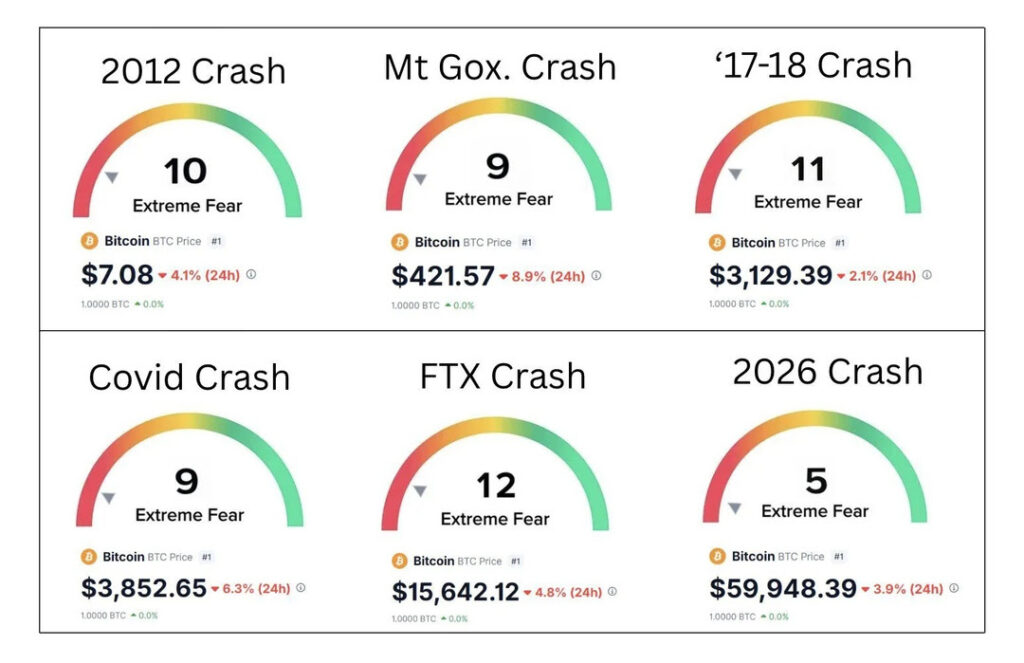
The Fear & Greed Index closed March at 8 out of 100 — deep in Extreme Fear territory — and has now registered Extreme Fear for 46 consecutive days. That is the longest sustained extreme fear streak since the aftermath of the FTX collapse in late 2022, when Bitcoin was trading near $16,000 and the industry was genuinely on its knees.
Let that sink in. The same fear readings we saw when a major exchange had just imploded, billions had been stolen, and the industry’s credibility was in ruins — those same readings are printing today, with Bitcoin trading at $66,700, ETFs holding over $65 billion in assets, and the most powerful financial institutions in the world actively adding exposure.
Sentiment is not the market. Sentiment is the mirror of the market. And right now, that mirror is showing maximum fear — which, historically, has been one of Bitcoin’s most reliable long-term entry signals. In five of the seven times the Fear & Greed Index has dropped below 10 over Bitcoin’s history, the 12-month forward return has been significantly positive. The two exceptions came during periods of genuine structural breakdown — not the environment we are in today.
That does not mean the bottom is in. But it absolutely means the risk-reward at current prices deserves serious respect.
The Critical Divergence: Retail vs. Institutions
Here is the story that the price chart alone cannot tell you.
While the Fear & Greed Index was printing 8, while retail investors were frozen in panic, while the headlines were uniformly negative — institutions were buying. Aggressively. Systematically. At a scale that has no precedent in Bitcoin’s history.
Bitcoin spot ETFs absorbed approximately $1.6 billion in net inflows during March alone — reversing four consecutive months of outflows and compressing the 2026 year-to-date ETF deficit to just $210 million. Total Q1 2026 ETF inflows reached $18.7 billion. Since their launch in January 2024, U.S. spot Bitcoin ETFs have now accumulated over $65 billion in total net inflows. BlackRock’s IBIT alone generated $8.4 billion in Q1 net inflows — a fund that did not exist two years ago is now one of the largest holders of a hard asset on the planet.
On-chain data adds another dimension. Large whale addresses collectively accumulated approximately 270,000 BTC over the past 30 days — the highest monthly accumulation rate recorded since 2013. A single entity executed a 12,500 BTC over-the-counter block trade worth approximately $925 million. The wallets associated with that entity have accumulated over 38,000 BTC since January 2026 alone.
This is not the behavior of people who believe Bitcoin is going to zero. This is the behavior of entities with billion-dollar research teams, long time horizons, and sophisticated risk models — and they are treating every dollar of retail panic as an opportunity to acquire more.
Note: the final days of March did see ETF outflows reverse, with approximately $296 million leaving the complex in the week ending March 28 — the first negative ETF week of the month. Strategy also paused its buying for the first time in 13 consecutive weeks. These are data points that deserve monitoring as April opens. A sustained reversal in institutional flows would change the calculus meaningfully.
Technical Structure: The Map for April
Current Price: ~$66,700 All-Time High: $128,198 (October 6, 2025) 52-Week Range: $60,187 – $126,186 RSI (14-day): ~42–44 — neutral, approaching oversold but not yet there Trend: Below the 200-day EMA. Downtrend structure technically intact.
Key Support Levels:
- $65,000–$66,000 — The most critical near-term floor. This level has held as the Point of Control in the volume profile for the current range. A decisive daily close below $65,000 opens the door to the next zone.
- $60,000 — The cycle low to date. The line in the sand. If this breaks with conviction, the bear case accelerates significantly.
- $48,000–$52,000 — The deep Fibonacci confluence zone. If the traditional cycle bottom thesis plays out, this is the destination. It is not the base case, but it demands respect.
Key Resistance Levels:
- $68,000–$69,700 — Immediate overhead resistance. Bitcoin needs to clear and hold this zone to signal any near-term strength.
- $74,000–$76,000 — The March candle wick high. Reclaiming this level would be the first meaningful technical confirmation that the selling pressure has genuinely shifted.
- $79,000–$80,000 — The level that, if reclaimed and held, would invalidate the current bear structure entirely.
The Volume Story: March’s price action occurred on below-average volume — approximately 25% below the 7-day average. Low-volume rallies in a downtrend are a bearish divergence signal. For any recovery to be credible, volume needs to expand materially on the upside. Until it does, every bounce is guilty until proven innocent.
Macro Overlay: The Headwinds Are Real
Bitcoin does not exist in a vacuum. The macro environment heading into April carries genuine headwinds that technical analysis alone cannot capture.
The U.S.-Iran conflict continues to send oil prices higher. Elevated energy costs feed inflation. Inflation feeds expectations of Fed rate increases — and the derivatives market is currently pricing approximately a 50% probability of a Fed hike by October. Rate hikes are historically a headwind for risk assets, including Bitcoin.
At the same time, the correlation between Bitcoin and equities — which had been declining — has crept back up toward 0.55 on a 30-day rolling basis. That means macro shocks that hit the S&P 500 are currently hitting Bitcoin with similar force. Trump’s ongoing tariff policy is adding another layer of uncertainty to global risk appetite.
The one macro development that cut through the noise in the final days of March: Trump announced the U.S. is in “serious discussions” with a new Iranian regime to end the military conflict and reopen the Strait of Hormuz. Bitcoin responded — surging above $67,600 on the news. That geopolitical reaction is instructive. If the conflict de-escalates, the macro headwind that has been suppressing risk appetite for weeks lifts simultaneously. That is a potential catalyst for April that most technical analyses are not adequately pricing.
April Outlook: Three Scenarios
Scenario 1 — The Continuation (Probability: ~45%) April fails to hold $66,000 under renewed macro pressure, prints its 6th red candle in seven months, and the traditional cycle bottom thesis plays out toward the $48,000–$52,000 range by mid-summer. The trigger would be renewed ETF outflows, a Fed rate hike signal,i or an escalation in geopolitical tensions. This is the scenario the cycle clock says to respect — and with 46 days of extreme fear already on the books, a further flush would reset positioning for a powerful eventual recovery.
Scenario 2 — The Consolidation (Probability: ~35%) Bitcoin grinds sideways through April in the $63,000–$70,000 range, digesting the March action while the macro picture gradually clarifies. Neither bulls nor bears get the decisive confirmation they are looking for. This is actually a constructive outcome — it would signal that the $60,000 floor is holding and allow accumulation to deepen. A consolidation month here sets up a potential breakout in May.
Scenario 3 — The Early Reversal (Probability: ~20%) April closes above the March wick at $76,000. This is the scenario the on-chain data is quietly building toward. Whale accumulation at this scale, ETF inflows at this pace, and 46 days of extreme fear create the conditions for a sharp, painful short squeeze. If geopolitical tensions ease and macro headwinds lift simultaneously, the fuel for a violent reversal is already loaded. This is the scenario that punishes those who waited for “one more dip.”
The Number That Matters Most Right Now
Here is the data point that cuts through every narrative and tells you the most important story of this moment: Bitcoin’s circulating supply recently crossed 20 million coins. That means fewer than 1 million Bitcoin remain to be mined — and at the current pace, those final coins will take approximately 114 years to reach circulation.
Twenty million out of twenty-one million already exist. The supply is effectively finite right now, today, in the real world. Not theoretically. Not eventually. Now.
At the same time, Strategy alone holds 762,099 BTC. BlackRock’s ETF holds billions more. The U.S. government holds its strategic reserve. Corporate treasuries globally have crossed one million coins combined. Every day, more of the fixed supply moves into long-term, institutional hands that have no intention of selling.
The math does not care about sentiment readings of 8. The math does not care about geopolitical conflicts or Fed rate expectations. The math says that a finite asset with a fixed supply ceiling, absorbing billions in institutional demand every quarter, cannot stay at a 48% discount to its all-time high indefinitely. Markets are not always rational in the short term. They are brutally rational over time.
Summary and Strategy
The picture heading into April 2026 is genuinely complex — more so than at any prior point in this cycle. The sentiment data says maximum fear. The on-chain data says maximum institutional conviction. The technical picture says the downtrend is intact but the floor is holding. The macro says headwinds are real but a catalyst for reversal exists.
What does that add up to?
It adds up to a market where the risk of being wrong in either direction is elevated — and where the cost of being wrong by sitting entirely in cash is potentially enormous. This is not a moment to be a hero. It is a moment to be systematic.
Keep accumulating at these levels. The probability that prices in the $65,000–$70,000 range look extraordinarily cheap from a five-year perspective is high. History does not guarantee it. The supply math heavily implies it.
Hold dry powder. If Scenario 1 plays out and Bitcoin sees one more leg toward $48,000–$52,000, you want capital available to deploy. That would be one of the best accumulation opportunities in Bitcoin’s history.
Watch April’s close above all else. A close above $76,000 changes the entire narrative. A close below $63,000 confirms the traditional cycle is still running. April will tell more of the story than any analyst can predict right now — including this one.
The final million Bitcoin are being mined over the next century. The institutions are buying the ones available today. The only question is whether you are on the right side of that trade before the window closes.
Final Thoughts — The Best Game on the Planet
Look. Step back from the noise for a second.
Step back from the Fear & Greed Index sitting at 8. Step back from the six consecutive red monthly candles. Step back from the headlines about geopolitical conflict, Fed rate hikes, and the next leg down. All of that is real. None of it changes what is actually happening at the macro level — and what is happening at the macro level is one of the most extraordinary wealth creation setups in the history of financial markets.
Here is what we actually covered this month.
Bitcoin is now embedded in the global financial system in a way that cannot be reversed. It is collateral on Wall Street. It is inside spot ETFs held at the world’s largest asset managers. It is the reserve asset of sovereign governments. It is the settlement layer for trillions of dollars in digital finance. It crosses every border, survives every conflict, and operates without permission from anyone. When gold was getting stranded in Dubai warehouses because a war closed the airspace, Bitcoin kept moving. That is not a feature. That is the entire thesis — proven in real time, under real pressure, in front of the entire world.
Institutions know it. Strategy has accumulated 762,099 Bitcoin — over 3.6% of the entire supply — and they did not slow down this month. They bought 45,000 coins in 30 days at the most aggressive accumulation pace in over a year. Whale wallets added 270,000 BTC in a single month. ETFs absorbed $18.7 billion in Q1 alone. BlackRock, the largest asset manager on earth, is building a digital asset empire on top of Bitcoin’s foundation. These are not speculators. These are the most sophisticated allocators of capital in human history — and they are buying every single dip that retail investors are panicking through.
Two new financial instruments — STRC and SATA — are showing you exactly where this is going. Bitcoin’s balance sheet is now generating yield. Monthly income, paid in dollars, backed by the hardest money ever created. Think about what that means. For the first time in history, you do not have to choose between holding Bitcoin and earning income from your capital. You can do both. That product category did not exist two years ago. It exists today. It will be a trillion-dollar market within a decade. The investors who understand it early are the ones who will benefit the most.
Yes — most altcoins are struggling. The stablecoin engine is not yet running at full capacity. The broad altcoin market is painful and will likely stay that way until liquidity returns in force. But even in that environment, the best-built projects — the ones with real utility, real users, and real revenue — are holding up. Hyperliquid processed $5.4 billion in a single day while the rest of the market was bleeding. TRON settled billions in stablecoin transfers while the Fear & Greed Index printed its worst reading in years. Real utility does not care about sentiment indices.
And Bitcoin itself? Sitting at $66,700 with 46 consecutive days of extreme fear on the books, trading 48% below its all-time high — and less than one million coins left to mine out of a total supply of twenty-one million.
One million coins. On a planet with eight billion people. With every major institution in the world now actively accumulating. With a fixed, mathematically enforced supply ceiling that no government, no central bank, and no board of directors can ever change.
The people calling this a reason to panic are looking at a 48% drawdown and seeing danger. The people who understand what Bitcoin is are looking at the same number and seeing one of the great buying opportunities of this generation.
This is the part where most financial content tells you to “stay diversified” and “only invest what you can afford to lose” and “past performance is not indicative of future results.”
We will not insult your intelligence with that.
Here is what we will say: the game is accumulation. It has always been about accumulation. Not perfect timing. Not catching the exact bottom. Not waiting for the chart to look comfortable before you act — because the chart never looks comfortable at the exact moment it matters most. The game is getting as much Bitcoin as you possibly can, within a plan you can actually stick to, over a long enough time horizon that the volatility becomes noise instead of trauma.
The four-year cycle may still have one more leg down. It may not. April and May will tell us more. Either way — at $66,000 or at $50,000 — you are accumulating an asset with a fixed supply, institutional demand that is accelerating, and a monetary network that the entire global financial system is now building on top of.
The institutions are not waiting. The whales are not waiting. The governments that are building strategic reserves are not waiting.
The window does not stay open forever.
We have said it before and we will keep saying it: there are only 21 million Bitcoin. Eventually, there will not be enough for everyone who wants one. We do not know exactly when that reality hits the market with full force. We just know — with absolute mathematical certainty — that it will.
Be positioned. Stay the course. Keep stacking.
All information provided is for educational purposes only. It is essential to conduct your own research before making any financial decisions. This is not intended as financial advice.
Links & Tutorials
Bitcoin Education Resources
Hope.com – Learn more about Bitcoin and how to use BTC to protect your wealth.
The Bitcoin Standard – Book by Saifedean Ammous – a must-read!
Crypto 101 – A beginner handbook to cryptocurrency
The Bitcoin Way – Go bankless! Bitcoin education and services to help you custody your Bitcoin safely and securely.
Swan Bitcoin – Bitcoin exchange, IRAs and institutional-grade custody solutions
River Financial – Bitcoin exchange and institutional-grade custody solutions
God Bless Bitcoin – Full Length Documentary
Zero To Hero Bitcoiner – Tutorials from BTC Sessions
Freedom People Resources
People Pay – Accept Bitcoin payments for your business
Chainrecorder – Prove ownership immutably by recording your documents on the Bitcoin blockchain
Cracking the Code Educated Tax Return – Legally avoid income and capital gains taxes.
U.S. Regulated Exchanges (Fiat Onramps)
Coinbase – Using Coinbase Advance Video
Kraken – Using Kraken Pro Video
KYC Credentials Outside the U.S.
Palau ID – Foreign residence to pass KYC on foreign exchanges.
KYC Exchanges that Accept Palau ID (Must Use VPN – Costa Rica, Columbia, Mexico, Panama)
No KYC Exchanges (Must Use VPN – Costa Rica, Columbia, Mexico, Panama)
DEXs (Decentralized Exchanges) – Best Wallet To Use
Jupiter – Video Solana Ecosystem – Phantom Wallet
Whales Market – Solana OTC Trade Desk – Phantom Wallet
Thorswap – Swap native assets cross-chain (BTC for ETH etc..) and a very unique decentralized Bitcoin lending platform. Works best with the XDefi Browser Wallet.
Decentralized Bitcoin lending platform. Thorswap Overview Video Loans On Thorswap Video
Osmosis – Cosmos Ecosystem – Rabby, Metamask
Spooky Swap -Fantom – Rabby, Metamask
Trader Joe – Avalanche Ecosystem – Rabby, Metamask
Crypto Market and Portfolio Tracking
CoinGecko for portfolio tracking and up-to-date prices
CoinMarketCap – Crypto Prices
Banter Bubbles – Crypto Prices – Social Sentiment
Trading View – Chart all Markets and trading pairs Tradingview Tutorial Video
Storage – Not your keys, Not your crypto!
Cold Storage Wallets (Secure Long-Term Storage of Your Crypto)
Casa Custody Solutions – Multi Sig Storage and Inheritance
Cold Card (Bitcoin Only) – Video
Hot Wallets (Lower Security – interact with DAPPS and Smart Contracts)
Bull Bitcoin Wallet – Video Bitcoin Wallet with Privacy features
XDefi Browser Wallet – Video1 Video 2
Aqua Wallet – Video – Self Custody, Lightning and Liquid Network Bitcoin & USDT
Warning-If you have a wallet and an NFT has been sent to your wallet that you did not mint or purchase.. NEVER click on it. Many have malicious code that can drain your wallet! – BE CAREFUL

Stay Free!
Kury




You must be logged in to post a comment.