


Bitcoin: The Solution for a Government That Cannot Be Trusted


In the last few months, the mask has started to slip.
We’ve seen massive fraud scandals exposed inside U.S. government programs — daycare and healthcare scams in Minnesota running into the billions, and tens of billions in fraud in California, with investigators openly admitting they’re still just scratching the surface.
On top of that, the Pentagon has failed its audit for the 8th year in a row and still can’t properly account for trillions of dollars. Many people remember that in 2001 we were told tens of trillions were “missing” or unaccounted for — a story that conveniently disappeared from the headlines after 9/11.
Put all of this together and it’s no surprise there’s a rising call for a tax strike. Social media is full of people talking about a moratorium on federal income tax until the fraud is exposed and accounted for. Whether you agree with that tactic or not, the sentiment is clear: trust is gone.
When you add in the revelations that have come out of the Department of Government Efficiency (DOGE) earlier this year, it’s hard to escape the conclusion that many of us have suspected for years:
our government institutions increasingly look like advanced money-laundering machines. They funnel cash into:
- Endless foreign wars and “security operations,”
- The military-industrial complex,
- Big Pharma, big food, and captured regulators,
- Both political parties and the politicians who keep this system alive.
None of this would be possible without an infinite supply of dollars.
Here’s how the average American gets dragged into it without even noticing:
- You work for dollars.
- You accept those dollars as payment.
- You deposit them in “your” bank.
- Your bank turns around and buys U.S. Treasuries and government debt with your deposits.
- That debt funds the exact same waste, fraud, and abuse you’re angry about.
You didn’t sign up for that. But as long as the system runs on central banking and fractional-reserve lending, your savings are the fuel.
This didn’t happen overnight. It took decades of regulation and legislation, all sold to the public as “consumer protection” and “stability,” to build a system where:
- The government can overspend without limit.
- The central bank can print without restraint.
- And the cost quietly shows up in inflation and currency debasement instead of an honest tax bill.
Some people believe a return to the gold standard would fix all this. They mean well, but they’re missing the point.
These schemes started under a gold standard too. The Federal Reserve and other central banks did exactly what you’d expect: they printed more paper claims than the gold they actually held. Throughout history, every monetary system that relied on trusted intermediaries has eventually collapsed under fraud, leverage, and counterfeiting.
The problem isn’t just what backs the money.
The problem is who controls it.
For the first time in history, we have an alternative:
- A monetary network that does not depend on trusted third parties,
- A system that doesn’t ask permission — it only requires a willingness to participate,
A network so decentralized that no bank, no government, and no corporation can print more or freeze your balance, - A form of money that separates the money from the state.
That system is Bitcoin.
You don’t have to fix Washington to opt out of this game.
You just have to stop storing your life’s work in a currency they can print at will and start storing it in one they can’t control.
There has never been a better time to start that transition.

How We Take Back Our Freedoms with Bitcoin
If you don’t trust the people running the money machine, the answer isn’t to beg them to behave. The answer is to stop feeding the machine and start taking responsibility for your own money and your own knowledge.
Step 1: Move Yourself Toward a Bitcoin Standard
The first step is personal: start shifting your own life onto a Bitcoin standard.
It won’t happen in a week. It’s a process. But every time you:
- Convert dollars into Bitcoin, and
- Take self-custody of those sats,
…you’re chipping away at the financial wall that props up fraud, waste, and permanent war.
When your savings sit as fiat deposits in a bank, those deposits don’t just rest there. Banks use them to:
- Buy Treasury bonds,
- Expand credit,
- And ultimately fund the very government spending you no longer trust.
By slowly reducing the amount of long-term savings you keep inside that system and moving it into Bitcoin you control, you’re effectively saying:
“You don’t get to use my balance sheet to fund this anymore.”
Keep some fiat for short-term needs and emergencies. Push the rest, over time, into sats you hold yourself.
Step 2: Save in Bitcoin — and Spend It
Opting out isn’t just stacking Bitcoin and never touching it. Long term, Bitcoin has to circulate.
The good news is: today, there’s very little you can’t get using Bitcoin in some form.
- With recent upgrades to Square and other payment platforms, thousands of retailers can now accept Bitcoin directly.
- Free or low-cost services like People Pay, from The Freedom People–style processors let small businesses and e-commerce shops take Bitcoin without needing to become tech experts.
- Online, you can route almost any purchase through Bitcoin one way or another — whether that’s direct BTC payments or BTC→gift-card flows.
Every time you choose Bitcoin instead of dollars — for your long-term savings or your day-to-day spending — you’re shifting power away from the state’s currency and toward a neutral, open network.
Step 3: Build Bottom-Up Bitcoin Communities
This doesn’t need a law passed in D.C. It needs neighbors talking to neighbors.
You can:
- Ask your local businesses if they’ll accept Bitcoin.
- Offer to pay in BTC for goods and services you already buy.
- Help your barber, your mechanic, your local café plug in a simple Bitcoin payment option.
- Share what you’ve learned about Bitcoin with people in your town, your church, your networks.
This is how a circular economy starts:
One person paying in sats → a few merchants start accepting → more people start earning and spending in Bitcoin → suddenly, your community is less dependent on fragile banks and captured institutions.
That local, ground-up movement can become a snowball of self-reliance in the hard days ahead.
Step 4: Make It Harder to Fund Corruption — By Learning the Law
If you believe the federal government is abusing the money you send it, it’s natural to look for ways to stop blindly funding it.
We’ve seen calls for a tax strike and protest campaigns. The reality is:
- Most people will still file the moment the first IRS notice arrives.
- Many will do it confused, afraid, and poorly informed about what the law actually says.
This is where education matters.
Important note: I’m not a lawyer or CPA, and this is not legal or tax advice. You should always follow the law.
What you can do is learn. And that’s where resources like the Cracking the Code tax course from The Freedom People come in.
The CTC course is designed to:
- Walk you through the actual text of the tax code and the Constitution,
- Explain how the system works from their perspective,
- Help you understand when and how income must be reported,
- And show you how, in their view, to file returns and amended returns properly and lawfully, rather than just guessing or letting fear run the show.
Whether you agree with every interpretation or not, the core idea is powerful:
- Stop being ignorant about the rules that control your money.
- Stop letting fear and confusion drive you into over-compliance or under-compliance.
- Take the time to educate yourself so you can act intentionally, lawfully, and confidently.
If this resonates with you and you want to dig deeper into their approach, you can start here:
Bitcoin gives you a way to store and move value outside of a corrupt monetary system.
Education about the tax and legal structure gives you a way to engage with that system on your terms, within the law.
Put the two together, and you get something rare in our time:
A path to take back real control over your money, your choices, and your future.
2025 Bitcoin Year in Review
2025 was supposed to be a banner year for Bitcoin.
We had a Bitcoin-friendly administration come into office, one that openly promised a strategic Bitcoin reserve. On top of that, post-halving years have historically delivered the largest gains of each four-year cycle. On paper, this was the perfect setup.
But Bitcoin had other plans.
Right after President Trump’s inauguration, Bitcoin took a sharp turn down, retracing most of the gains from late 2024 and dropping to just above $74,000. From there it began to grind higher again — slow, steady, relentless — eventually running all the way to $126,000 on October 6th.
At that point, everyone was leaning hard bullish.
People were calling for the classic blow-off top that usually caps a Bitcoin cycle.
Instead, we got something very different.
Bitcoin slipped to just under $119,000, and then came the October 10th mass liquidation event: a brutal flush that sent BTC down to about $100,000 on most exchanges before it rebounded and stabilized around $110,000.
A lot of analysts wrote this off as a one-off anomaly — myself included at first. But looking back, it was almost certainly a huge player caught offsides, forced to dump a massive amount of Bitcoin to cover margin. After that, the selling didn’t stop.
The weeks that followed saw a steady, grinding selloff. Massive amounts of Bitcoin changed hands as price bled all the way down toward $80,000.
For December, BTC mostly chopped between $85,000 and $94,000, closing down 2.97%, and ultimately closed the year down about 6%, finishing around $87,440
For a lot of people, that was a gut punch.
A down year in 2025 had many shouting that “the four-year cycle is broken.” But when you zoom out, Bitcoin behaved almost exactly the way it always has.
The Bitcoin cycle has never been a perfect 48-month metronome. That’s why:
- In 2017, the top came in December.
- In 2021, the top came in November.
- In 2025, we saw a major high in October.
Each cycle top has arrived a little earlier. That’s not “broken” — that’s normal cycle behavior.
Look even closer and it gets more precise:
- All three cycles, measured from the cycle low to the cycle high, lasted exactly 35 months.
- The $126,000 top in 2025 lines up almost perfectly with a diagonal trendline that has marked the top of each of the two previous cycles.
If nothing else, Bitcoin is remarkably consistent.
Now, to be fair, not everyone agrees. Some analysts insist Bitcoin never truly entered a real bull market this time — that 2026 will be the real end of the four-year cycle. They make some valid points, especially when you map Bitcoin against the business cycle and Fed quantitative easing cycles.
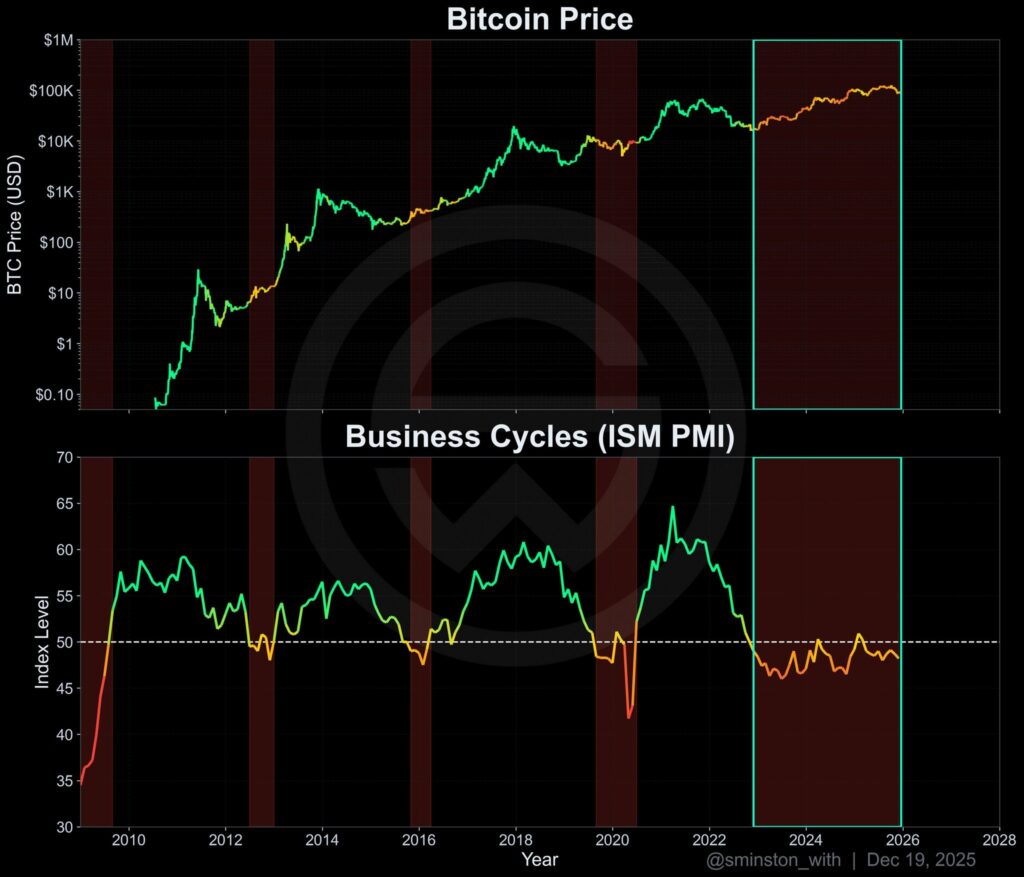
But I’ll repeat my caution:
There is no hard evidence that the Bitcoin cycle is broken.
If the four-year rhythm continues to hold, we should expect a cycle low sometime around October or November 2026.
That doesn’t mean Bitcoin can’t push back above $100,000 at some point in 2026 — it absolutely can. But unless Bitcoin makes a new all-time high in 2026, the simplest assumption is that the four-year cycle remains intact, doing what it has always done:
35 months up, then a painful reset.
What to Look Forward to in 2026 for Bitcoin
Even if we’re in a bear phase, adoption is not slowing down.
- Banks, businesses, and financial institutions are moving closer to Bitcoin.
- Individuals are waking up and starting to move part of their savings onto a Bitcoin standard.
- And innovation around wallets, custody, and payment rails keeps making it easier to interact with the network.
Structurally, Bitcoin is in its normal bear-cycle window. But this one has a key difference:
We never got the euphoric blow-off top.
In past cycles, the end was obvious: every metric you could track was screaming overheated. In 2025, none of the 30+ indicators that have historically nailed Bitcoin tops triggered. No full mania, no parabolic vertical insanity.
That matters.
Every previous cycle saw Bitcoin correct more than 70% from top to bottom in the bear market. This time, because:
- There was no true blow-off,
- Bitcoin never got insanely overbought, and
- Volatility has dropped by about half compared to earlier cycles,
…it’s entirely possible this bear market delivers a milder drawdown — something on the order of 35–45% instead of a full nuclear winter.
For anyone serious about stacking as much BTC as possible, that’s not bad news.
That’s a golden opportunity.
How to Think About Accumulation in 2026
If you’re already running a DCA strategy, 2026 is a good year to consider leaning into it intelligently:
- Keep your base DCA going.
- As price moves lower, consider increasing the size of your buys at key levels.
Example (your framework):
Say you have $10,000 set aside to deploy into Bitcoin during this bear market.
You might:
- Use 10% ($1,000) if Bitcoin breaks below $80,000 again.
- Use 15% ($1,500) if Bitcoin breaks below $70,000.
That would still leave you $7,500 in reserve. You could then look to deploy that remaining chunk when the 2-week stochastic RSI makes a bullish cross back above the 20 level — historically a strong signal that the worst of the selling may be over.
The key idea: don’t YOLO one lump sum and hope you nailed the bottom.
Scale in as fear increases and technicals start to turn.
Remember:
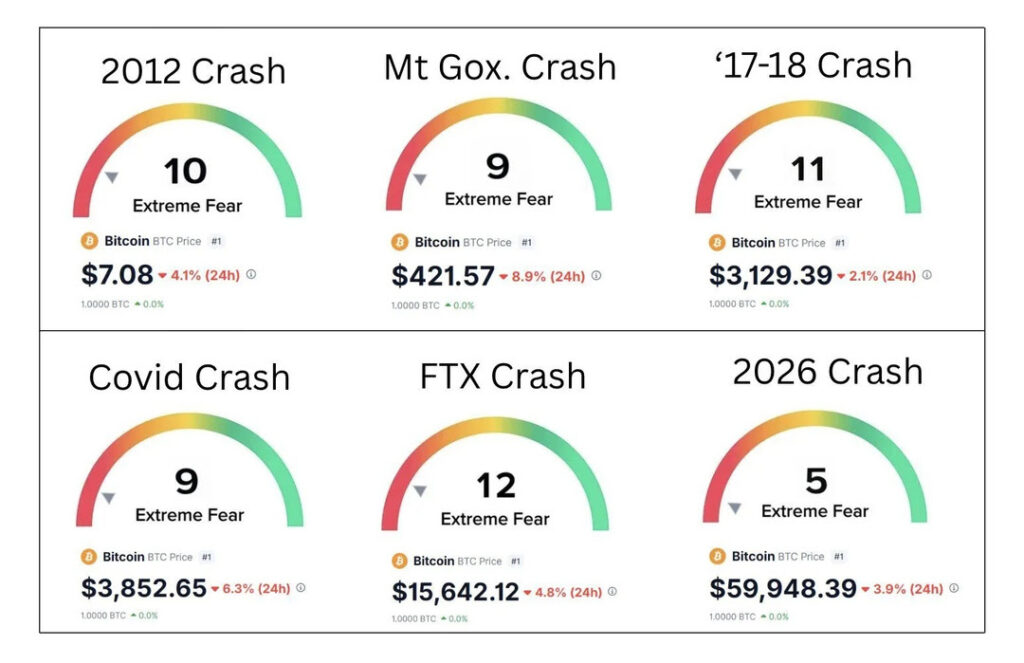
Fortunes in Bitcoin are usually made in the bear markets, when fear is at its highest.
When:
- People are calling for “Bitcoin to go to zero,”
- Headlines say “Bitcoin has failed,”
- Friends tell you they’re “done with crypto”…
…that’s your cue to pay attention, not check out.
IF you are planning to purchase $50,000 or more consider using a trusted OTC desk. They match sellers with buyers and move your Bitcoin to your cold storage wallet.The Bitcoin Well OTC and Caleb & Brown are two that you can trust.
Catalysts That Could Change the Shape of This Bear
This cycle comes with some potential wildcards that could make the bear shallower or end earlier than the textbook pattern.
1. The Clarity Act
Originally expected before year-end, the Clarity Act got pushed into 2026. Congress is expected to take it up again in March.
If it passes and gives clear regulatory rules around Bitcoin, institutions that have been hesitant will have the green light:
- Many are already in the game, but in cautious size.
- Once the rules are official, you can expect allocations to grow, products to expand, and flows to deepen.
2. Quantitative Easing & Stimulus
2026 is also shaping up to be a liquidity story:
- Fed Chair Powell will be replaced.
- President Trump has signaled he’ll install someone committed to cutting rates and stimulating the economy.
- With lower rates and unlimited Treasury purchases by the Fed, the federal government can unleash massive spending quickly.
On top of that, Trump has promised rebate checks from tariffs. We already saw in 2020 what happens when the government injects cash directly into consumers’ hands:
- Stocks ripped.
- Bitcoin exploded higher.
Those same dynamics could easily show up again.
All of this means we could see a premature Bitcoin bottom sometime between April and August if liquidity and stimulus hit faster and harder than expected.
This is why it’s so important to stay engaged:
- Watch price action.
- Watch macro moves.
- Watch policy decisions.
You want to be ready to act when the opportunity shows up — not sitting on the sidelines waiting for “one more dip” that never comes.
The Hard Cap and the Endgame
Through all of this, the long-term math doesn’t change:
- There will only ever be 21 million Bitcoin.
- More Bitcoin will be brought into traditional finance and used as collateral,
- Fewer and fewer coins will actually be available for sale.
We don’t know exactly when we hit that “oh no, there’s not enough Bitcoin” moment. We just know that on the current trajectory, it’s coming.
You do not want to be the person waiting for a perfect $5000 dip while long-term supply is disappearing into:
- State treasuries,
- Corporate balance sheets,
- ETF vaults,
- And collateral arrangements that don’t easily return coins to the open market.
With Bitcoin, the game is different from almost every other asset:
It’s less about nailing the perfect entry and more about how much Bitcoin you actually end up with.
As long as the government is openly committed to devaluing the dollar over time — and they are not hiding that — Bitcoin will continue to appreciate in value measured in that currency.
So for 2026:
- If you haven’t already, make a plan.
- Make sure it fits your budget and your nerves.
- Then execute it without hesitation.
Don’t let fear, headlines, or noise knock you off your strategy.
This is the part of the cycle where disciplined people quietly change their lives.
Altcoins – 2025 Year in Review
Meme coin mania hit hard at the very end of 2024 and into early 2025. For a moment, it looked like we were about to run the classic script again: Bitcoin leads, and then in the final year of the cycle, altcoins go wild and outperform everything.
That script never showed up.
By February, the altcoin market took a terrible turn. Many coins dropped straight down toward their bear-market lows, and by April a huge chunk of the alt universe was right back where it had been in the depths of the previous winter.
When Bitcoin started its march toward a new all-time high, the altcoins did follow — but not like before. Unlike past cycles, they did not outperform Bitcoin. With only a few rare exceptions, altcoins lagged BTC:
- Yes, there were random, isolated pumps.
- Yes, a few coins had short-lived hype waves.
- But as a whole, the altcoin market spent very few days actually beating Bitcoin.
2025 taught us something important:
The days when you could count on “Bitcoin gains rotating into alts” as a reliable pattern are over.
From here on out, altcoins have to stand on their own:
- They need a real use case,
- They need to function efficiently,
- And they need to be able to attract institutional money — not just retail hopium.
With 99% of them being effectively worthless, that’s a very high bar.
In my view, now and going forward, altcoins are even more risky than they’ve ever been.
In past markets, you could almost throw darts:
- Pick almost any alt,
- Time the market half-decently,
- And you’d have at least some shot at increasing your Bitcoin-denominated value.
I don’t believe that world exists anymore.
Yes, there will still be altcoins that outperform Bitcoin for stretches of time. There will still be narratives and sectors that run hot. But for the casual investor, there is no compelling reason to be in alts at all:
- Higher risk,
- No guaranteed beta to Bitcoin,
- And a massive graveyard of dead projects behind every new shiny thing.
For those willing to do the work, there will still be opportunities:
- You can track institutional inflows and see which altcoins are actually getting serious attention.
- You can trade those against their BTC value, using their lower market caps and violent moves to your advantage when the setups are right.
But that is an active trading game, not a passive “set and forget” investment.
Until something structurally changes, my stance for 2026 is simple:
A sane portfolio, in my opinion, looks like 70–80% Bitcoin and 20–30% in stablecoins.
Nothing else.
Bitcoin for long-term appreciation and protection against debasement.
Stablecoins for liquidity, dry powder, and flexibility.
Everything else? Optional at best, dead weight at worst.
AI January Bitcoin Analysis – By ChatGPT AI
1. Detailed Bitcoin Market Analysis
Current Price Environment & Recent Performance
As January 2026 begins, Bitcoin is emerging from a weak end to 2025, where price traded significantly lower than mid-year highs. After reaching over $126,000 in October 2025, BTC corrected sharply through November and December, ending the year under pressure and finishing near $87,000–$90,000. This recent volatility reflects a shift in market balance from strong bullish conviction earlier in the cycle to a more cautious environment.
Technical Landscape & Key Levels
- Support Zones:
Near-term support sits around $85,000–$90,000, a region that has seen multiple tests and may act as a psychological and structural floor early in January. If downside pressure increases, deeper support could emerge in the $75,000–$80,000 zone, which historically has served as a winter correction buffer. - Resistance Zones:
On the upside, Bitcoin must reclaim $95,000–$100,000 to shift sentiment more clearly into a recovery phase. Beyond that, $110,000–$120,000 represents a key resistance cluster where selling pressure has previously mounted. - Momentum & Market Structure:
Overall price action suggests a bottoming or base-forming phase rather than a clear reversal or fresh rally. Momentum indicators are mixed: volatility remains elevated, but there are early signs that selling pressure may be easing and accumulation could be underway.
Sentiment & Positioning
Following the sharp corrections of late 2025, market sentiment has moved toward fear, as participants reassess bullish assumptions and traders digest realized losses. This psychological shift often precedes periods of consolidation or counter-trend rallies, as markets work through lower conviction levels and lingering uncertainty.
Institutional contributions continue to matter: while early 2025 saw robust flows from ETFs and corporate treasuries, activity slowed toward year-end. That said, major holders (including some institutional balance sheets) have shown willingness to accumulate at lower levels, indicating confidence among long-term players even when short-term sentiment weakens.
Fundamental & Macro Drivers
The broader macro landscape remains a significant influence on Bitcoin’s path:
- Risk Asset Correlation: Bitcoin increasingly behaves like a risk asset, responding to global liquidity conditions and traditional market moves rather than purely crypto-specific narratives.
- Institutional Role: Large holders continue to add selectively to positions, potentially providing a base for price support.
- Policy & Regulation: Market participants are watching potential macro and policy signals closely—especially central bank direction and regulatory clarity—which could catalyze renewed flows into crypto.
Historical & Cycle Context
Statistically, Bitcoin often sees momentum building in January following a weaker year-end, especially when prices stabilize after a drawdown. Historical patterns suggest that negative December closes can sometimes lead to positive performance in January, as traders and institutions re-enter positions at lower price levels and begin positioning for the year ahead.
2. January Outlook & Scenarios
🟢 Bullish Case
Bitcoin stabilizes around current support, builds conviction, and breaks above $95,000–$100,000, attracting renewed buying. A sustained push above $105,000 could trigger broader participation and set the stage for a Q1 recovery phase.
🔵 Base / Neutral Case
Price consolidates in a range between $85,000 and $100,000 throughout January, as investors digest year-end losses and cautious sentiment persists. Accumulation by long-term holders and selective institutional inflows support this base.
🔴 Bearish Case
Failure to hold $85,000 leads to deeper retracement toward $75,000–$80,000, driven by broader risk-off conditions or persistent macro headwinds. This outcome would likely correlate with weakening global risk appetite.
3. Summary
Bitcoin enters January 2026 coming off a difficult end to 2025. After peaking near $126K in October, the market corrected sharply, ending the year in a lower trading range. As January begins, key support around $85K–$90K could hold as a base, while resistance near $95K–$100K will be pivotal for sentiment. Price may consolidate in this range early in the month, with breakouts above $100K signaling recovery potential and deeper losses below $85K indicating lingering weakness.
4. What to Watch This Month
- Support integrity around $85K: Early test of this level will indicate market risk tolerance.
- Reclaiming $95K–$100K: A key threshold for sentiment shift and potential renewed rallies.
- Institutional flows and macro data: Signals from traditional markets, policy decisions, and ETF activity could steer January’s directional bias.
- Base formation vs breakdown: Whether a trading range builds or price weakens further will define Q1 risk and opportunities.
AI 2026 Bitcoin Analysis – By ChatGPT AI
1. Historical Perspective & Cyclical Structure
Bitcoin’s market history is driven by multi-year boom–bust cycles, largely influenced by:
- Halving events (approximately every 4 years), which reduce Bitcoin’s issuance rate.
- Behavioral and liquidity cycles, where periods of euphoria are followed by steep corrections and consolidation.
- A long-term pattern of higher highs and higher lows across cycles, despite dramatic volatility.
The major cycles to date — post-2012, 2016, 2020, and the emerging post-2024 cycle — show a repeating rhythm:
- Phase 1: Accumulation and undervaluation post-bear market
- Phase 2: Slow grind higher into a “re-accumulation” zone
- Phase 3: Strong trending advance with growing retail and institutional participation
- Phase 4: Distribution and cyclical correction
The 2025 price action likely marked the late stages of Phase 3 (strong advance up to the $126K high) and the beginning of Phase 4 (correction and distribution). That means 2026 is likely to be defined by rebalancing, volatility, and base-building — a “reset” year inside a broader, still-intact secular bull trend.
2. Technical Forecast: Expected Ranges and Timing
🔹 Quarterly Trend Map for 2026
| Quarter | Expected Trend | Price Behavior | Notes |
| Q1 | Consolidation | $85K–$100K | Sentiment repair & structure formation |
| Q2 | Recovery Push | $100K–$120K | Potential return of accumulation, ETF demand |
| Q3 | Volatility | $90K–$130K | Breakout attempts or shakeouts based on macro |
| Q4 | Upside Bias | $120K–$160K | Return of bullish trend if cycle structure bends bullish |
🔹 Support & Resistance Forecast (Yearly Outlook)
- Strong Support Zones:
- $80,000 – psychological cycle floor and possible deep reset area
- $90,000 – major consolidation base from late 2025
- Resistance Zones:
- $120,000 – prior distribution area where sellers previously stepped in
- $135,000 – region just above the last cycle’s $126K high; potential “new high” friction zone
- $150,000 – major psychological and speculative target
- $175,000–$180,000 – extreme euphoria zone (if reached)
Under a wide-range scenario, Bitcoin may move mostly within a $90,000 to $150,000 band in 2026, with upside potential expanding late in the year if macro trends and liquidity strongly favor risk assets.
3. Sentiment & Investor Behavior Outlook
Early 2026
- Sentiment is likely to remain muted to cautious after the late-2025 drawdown.
- Institutions and high-conviction holders may re-accumulate on dips, while retail remains hesitant until price sustains above ~$110K again.
Mid-2026
- A gradual sentiment shift becomes more likely if Bitcoin holds higher lows and builds a stable range or uptrend.
- Signals of improving sentiment may include:
- Falling exchange balances,
- Growth in ETF inflows,
- Volatility expanding to the upside rather than on selloffs.
Late 2026
- If Bitcoin pushes into or above the $126K–$135K region, media attention and retail interest are likely to return in force.
- That same zone can act as heavy resistance:
- Some long-term holders may take profit,
- Macro or policy headwinds could turn a breakout attempt into a double-top or choppy re-accumulation range, rather than straight-line euphoria.
4. Risk Factors to Watch in 2026
Key risks that could bend or break this roadmap:
- Macro volatility:
High or rising interest rates, inflation shocks, credit events, or geopolitical escalation could crush risk appetite and push BTC toward the lower end of its projected range (or below). - Regulatory shifts:
Sudden changes in how governments treat crypto taxation, custody, ETFs, or securities classification could slow institutional participation or trigger forced de-risking. - ETFs and institutional behavior:
A stall or reversal in spot ETF demand, or major funds rotating out of Bitcoin, could suppress bullish continuation, especially if retail isn’t ready to step in. - Supply concentration & profit-taking:
If long-term holders use strength above $120K–$130K to distribute supply, rallies could be choppy, with sharp pullbacks as liquidity pockets get hit.
5. Cycle Position & Final Forecast
Within the four-cycle framework, 2026 most likely acts as a “Cycle Reset + Accumulation Year” — not the explosive launchpad we saw in 2017 or 2021, but a year where:
- The market digests the 126K October 2025 high,
- Price action oscillates between fear and cautious optimism,
- And long-term players quietly accumulate while weaker hands cycle out.
It shares traits with years like:
- 2019 – post-capitulation recovery attempts, fakeouts, and macro-driven swings.
- 2015 – long bottoming basing structure after the worst of the pain.
- 2022 – structured re-accumulation before clear catalysts (ETFs, policy shifts, macro pivot) emerged.
From your broader cycle view, there are two main pathways for 2026:
- Cycle-Continuation Base Case
- Bitcoin respects the four-year rhythm, with a cycle low window around October–November 2026.
- Drawdown from the 126K high stays in the 35–45% range (i.e., lows somewhere in the $70K–$80K zone).
- Price spends much of the year below the all-time high, with rallies toward or slightly above $100K but no decisive breakout to new highs unless macro forces are overwhelming.
- Cycle-Breaking Liquidity Surge (Less Likely but Possible)
- Aggressive quantitative easing, stimulus, and regulatory clarity (e.g., the Clarity Act + rate cuts + checks to consumers) hit harder and sooner than expected.
- Institutional allocations scale faster, and risk assets rip higher.
- In this scenario, Bitcoin could break above prior highs and finish 2026 deep into the $130K–$150K range, effectively breaking the classic four-year cycle template.
🔮 End-of-Year Target Range (2026)
Putting this together, you can think in probability bands, not certainties:
- Conservative (cycle holds, mild bear):
$110,000–$120,000 – recovery from lows, but still below aggressive breakout levels. - Base Case (reset + partial recovery):
$125,000–$140,000 – reached only if liquidity and policy tilt supportive; would imply the cycle is bending more bullish than historical norms. - Aggressive Breakout (cycle breaks):
$150,000–$175,000 – requires strong macro tailwinds, major institutional flows, and likely a clear stimulus/QE regime. - Black Swan Downside:
$75,000–$80,000 – triggered by severe macro stress, regulatory shock, or a major risk-off cascade. This zone also aligns with your 35–45% drawdown window from the 126K high.
6. Summary
Bitcoin in 2026 is positioned as a year of volatile consolidation, accumulation, and potential transition:
- The first half of the year is likely to be about base-building and sentiment repair, with price chopping between strong supports ($80K–$90K) and heavy resistance ($110K–$120K).
- If macro conditions, regulation (e.g., the Clarity Act), and institutional flows align, Bitcoin could threaten or break prior highs late in 2026 — but that should still be treated as the exception scenario, not the default.
- Downside flushes remain very possible, especially into your projected October–November 2026 cycle-low window, and especially if fear returns or risk markets wobble.
For serious accumulators, 2026 is not about calling the exact bottom or top. It’s about:
- Respecting the four-year structure,
- Using fear and volatility to add strategically,
- And remembering that the endgame is how much Bitcoin you own when the next true expansion wave arrives — not whether you bought it $5K higher or lower along the way.
Summary
If there’s one thing I want you to walk away with, it’s this:
You are not powerless.
You’re not stuck funding a government you don’t trust, trapped in a currency they openly plan to debase, or doomed to ride every panic headline like a roller coaster. You have an exit. You have a tool. You have Bitcoin.
Every Sat you move out of the banking system and into self-custody is a vote against corruption and for sovereignty.
Every time you choose to save in Bitcoin instead of melting dollars, you’re quietly taking your future back.
Every conversation you have, every local business you orange-pill, every person you help get off zero—that’s real-world change that no politician can veto.
And yes, we’re in a bear phase.
Bear markets are not punishments.
Bear markets are opportunities.
They’re where the noise dies down, the tourists leave, and the people who actually understand what’s happening quietly build generational positions. This is when you make your plan, size it to your life, and execute without flinching every time price moves a few percent.
The state will keep printing.
The dollar will keep bleeding.
The headlines will keep screaming.
Your job is simple:
- Stay solvent.
- Stay consistent.
- Keep stacking sats.
Opt out of the game you can’t win.
Opt into the one with fixed rules and a hard cap.
We’re early.
Act like it.
All information provided is for educational purposes only. It is essential to conduct your own research before making any financial decisions. This is not intended as financial advice.
Links & Tutorials
Bitcoin Education Resources
Hope.com – Learn more about Bitcoin and how to use BTC to protect your wealth.
The Bitcoin Standard – Book by Saifedean Ammous – a must-read!
Crypto 101 – A beginner handbook to cryptocurrency
The Bitcoin Way – Go bankless! Bitcoin education and services to help you custody your Bitcoin safely and securely.
Swan Bitcoin – Bitcoin exchange, IRAs and institutional-grade custody solutions
River Financial – Bitcoin exchange and institutional-grade custody solutions
God Bless Bitcoin – Full Length Documentary
Zero To Hero Bitcoiner – Tutorials from BTC Sessions
Freedom People Resources
People Pay – Accept Bitcoin payments for your business
Chainrecorder – Prove ownership immutably by recording your documents on the Bitcoin blockchain
Cracking the Code Educated Tax Return – Legally avoid income and capital gains taxes.
U.S. Regulated Exchanges (Fiat Onramps)
Coinbase – Using Coinbase Advance Video
Kraken – Using Kraken Pro Video
KYC Credentials Outside the U.S.
Palau ID – Foreign residence to pass KYC on foreign exchanges.
KYC Exchanges that Accept Palau ID (Must Use VPN – Costa Rica, Columbia, Mexico, Panama)
No KYC Exchanges (Must Use VPN – Costa Rica, Columbia, Mexico, Panama)
DEXs (Decentralized Exchanges) – Best Wallet To Use
Jupiter – Video Solana Ecosystem – Phantom Wallet
Whales Market – Solana OTC Trade Desk – Phantom Wallet
Thorswap – Swap native assets cross-chain (BTC for ETH etc..) and a very unique decentralized Bitcoin lending platform. Works best with the XDefi Browser Wallet.
Decentralized Bitcoin lending platform. Thorswap Overview Video Loans On Thorswap Video
Osmosis – Cosmos Ecosystem – Rabby, Metamask
Spooky Swap -Fantom – Rabby, Metamask
Trader Joe – Avalanche Ecosystem – Rabby, Metamask
Crypto Market and Portfolio Tracking
CoinGecko for portfolio tracking and up-to-date prices
CoinMarketCap – Crypto Prices
Banter Bubbles – Crypto Prices – Social Sentiment
Trading View – Chart all Markets and trading pairs Tradingview Tutorial Video
Storage – Not your keys, Not your crypto!
Cold Storage Wallets (Secure Long-Term Storage of Your Crypto)
Casa Custody Solutions – Multi Sig Storage and Inheritance
Cold Card (Bitcoin Only) – Video
Hot Wallets (Lower Security – interact with DAPPS and Smart Contracts)
XDefi Browser Wallet – Video1 Video 2
Aqua Wallet – Video – Self Custody, Lightning and Liquid Network Bitcoin & USDT
Warning-If you have a wallet and an NFT has been sent to your wallet that you did not mint or purchase.. NEVER click on it. Many have malicious code that can drain your wallet! – BE CAREFUL
If Alive Today, The Founders Would Be Bitcoiners

Stay Free!
Kury




You must be logged in to post a comment.