


The Bitcoin Bear Market Is Doing Its Job

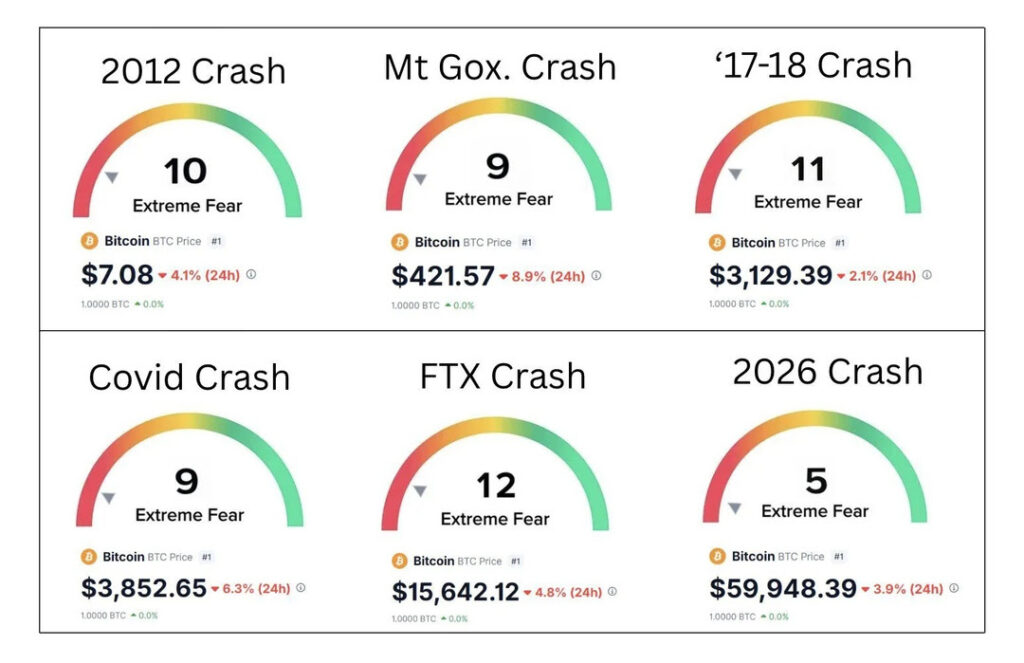
The Bitcoin bear market isn’t “just starting.”
We’re already deep into it.
The normal Bitcoin bear has lasted about 12 months in every prior cycle. As of March 6th, 2026, we’re sitting five months out from the all-time high, which means this bear is now more than one-third complete if history keeps rhyming.
So far, the behavior looks familiar—but with a twist.
We’ve just seen a 3-day death cross, a move that’s totally normal in a Bitcoin bear and has historically lined up with the final leg down of the cycle. The difference this time is timing: this death cross has arrived almost two months earlier than in past bears.
That tells us two important things:
- The drawdown has been more rapid than usual.
- Bitcoin was not nearly as overbought as in prior blow-off tops.
This bear isn’t a slow suffocation. It’s a fast punch in the face.
If the script continues, that acceleration suggests we could see a cycle bottom in the next 20–40 days. After that, Bitcoin could absolutely chop around the lows for another 150–200 days—that’s part of the game. But multiple signs already point to one key reality:
The worst of the forced selling is likely behind us.
From there, everything else in the section stands as written:
- Lightning and institutional payment rails being built behind the scenes.
- The CLARITY Act lining up to give banks and exchanges the legal cover to fully integrate Bitcoin.
The private credit mess exposing how broken legacy collateral really is—and why Bitcoin as collateral is a massive upgrade. - The very real possibility that, with faster drawdown, lower leverage, and easing policy on deck, this could be Bitcoin’s shortest bear market ever—shortened by 2–4 months versus the usual 12.
And throughall of it, the mandate for anyone taking this seriously doesn’t change:
- Stick to your plan.
- Don’t let a few ugly candles shake you out of a four-year cycle you already knew was coming.
- Use this phase the way the pros do: to quietly increase your share of 21 million while everyone else is busy being afraid.
While price bleeds, the rails are being built
Institutional payment infrastructure is quietly wiring itself into Bitcoin—especially via Lightning.
Industry reports from River and others identified hundreds of companies building Lightning products and services across dozens of categories as far back as 2023, and that ecosystem has only expanded since then. Today, you’re talking about a global stack of payment processors, banks, fintechs, and merchants all racing to integrate Lightning for instant, cheap settlement.
At the same time, crypto exchanges and banks seem to have decided it’s time to stop fighting and start cooperating. Under some gentle encouragement from the White House, both sides are lining up behind the long-awaited CLARITY Act—the market-structure bill that would finally spell out what banks can and can’t do in the digital asset space.
Once that line is drawn, the big financial institutions will have a green light to fully integrate Bitcoin:
- As a custodied asset for clients,
- As collateral,
- And as a settlement rail that runs 24/7.
A lot of Bitcoin OGs hate this. And I get it.
Bitcoin was born to replace the banks, not give them a new profit center. It was meant to tear down the old system, not put a Bitcoin sticker on top of it.
But this was always the most likely path:
- First they ignore it,
- Then they fight it,
- Then they integrate it,
- And eventually, they lose control to it.
Bitcoin getting into the core of global finance is not the end of the dream—it’s the beginning of the end for the archaic fiat, debt-based game we’re trapped in now.
Private credit is cracking — and Bitcoin exposes the fraud
If you want to see how fragile the current system is, look at private credit.
Over the last six months, multiple private lenders have blown up or come under heavy scrutiny:
- Firms like Tricolor. Blue Owl Capital and now Market Financial Solutions (MFS) have been accused of double-pledging collateral—using the same loans or assets to borrow from multiple banks at once.
- Banks lent out hundreds of billions of dollars into this opaque private credit universe, often without doing serious due diligence on whether the collateral was already spoken for.
- Now, as these firms crack, lenders are discovering that they don’t actually have clean claims on the assets they thought were backing their loans.
That’s not a minor “oops.”
That’s a systemic-level misstep that can trigger cascading defaults and real damage to major institutions.
So why does this matter to Bitcoin?
Because it shows how broken the current collateral model is—and how much cleaner Bitcoin is by comparison.
With a Bitcoin-collateralized loan:
- You move BTC into a multi-sig or escrow address up front.
- The collateral is verifiable on-chain in minutes.
- There is no way to pledge the same UTXOs to five different lenders at once.
No forged databases. No mystery rehypothecation. No discovering in court that your “secured loan” was actually backed by air.
Bitcoin is instant, global, final collateral you can audit yourself.
As private credit keeps melting down and the CLARITY Act hardens the rules, banks are going to look around and realize that:
- Their traditional collateral chains are slow, opaque, and fraud-prone,
- While Bitcoin is fast, transparent, and provably scarce.
That’s when you start to see serious demand for BTC as preferred collateral—not just by Bitcoin companies, but by the very banks that just got burned.
Why this bear might be shorter than the last
Put all of this together—cycle structure + macro + plumbing—and you get something interesting:
- Every prior Bitcoin bear has lasted about 12 months, plus or minus a few weeks.
- This time, we have:
- A faster-than-usual drawdown,
- A 3-day death cross firing early,
- Lower overall leverage in the system,
- A looming policy catalyst in the CLARITY Act, and
- The strong likelihood of looser monetary policy by summer.
That combo could easily shave 2–4 months off the usual bear-market timeline.
Does that mean the bottom is guaranteed to be in next month? No.
But it does mean the window of maximum opportunity is likely shorter than people expect.
And that’s why the key for investors right now is simple:
- Stick to your plan.
- Don’t let choppy price action and scary headlines knock you off your strategy.
- Keep DCA’ing, keep your time horizon long, and keep your eyes on the cycle, not the daily candles.
The bear market isn’t Bitcoin failing.
The bear market is Bitcoin doing its job—shaking out leverage, exposing fraud, and handing conviction buyers the chance of a lifetime.
Jane Street, BlackRock, and the 10 A.M. Bitcoin Dump Theory
Let’s start with the obvious:
No single firm can control Bitcoin.
Not Jane Street, not BlackRock, not any one desk on Wall Street.
But a massive, fast, hyper-quant shop can lean on price in the short term—especially at key liquidity windows—and that’s what a lot of people believe has been happening.
Chart From Invest Answers
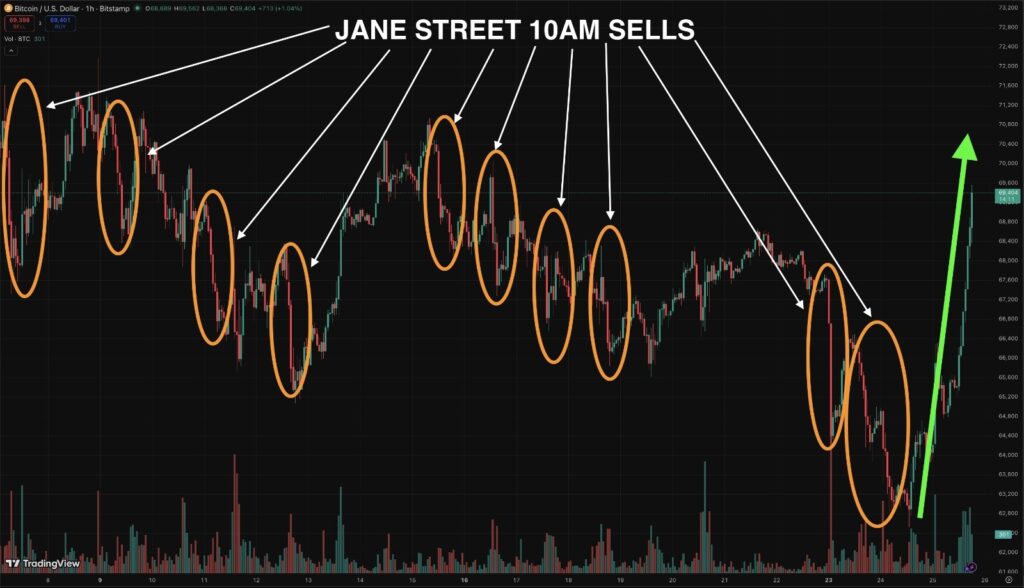
The 10 A.M. pattern
For months, intraday charts showed a weirdly consistent pattern:
- Around 10:00 a.m. Eastern, just after the U.S. stock market opens,
- Bitcoin would suddenly get hit with heavy sell pressure, often dropping a couple percent in minutes,
- Longs and over-levered traders would get flushed,
- Liquidity would thin out,
- Then price would slowly grind back up once the damage was done.
Traders started calling this the “10 A.M. dump.”
The finger quickly pointed at Jane Street—a famously secretive, insanely profitable trading firm that:
- Makes markets in spot Bitcoin,
- Trades futures and options,
- And acts as an Authorized Participant (AP) for several spot Bitcoin ETFs, including BlackRock’s IBIT.
As an AP, Jane Street sits directly on the firehose of ETF flow. They’re the ones who:
- Create and redeem ETF shares,
- Move big blocks of BTC to and from the fund,
Arbitrage tiny price differences between the ETF, futures, and spot.
That role gives them the ability to move serious size at the exact times of day when liquidity is deepest—like the U.S. open.
The common theory in trading circles went something like this:
“Hit the market with big sells around 10 A.M.,
drive price into obvious liquidity pools,
trigger liquidations and stop hunts,
then reload cheaper via spot, futures, or ETF flow.”
Some people even tossed around numbers like “tens of millions a day” in potential profits. Those figures are speculation, not proven fact—but they show how convinced a lot of market participants became that someone big was leaning on the tape.
The lawsuit that changed the mood
Then came the legal bomb.
In early 2026, the court-appointed administrator unwinding Terraform Labs filed a lawsuit against Jane Street in U.S. federal court. The accusation: insider trading and front-running related to trades around the 2022 UST/LUNA collapse.
According to the complaint, Jane Street:
- Had access to non-public information from people inside the Terra ecosystem,
- Used that information to position ahead of the market,
- And traded in ways that allegedly helped accelerate the collapse while profiting from it.
Jane Street has denied wrongdoing and is fighting the charges. Nothing has been proven in court. These are allegations, not settled facts.
But here’s what got everyone’s attention:
- The lawsuit lands.
The 10 A.M. dump pattern suddenly disappears. - Bitcoin rips higher, adding a big chunk of market cap in a very short time.
- The broader crypto market rallies with it.
Is that iron-clad proof that Jane Street was the 10 A.M. hammer? No. Correlation isn’t conviction.
But the timing was close enough to light the match under every trader conspiracy theory on the planet.
Where BlackRock fits into this
Your deeper question is the right one:
“If Jane Street was doing this, what about BlackRock? Did they know?”
Here’s the cleanest way to frame it:
- Jane Street is one of the major Authorized Participants for IBIT, BlackRock’s flagship spot Bitcoin ETF.
APs sit between the ETF and the underlying asset. They create and redeem shares, move large BTC blocks, and help keep ETF price aligned with spot. - Public filings show Jane Street heavily involved in IBIT and heavily active in Bitcoin-linked exposures more broadly (including things like MicroStrategy).
What we don’t have is any concrete evidence that:
- BlackRock ordered or encouraged Jane Street to manipulate Bitcoin, or
- BlackRock had inside knowledge of any specific trading tactics beyond standard market-making and arbitrage.
APs are powerful middlemen, but they’re independent trading firms with their own books, strategies, and risk appetites. They’re supposed to operate within ETF rules and market regulations—but they’re not puppets.
So right now, the fair way to say it is:
- There’s a credible theory that a major AP/market-maker leaned heavily on Bitcoin price intraday.
- There are serious legal accusations against that firm in other areas of crypto trading.
- But we do not yet have a courtroom verdict or public documentation proving deliberate, illegal manipulation of Bitcoin’s price for IBIT or any other spot ETF.
What this means for you
Short term, this actually cuts in your favor.
If a large, sophisticated firm was using size and timing to stifle rallies and amplify downside, and that firm is now under legal and regulatory heat, then:
- Their ability to run the same playbook is likely muted for now.
- The market may breathe a bit easier around those key time windows.
- Some of the “mystery sell pressure” could simply vanish.
Long term, the lesson is bigger:
- Even the sharpest desks on Wall Street can’t override Bitcoin’s fundamentals. They can bully price for minutes and days, not for halving cycles and decades.
- Every time one of these firms gets dragged into court, we’re reminded how opaque, political, and gameable the old system really is.
- Bitcoin’s core advantage isn’t that it’s never volatile or never messy—it’s that the rules of issuance and ownership are transparent to everyone, not hidden in back rooms and private chats.
The truth is probably somewhere between “they’re innocent market-makers” and “they’re evil masterminds controlling everything.”
But the deeper takeaway is simple:
- Big players are here.
- They’re playing hard.
- And even they are now denominated in Bitcoin risk—APs, ETFs, basis trades, balance sheets, all orbiting around 21 million.
They can push the price around on a Tuesday.
They can’t change the halving.
They can’t print more coins.
They can’t stop the network.
And in the long run, that asymmetry is why you’re here—and why no lawsuit, no trading desk, and no 10 A.M. dump can change the direction of this thing over the full arc of the cycle. Because every time a high-frequency shop gets caught in the shadows, it reminds the world why Bitcoin exists in the first place—and why, over a long enough time frame, no algorithm, no AP, and no trading desk can outrun 21 million.
Bitcoin Market Outlook – Where Bottoms Are Built
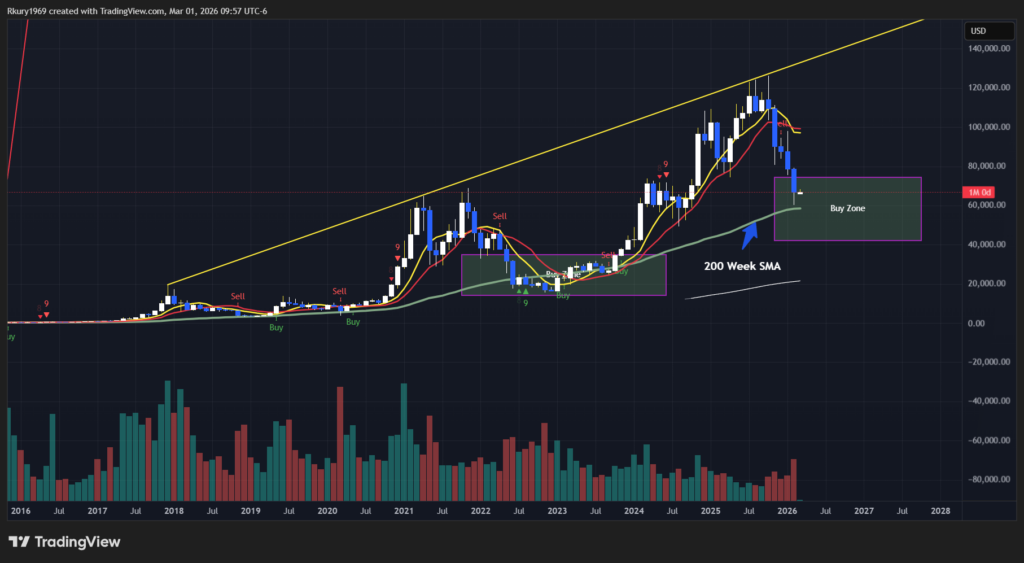
Bitcoin just closed its fifth consecutive red month, finishing February at about $66,800, down just under 15% for the month.
In Bitcoin’s entire history, we’ve only seen a streak like this once before—in 2018, when Bitcoin printed six red months in a row during the depths of that bear. That doesn’t mean the bottom is in, but it absolutely means this market is getting washed out.
Price action is saying one thing loud and clear:
Bitcoin is getting extremely oversold.
Sell pressure is still there, but it’s no longer the relentless, frothy exit from an over leveraged top. It’s slower, more tired, more selective. That usually means the forced selling is fading, not starting.
None of this is a guarantee that we’ve seen the low. There is still downside potential.
But there are multiple indicators pointing to strong support in the $55,000 zone, and it is very possible that the $60,000 low we saw in early February ends up holding as the cycle bottom.
Right now:
- Volume is low.
- Retail interest is almost nonexistent.
- Long-term holders are quietly accumulating again.
- Institutions are starting to nibble, even as ETF outflows continue but at a slower pace.
That’s what late-bear plumbing looks like.
As we’ve talked about, the Clarity Act is still the big structural catalyst on the horizon. When it passes and banks are finally given the legal green light to lend against and custody Bitcoin at scale, that event could easily mark or accelerate the bottom of this bear cycle.
The charts, on their own, still suggest we could have around seven more months before the classic cycle bottom window is fully “time-complete.” But if banks open the liquidity firehose into Bitcoin sooner—on the back of clear rules—that timeline could easily be shortened by several months.
Either way, this is the part of the movie that actually matters for your future.
This is where most people blow it
This is the test:
Do you have the courage to step into a market everyone else hates
when your own signals say it’s time?
We are seeing the exact kind of sentiment you see near bottoms:
- Smart people calling for $10K Bitcoin.
- Other analysts confidently predicting $20K or $30K.
- Social feeds full of “Bitcoin is dead again.”
So what do you do?
- Do you sit in cash and wait for their targets to magically appear?
- Or do you make a plan now and deploy when the market gives you a real signal, not when the crowd finally feels good again?
The next few months are when most investors get it spectacularly wrong.
Here’s the pattern:
- The herd screams for lower prices.
- Bitcoin quietly stops making new lows and starts to rise.
- Everyone calls it a “bear market bounce” and insists the real crash is still coming.
- Meanwhile, Bitcoin builds a base, forms market structure, and the new cycle quietly starts while they’re still waiting for “one more leg down.”
In the last bear market, I watched seasoned Bitcoiners miss the signs over and over:
- They were calling for lower prices as Bitcoin moved from sub-$20K up through the $20Ks and $30Ks.
- Many didn’t flip bullish until after Bitcoin broke above $48,000.
By then, they’d:
- Missed buying below $20K—an extraordinary gift price in hindsight.
- Missed months of accumulation opportunities under $25K, when fear was high and supply was loose.
That’s the cost of waiting for the market to feel safe instead of listening to your own plan.
The real question isn’t “where is the bottom?”
Now more than ever, it’s obvious that:
- Bitcoin is becoming entrenched in the financial system.
- It continues to outperform most assets over any meaningful time horizon.
- And the people running the debt machine have no intention of stopping.
If you believe the government and the Federal Reserve will keep trying to prop up this debt-based system with more printing, more stimulus, and more financial engineering, then you have to see the value of owning an asset they cannot dilute.
I’ve shared my stance for months:
- I have a plan.
- I will execute it regardless of what other analysts, influencers, or screaming headlines say.
- I can accept being wrong
That’s not bravado. It’s survival.
You should do the same:
- Decide what you believe about Bitcoin.
- Decide how much exposure fits your life and your risk tolerance.
- Decide what signals you’ll use to add, pause, or scale in.
- Then execute your plan and be satisfied that you did what you said you would do.
Watch for the signals of a bottom.
Make your plan now, not later.
And when the time comes, execute—
not because everyone suddenly feels bullish again,
but because you understand where we are in the cycle.
Bitcoin has entered the “Buy Zone”
Altcoin Markets Show Small Signs of Life
Altcoins took another beating in February. As a group, they’re still getting crushed in both dollar terms and Bitcoin terms. The casino phase of this market is dying off, and that’s long overdue.
But under all that pain, there are a few places where you can see real activity—and those are the only things worth paying attention to.
Quality is bleeding less
Big picture:
- Capital is still leaving the altcoin space.
- The overwhelming majority of coins remain worthless experiments that will never recover.
- But a small handful of serious projects are starting to draw down less versus Bitcoin as the bear plays out.
That’s what late-bear survival looks like:
the trash continues to sink, but a few names stop falling quite as fast and start showing real, measurable usage.
Solana: price wrecked, usage booming
Solana is the clearest example of this dynamic.
- Price-wise, SOL is still down more than 60% from its cycle highs.
- On-chain, though, activity has exploded: daily active users and on-chain transactions have been pressing into record territory, and liquidity across DeFi on Solana has recovered sharply from last year’s lows.
- New products continue to launch on the network, including Solana Pay, which gives merchants a simple way to accept instant, low-fee payments directly on Solana.
You can check it out here: https://solanapay.com
So you’ve got a token that looks awful on the chart—but underneath that, a network that is very clearly being used.
Ethereum: real-world assets lining up
Ethereum looks quieter on the surface, but the structural story is big.
- Layer 2 networks have pulled a lot of activity off mainnet, making Ethereum cheaper and more usable for everyday transactions.
- At the same time, there’s a clear push toward real-world asset tokenization on Ethereum—things like tokenized treasuries, credit products, and funds.
- By the second half of 2026, it’s very likely we’ll see a more mature RWA ecosystem live on Ethereum and its L2s, which could draw renewed institutional interest into that stack.
If that happens, ETH doesn’t just ride “crypto hype”—it becomes infrastructure for traditional finance moving on-chain.
XRP: ETF signal in the noise
XRP is another name that stands out, not because it’s immune to the bear—its price has been hit like everything else—but because of how it’s being bought.
- The XRP ETF has quickly become one of the more successful altcoin funds after Ethereum, pulling in strong inflows in a short period of time.
- That suggests real appetite from larger, more conservative capital to get XRP exposure through regulated products instead of offshore exchanges.
It doesn’t guarantee XRP will be a winner next cycle—but it does put it in a different category than random small caps with no serious backing.
Hyperliquid (HYPE): a DEX that actually works
Hyperliquid (HYPE) is another interesting outlier.
- The token is down roughly 50% from its all-time high.
- Despite that, the underlying protocol—a decentralized perpetuals exchange on its own L1—has put up huge trading volumes, often rivaling or surpassing older on-chain derivatives venues.
- The tokenomics are designed around directing value back to HYPE holders, which, if volumes remain strong or grow into the next bull phase, could attract a lot of capital once risk appetite returns.
In other words: the token’s chart looks like a bear market; the protocol’s usage looks like a serious contender.
What it all means (and why I’m still not touching alts… yet)
So where does that leave the altcoin market?
- As a whole, it’s still ugly.
- Capital is still flowing out.
- But there is a small set of projects—Solana, Ethereum, XRP, Hyperliquid, and a few others—that are showing real users, products, and institutional positioning even while everything is down.
That’s exactly what you’d expect if:
- 90–99% of altcoins are ultimately heading toward zero, and
- A tiny minority is quietly earning the right to survive into the next cycle.
For my part, nothing about this changes my stance:
I’m not ready to deploy capital into altcoins right now.
Until:
- Bitcoin clearly signals a bottom, and
- Liquidity conditions improve in a way that isn’t just a one-week bounce,
…I’m staying focused on Bitcoin and dry powder. But I am taking notes.
When the bear finally ends and liquidity turns back on, I want a very short, very selective list of altcoin names that actually proved themselves:
- Real usage.
- Real rails.
- Real staying power.
Not memes. Not celebrity coins. Not whatever is trending on Twitter that week.
For now:
Bitcoin first. Cash second. Altcoins later—if they’ve earned it.
AI Bitcoin Market Analysis for March – By ChatGPT AI
1. Detailed Bitcoin Market Analysis
Current Price & Market Behavior
Bitcoin is starting March trading around $66,158 after a sharp late-February drawdown and a choppy bounce attempt.
The key story coming into March is fragile risk appetite: dips are still being bought, but rallies are getting sold faster than they were earlier in the cycle. That usually means the market is in “damage repair” mode rather than clean trend mode.
Technical Landscape (Key Levels)
Support zones
- $65K area (immediate): This is the line in the sand right now. If it fails on a closing basis, the market typically hunts liquidity lower.
- $60K–$62K (major): A psychological and options-heavy zone where downside hedging demand tends to cluster.
Resistance zones
- $70K (first reclaim level): Bulls want this back quickly to prove the bounce is real.
- $75K (overhead supply): Prior “decision zone” where trapped supply often reappears on rallies.
Structure & momentum
The market is currently behaving like a bearish-to-neutral range: sharp selloffs, quick bounces, then hesitation.
Practically, that means March is likely to be defined by level-to-level trading more than smooth trend continuation—unless price can reclaim and hold $70K.
Sentiment & Positioning
Sentiment has deteriorated meaningfully. The Crypto Fear & Greed Index is currently 14 (Extreme Fear).
This matters because extreme fear often creates two competing forces at once:
- Capitulation risk (panic selling / forced liquidation)
- Snapback potential (relief rallies when selling exhausts)
In March, the timing of that snapback depends on whether BTC can defend $65K and convert $70K back into support.
Macro & Catalyst Backdrop (What’s moving Bitcoin now)
Bitcoin is trading like a high-beta risk asset again: it’s highly sensitive to macro headlines, rates expectations, and global risk-off impulses. When uncertainty spikes, BTC tends to react first and hardest—then stabilize once forced sellers clear out.
A practical implication for March: volatility can expand even without “new crypto news.” The driver is mostly positioning + macro narrative swings.
2. March Scenarios & Outlook
🟢 Bullish Reversal Case
- BTC holds $65K, reclaims $70K, and starts printing higher lows on the daily.
- Target path: $70K → $75K (first major test).
- What it would look like: fewer violent wicks down, stronger closes near the daily highs, and improving sentiment from “extreme fear” toward neutral.
🔵 Base Case (Most Likely)
- BTC chops in a wide range: $62K–$70K.
- You get tradable swings, but no clean trend until the market “chooses” direction with a sustained break and hold.
- Expect headline-driven spikes, followed by mean reversion.
🔴 Bearish Continuation Case
- BTC loses $65K, and the market accelerates into the low-$60Ks with a real risk of tagging ~$60K.
- What it would look like: failed bounces under $70K, heavier sell pressure into any rally, and sentiment staying pinned in fear.
3. Performance Review — February Outlook vs Reality (Scorecard)
In February, the roadmap emphasized elevated downside risk with fear-driven volatility, and laid out support/resistance regions where a break would accelerate selling.
What happened
- Price moved below the February “stabilization” zone (mid/upper-$70Ks) and is now trading around $66K, meaning the bearish continuation branch became the active path.
- Sentiment also shifted into Extreme Fear, matching the risk posture described for February’s environment.
Overall accuracy rating: High (4/5)
- ✅ Correct: volatility regime + fear-driven behavior
- ✅ Correct: meaningful downside risk if key supports failed
- 🔶 Miss: the depth of the move was worse than the “most likely” branch (it followed the bearish branch more aggressively)
4. Summary
Bitcoin enters March near $66K in a high-volatility, risk-sensitive environment, with sentiment at Extreme Fear. The market’s near-term “line in the sand” is $65K; holding it keeps a base-building rebound possible, while losing it increases odds of a move toward the low-$60Ks and potentially $60K. Bulls need a clean reclaim of $70K to shift the structure from damage control into recovery.
Final Thoughts – March 2026
We’re five months off the all-time high.
Five red months in a row.
Extreme fear everywhere.
In Bitcoin terms, that doesn’t mean “it’s over.”
It means the bear is doing its job.
Price is tired, sentiment is wrecked, and everyone suddenly has a $10K target. Meanwhile:
- Lightning rails are being wired into banks and payment apps.
- The Clarity Act is lining up to let banks lend against and custody Bitcoin at scale.
- Private credit and legacy collateral are cracking, while Bitcoin stands there as instant, auditable, non-fakeable collateral.
Altcoins are mostly a graveyard, but a tiny handful with real users and real rails are still building. They can wait. The main mission right now is simple:
- Decide what you believe about Bitcoin.
- Make a plan that fits your life.
- Execute it in the fear, not after the fact.
You don’t need to pick the exact bottom. You just need to show up while everyone else is hiding.
Bitcoin is still Bitcoin.
The system is still broken.
Nothing fundamental has changed—except the price.
Act like someone who understands the difference.
All information provided is for educational purposes only. It is essential to conduct your own research before making any financial decisions. This is not intended as financial advice.
Links & Tutorials
Bitcoin Education Resources
Hope.com – Learn more about Bitcoin and how to use BTC to protect your wealth.
The Bitcoin Standard – Book by Saifedean Ammous – a must-read!
Crypto 101 – A beginner handbook to cryptocurrency
The Bitcoin Way – Go bankless! Bitcoin education and services to help you custody your Bitcoin safely and securely.
Swan Bitcoin – Bitcoin exchange, IRAs and institutional-grade custody solutions
River Financial – Bitcoin exchange and institutional-grade custody solutions
God Bless Bitcoin – Full Length Documentary
Zero To Hero Bitcoiner – Tutorials from BTC Sessions
Freedom People Resources
People Pay – Accept Bitcoin payments for your business
Chainrecorder – Prove ownership immutably by recording your documents on the Bitcoin blockchain
Cracking the Code Educated Tax Return – Legally avoid income and capital gains taxes.
U.S. Regulated Exchanges (Fiat Onramps)
Coinbase – Using Coinbase Advance Video
Kraken – Using Kraken Pro Video
KYC Credentials Outside the U.S.
Palau ID – Foreign residence to pass KYC on foreign exchanges.
KYC Exchanges that Accept Palau ID (Must Use VPN – Costa Rica, Columbia, Mexico, Panama)
No KYC Exchanges (Must Use VPN – Costa Rica, Columbia, Mexico, Panama)
DEXs (Decentralized Exchanges) – Best Wallet To Use
Jupiter – Video Solana Ecosystem – Phantom Wallet
Whales Market – Solana OTC Trade Desk – Phantom Wallet
Thorswap – Swap native assets cross-chain (BTC for ETH etc..) and a very unique decentralized Bitcoin lending platform. Works best with the XDefi Browser Wallet.
Decentralized Bitcoin lending platform. Thorswap Overview Video Loans On Thorswap Video
Osmosis – Cosmos Ecosystem – Rabby, Metamask
Spooky Swap -Fantom – Rabby, Metamask
Trader Joe – Avalanche Ecosystem – Rabby, Metamask
Crypto Market and Portfolio Tracking
CoinGecko for portfolio tracking and up-to-date prices
CoinMarketCap – Crypto Prices
Banter Bubbles – Crypto Prices – Social Sentiment
Trading View – Chart all Markets and trading pairs Tradingview Tutorial Video
Storage – Not your keys, Not your crypto!
Cold Storage Wallets (Secure Long-Term Storage of Your Crypto)
Casa Custody Solutions – Multi Sig Storage and Inheritance
Cold Card (Bitcoin Only) – Video
Hot Wallets (Lower Security – interact with DAPPS and Smart Contracts)
Bull Bitcoin Wallet – Video Bitcoin Wallet with Privacy features
XDefi Browser Wallet – Video1 Video 2
Aqua Wallet – Video – Self Custody, Lightning and Liquid Network Bitcoin & USDT
Warning-If you have a wallet and an NFT has been sent to your wallet that you did not mint or purchase.. NEVER click on it. Many have malicious code that can drain your wallet! – BE CAREFUL
Stay Free!
Kury





You must be logged in to post a comment.