


Bitcoin – Sound Money Falls as Stocks Rise


Look around. While everyone obsesses over Bitcoin’s price action, the real story is unfolding in plain sight: sound money is getting hammered while a handful of AI-fueled stocks rocket to new all-time highs. Bitcoin and gold — the two hardest assets on the planet — are both under pressure, and the usual suspects are cheering it on. But here’s the thing: this divergence isn’t random. It’s the market handing you a roadmap.
Bitcoin and gold share the same DNA. Both are scarce. Both require real energy to produce. Both are true bearer instruments you can hold in your hand or in your head — no counterparty, no permission, no counterparty risk. They are the only two forms of money that have survived every empire, every fiat experiment, and every debt supercycle in history. Yet they do not move in lockstep, and that separation is exactly where the edge lives.
Gold is the ultimate credit-market asset. When credit expands, gold rides the wave. Bitcoin is the purest expression of banking-system liquidity. When the pipes are wide open — stimulus, carry trades, easy money — Bitcoin surges with violent conviction. When liquidity tightens, Bitcoin gets punished first and hardest. That is not my opinion. That is mathematical reality playing out on the Bitcoin-to-gold ratio chart for over a decade.
Right now, both are under pressure because credit is contracting and liquidity is being drained. Japan’s rate hikes have strangled the yen carry trade that flooded risk assets with cheap capital for years. Foreign governments — most notably Turkey — have been dumping gold reserves to defend collapsing currencies. In the weeks following the outbreak of the US-Iran conflict in February 2026, Turkey’s central bank sold and swapped over 118 tonnes of gold worth more than $8 billion, on top of approximately $26 billion in broader foreign exchange reserve depletion, all in a desperate attempt to keep the lira from imploding amid regional chaos. It didn’t work. Turkey now sits with severely depleted reserves and a painful lesson in what happens when you fight the dollar with finite collateral.
From a top the Gold to Bitcoin Ratio always takes 14 months To bottom
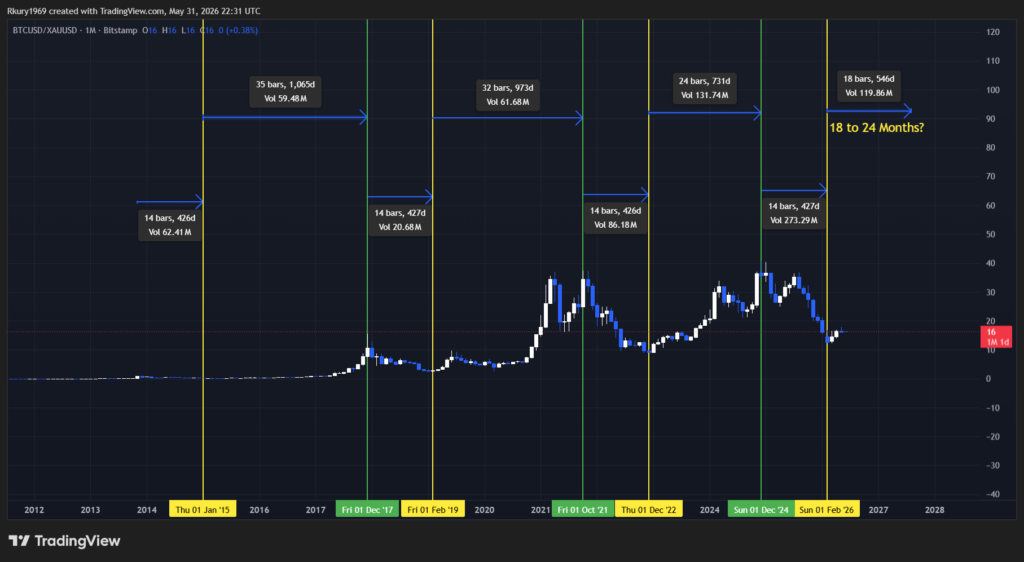
Yellow lines = lows Green lines = highs
Meanwhile, money is pouring into a narrow slice of AI-adjacent stocks. The same dangerous concentration we witnessed before previous market tops. The market is betting everything on a handful of names while the hardest money on Earth gets sold like it’s yesterday’s news.
This is temporary. Central banks only have one playbook when the credit machine starts coughing: print more. More liquidity. More stimulus. A new credit cycle. And when that wave hits — and it always does — Bitcoin will lead the charge, because its correlation to global liquidity is absolute. Gold will follow, perhaps with a lag, but with powerful conviction once the next leg of monetary expansion begins.
For the next year or two, Bitcoin stands ready to outperform gold decisively. Further out, the setup becomes even more explosive: Bitcoin eventually displaces gold as pristine digital collateral while gold remains the central-bank reserve asset of choice. The ratio is already telling the story. Anyone paying attention can rotate intelligently between the two and crush the average investor who simply holds both passively through every cycle.
The summer ahead looks messy. Landmines everywhere. But history is screaming the outcome: more debasement, more liquidity, more global recognition that the debt-based monetary system is structurally broken. Hard assets win. Sound money wins.
Bitcoin is not failing. Gold is not failing. The fiat system is failing — and the market is simply reminding everyone who still holds real money. The window is open. The divergence is your signal. Act like someone who sees it.
Bitcoin Showed Strength Early in May but Fell to Close the Month
Bitcoin flashed strength early in May, ripping toward a local top near $83,000 before reality reasserted itself. It closed the month down roughly 3.4 percent. Here’s the thing: this kind of relative weakness is not abnormal at this exact point in the cycle. In fact, as we roll into June — one of the historically soft months for Bitcoin — this pattern could easily continue, forcing price down to retest the lows carved back in February.
This is the four-year cycle doing exactly what it has always done. It repeats with mathematical precision. But something is profoundly different this time.
The 200-week simple moving average sits rock-solid near $61,000 and has served as nearly unbreakable support in every prior bear market. The one time Bitcoin smashed through it — in 2022 — it found ironclad footing at the 300-week moving average, currently sitting around $53,000 and still rising with conviction. My thesis is clear: we likely saw the true cycle low in February. What we may get now is a double bottom over the next four months — a final shakeout that retests the $60,000 zone, maybe even a quick wick down toward that rising 300-week average. A move engineered to scare weak hands into full capitulation while the pundits and perma-bears scream for $30,000 or $40,000. I now believe that those who wait for those prices will be sorely disappointed.
Read that again.
Fundamentally, institutional adoption has never been stronger. Texas is advancing its Strategic Bitcoin Reserve toward direct on-chain custody — moving its $10 million allocation from BlackRock’s IBIT ETF into self-custodied Bitcoin, with an RFP issued and an advisory committee named, signaling that sovereign ownership of Bitcoin is no longer theoretical. It is operational. Strategy and Strive continue buying relentlessly, funding massive accumulation through their perpetual preferred stock offerings. On-chain data confirms it: long-term holders have now accumulated more than 2 million additional Bitcoin since the October 2025 peak, with LTH supply approaching all-time highs near 16.3 million BTC. That behavior has historically appeared three to four months before the final bottom.
Where the exact low prints, nobody knows with certainty. But the signs are screaming that we are close — dangerously close. The $60,000 level is the magnet. The smart money is already stacking with both hands. It is time for retail to stop watching and start acting like the smart money. The window is narrowing. The cycle is turning. Stack accordingly.
Bitcoin is heavily correlated with the Business Cycle and it is starting to turn
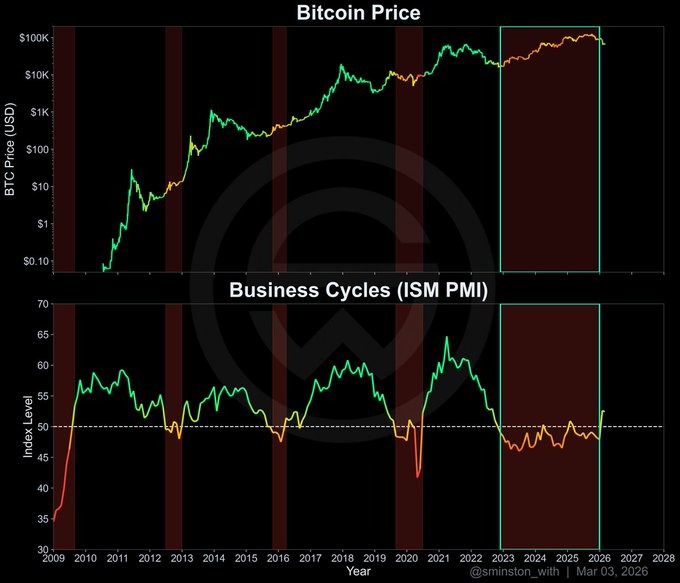
Altcoins Continue to Struggle with a Few Exceptions
Most of crypto is getting absolutely crushed right now. Low liquidity, stagnant stablecoin market cap, no fresh capital flowing in — the entire sector is starving for fuel. And as Bitcoin retraces, altcoins are not just following — they are leading the way lower with even deeper, more violent corrections.
This is the bear market doing its job. It separates the signal from the noise. Ninety-nine percent of these tokens are still worthless lottery tickets with logos, bleeding out in both dollar and Bitcoin terms. The casino is closing. Good. But there are a few standouts that refuse to die.
Hyperliquid continues to show real strength — and not the manufactured kind. While the broader altcoin market bleeds, HYPE just hit an all-time high of $67.24 on May 29, 2026, and is trading near $65 with a $16.5 billion market cap. Their model of actually returning profits to token holders — routing 97% of trading fees directly into HYPE buybacks — is the blueprint every new project should be studying. It aligns incentives the right way and drives genuine market participation. Right now it functions as a powerful, permissionless decentralized perpetuals exchange where you can trade real-world assets including S&P 500 index contracts and oil futures alongside crypto — just connect your wallet and go. It is not fully decentralized, and regulators will eventually try to co-opt or attack it. That risk is real. But for now, it is delivering where others are failing, and the market is voting with its capital.
Privacy coins are also holding up far better than the rest of the market. Monero and Zcash have been among the strongest performers in all of crypto over the last six months while everything else crumbled. Zcash exploded to a 2026 high above $642 in early May, fueled by a Grayscale ETF filing and Multicoin Capital publicly disclosing a major position. Monero broke its 2021 all-time high before pulling back, and as of May 31 is trading near $397. In a world racing toward total financial surveillance — CBDCs, transaction monitoring, government-mandated transparency — the demand for real privacy is not fading. It is accelerating.
Tron has quietly held its value far better than most major altcoins. There is no complex narrative here. The network now hosts $84 billion in USDT and processes roughly 50% of all global USDT transaction volume. It is the dominant settlement rail for digital dollars worldwide, with the heaviest usage concentrated across Asia and emerging markets. Utility wins when liquidity dries up. Always has. Always will.
Near Protocol deserves watching too. NEAR has always carried promise, with deep roots in the Korean crypto community and a co-founder — Illia Polosukhin — who co-authored the 2018 paper “Attention Is All You Need,” the foundational architecture behind modern AI. In 2026, that pedigree is finally getting priced in. NEAR surged over 70% in May alone as the AI infrastructure narrative caught fire, with Arthur Hayes publicly endorsing it as a top AI-native blockchain play. If NEAR can truly become the payment and coordination rail for autonomous AI agents — delivering fast, cheap, cross-chain transactions at machine speed — it could emerge as critical infrastructure as those agents begin moving real value at scale. The thesis is live. The execution is being watched closely.
Still, the big picture is ugly. The altcoin market as a whole looks unhealthy and continues to lose ground against both Bitcoin and the dollar. Unless you are already positioned in these few outperformers, the smartest move is keeping capital on the sidelines. Wait for the liquidity environment to change. Do not chase. Do not hope.
Time will tell whether we get another explosive alt season where quality coins dramatically outperform Bitcoin, or whether those days are behind us entirely. Until the macro shifts and fresh capital floods back in, the path of least resistance for most alts remains lower.
Bitcoin first. Dry powder second. Everything else later — only if it has earned the right to survive.
Bitcoin AI Market Analysis by Claude
What played out correctly from last month’s analysis:
The macro overlay correctly identified elevated geopolitical risk as the dominant force suppressing Bitcoin’s price action in Q2. The call for continued institutional divergence from retail — with whales and corporate treasuries accumulating while spot prices lagged — proved accurate. Strategy did exactly that, continuing purchases even while ETF outflows mounted.
What did not materialize:
The base-case scenario for May targeted a range of $85,000–$90,000. That target was not reached. Bitcoin opened May near $78,280, briefly pushed toward $81,000 in the first week, then reversed sharply following renewed US-Iran military escalation. The May candle is tracking to close red — the third red month since the October 2025 all-time high.
What carries forward into June:
The $75,000 resistance level and EMA cluster at $76,400–$76,700 remain critical overhead obstacles. The $66,000–$68,000 zone is the principal macro support. The US-Iran conflict remains unresolved with a naval blockade of the Strait of Hormuz still in effect. ETF flows are net positive for 2026 but barely — $536M YTD after a $1.55B six-day outflow streak in late May. Strategy continues to accumulate. The ATH of $126,210 set on October 6, 2025 remains the target that defines this cycle.
Where We Stand
Bitcoin enters June 2026 trading near $73,400, approximately 42% below the all-time high of $126,210 set on October 6, 2025. Read that number again. Forty-two percent below the peak — and yet this is not a broken asset. This is a maturing one.
The May monthly candle is closing red, ending the two-month green streak that March and April built together. March gained 2%. April gained 12% — the strongest month of the year. May gave a significant portion back, opening near $78,280, briefly touching $81,000 in the first week, then reversing hard as fresh US-Iran military escalation in the final days of the month drove Bitcoin below $74,000 and triggered the worst single-day ETF outflow since late January.
This is not a broken structure. It is a market under acute macro pressure that has not yet found its floor for this correction cycle. The difference matters enormously.
Sentiment Picture
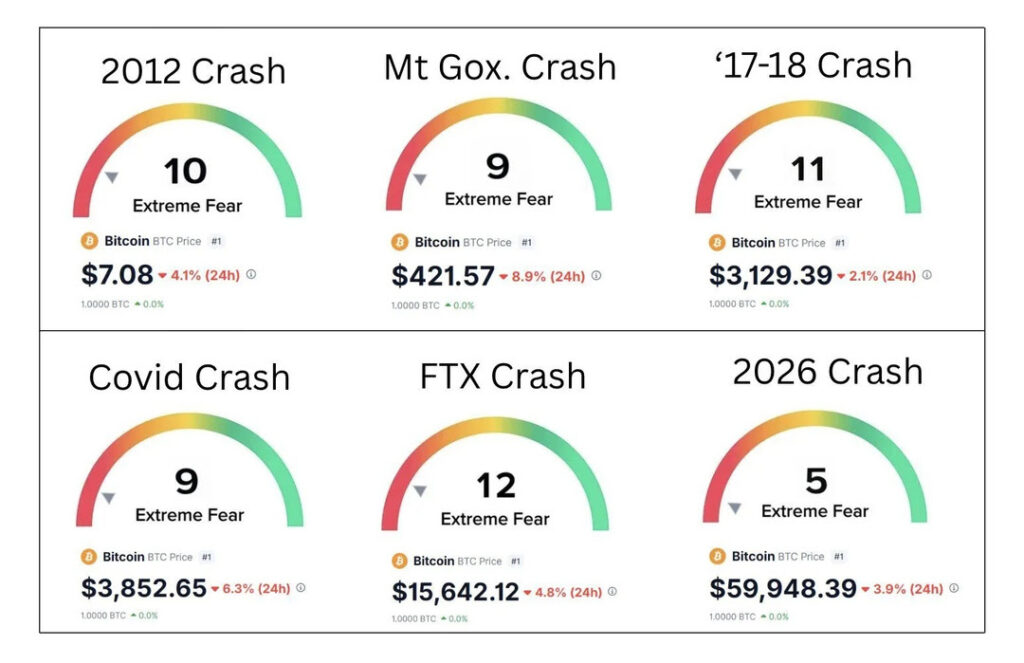
The Fear & Greed Index sits at 35 — Fear — as of May 31. This follows one of the most sustained negative sentiment runs since the 2022 bear market. After 108 consecutive days of fearful readings that bottomed near 14 in March, the index briefly touched neutral on May 6 before renewed geopolitical escalation dragged it back below 40. The last daily Greed reading was May 12. The last Extreme Greed reading was October 5, 2025 — the day before the all-time high.
Here’s what that means in plain language: retail is scared. Retail has been scared for most of 2026. And historically, that is precisely when the most durable wealth is built in Bitcoin — not when everyone is celebrating new highs, but when the headlines are ugly and the index is screaming fear. The market is not euphoric. It is exhausted. Exhausted markets bottom.
The Critical Divergence
This is where the real story lives in June 2026, and it is the same story that defined every Bitcoin institutional accumulation cycle in history: retail is selling, and the smart money is buying everything they sell.
US spot Bitcoin ETFs enter June with 2026 net inflows standing at approximately $536 million year-to-date — barely positive after a brutal six-day outflow streak totaling $1.55 billion in late May, culminating in a single-day $733 million outflow on May 27-28 tied directly to renewed military strikes in the US-Iran conflict. BlackRock’s IBIT alone accounted for $68.9 million of the May 22 outflows. For context, IBIT attracted over $25 billion in all of 2025. The pace has collapsed.
But zoom in on the institutional layer — not the ETF wrapper, but the direct corporate treasury players — and you see a completely different picture. Strategy, the world’s largest corporate Bitcoin holder, now controls 843,738 BTC as of May 18, 2026. Their average cost basis is $66,384 per coin. They raised $11.68 billion year-to-date as the largest US equity issuer of 2026 — and put it directly into Bitcoin while the price was falling. Even in April, during peak geopolitical chaos, they added 34,164 BTC in a single purchase at $74,395 per coin. In May, after signaling publicly for the first time they might eventually sell under extreme circumstances, they immediately turned around and bought another 535 BTC at $80,340 — a declaration of continued conviction delivered in the language of capital.
Mega-whale addresses — those holding more than 10,000 BTC — increased their aggregate holdings by approximately 4% since the Iran conflict began in February. The entities with the largest exposure to downside are the ones adding the most aggressively. When the people who know the most keep buying, the people who know the least are the ones selling.
The divergence between retail fear and institutional accumulation is not noise. It is the signal.
Technical Structure
Bitcoin is trading near $73,400 against an all-time high of $126,210 — a 42% drawdown that puts this correction in the historical range of mid-cycle retracements rather than full bear market capitulation. For comparison, the correction from Bitcoin’s November 2021 peak reached 77% at the cycle low. This move has been painful. It has not been catastrophic.
The 52-week range runs from approximately $60,500 at the February 2026 lows to $126,210 at the October 2025 peak. Bitcoin is currently trading at roughly 57% of the 52-week high — positioned in the lower half of its annual range but off the worst levels.
The RSI on the daily timeframe is approximately 37 — approaching oversold territory, consistent with conditions that have historically preceded relief rallies. The 200-day moving average has been falling since May 1, currently sitting near $83,200, representing the first major resistance ceiling above current prices. The 50-day EMA sits near $74,950 — just above current price and acting as the immediate resistance that bulls need to recapture.
Key levels entering June:
Critical support: $68,000–$66,000. This is the line in the sand. A decisive daily close below $66,000 opens the trapdoor toward $60,000–$62,000, where the most aggressive leveraged longs from 2025 were originated.
Immediate resistance: $75,000–$76,700. This zone aligns with the EMA cluster and the 61.8% Fibonacci retracement of the October peak-to-February trough move. Every significant rally attempt in 2026 has stalled or reversed in this vicinity.
Secondary resistance: $82,000–$83,200. The 200-day moving average. Reclaiming this level would represent the first legitimate signal of macro trend restoration.
The bull case target: $90,000–$95,600. The upper Bollinger Band boundary and a level multiple analysts have identified as the natural destination of a confirmed breakout from current structure.
Macro Overlay
The macro picture entering June 2026 is the most complex this market has navigated since the Federal Reserve’s 2022 rate hiking cycle — and arguably more dangerous in its unpredictability.
The US-Iran conflict that ignited in February 2026 remains the dominant force. A US naval blockade of the Strait of Hormuz has kept oil elevated near $100 per barrel — roughly 35% above pre-conflict levels. That persistent energy price shock feeds inflation directly, constrains the Federal Reserve’s ability to pivot toward rate cuts, and maintains the dollar-strength environment that suppresses all risk assets including Bitcoin. Every new headline out of the Middle East generates an immediate volatility response in crypto markets.
Turkey’s gold reserve collapse is the case study in slow-motion sovereign failure that the author identified in Section 1, and it deserves technical emphasis: when sovereign actors are forced to liquidate hard assets to defend fiat currencies, it creates temporary supply shock in gold markets and a negative signal for global risk appetite that cascades into Bitcoin. It is temporary — Turkey has historically rebuilt reserves after every crisis — but the timing is painful for anyone hoping for a near-term liquidity expansion.
The Federal Reserve’s posture remains the decisive variable. The stickiness of energy-driven inflation has delayed the rate-cut cycle that markets were anticipating for early 2026. Every delay in monetary easing is a delay in the liquidity expansion that Bitcoin’s correlation profile requires to drive the next leg higher. The moment the Fed pivots — and it will pivot, because the US debt load makes every tightening cycle self-defeating — Bitcoin will be the first and most violent beneficiary.
The Japan factor deserves mention. The yen carry trade that powered years of cheap global capital flows has been structurally disrupted by the Bank of Japan’s rate normalization. The unwinding of that trade is deflationary for risk assets in the short term. The rebuilding of a new carry trade — likely in a higher-rate environment with more diverse funding currencies — will eventually add new fuel to the liquidity cycle.
Against all of this, one data point stands out as structurally bullish: global central banks, excluding Turkey’s emergency sales, purchased a net 244 tonnes of gold in Q1 2026, up 3% year-over-year. The official sector is not abandoning hard assets. They are accumulating them at near-record pace. Bitcoin, the hardest asset in existence, will eventually be viewed through the same sovereign reserve lens.
Monthly Outlook: Three Scenarios
Bullish Case — Probability: 25%
Bitcoin reclaims the $75,000–$76,700 EMA cluster in the first two weeks of June, converting resistance to support. A diplomatic breakthrough in the US-Iran conflict — ceasefire or meaningful peace talks — triggers a risk-on repricing across global markets. ETF outflows reverse sharply, the Fear & Greed Index recovers toward neutral, and Bitcoin tests the $82,000–$83,200 level (200-day MA). A clean breakout above $83,200 opens a direct path toward $90,000–$95,600. This scenario requires both a macro catalyst and technical confirmation.
Neutral Case — Probability: 50%
Bitcoin consolidates between $70,000 and $76,000 through most of June, grinding sideways as the market searches for directional conviction. The geopolitical situation neither dramatically escalates nor resolves. ETF flows stabilize near zero net. Sentiment remains in Fear territory but does not deteriorate further. Bitcoin absorbs selling pressure and builds a base. This is the scenario where patient accumulators win and reactive traders lose. Price exits June at roughly the same level it entered — with a slightly firmer technical foundation underneath it.
Bearish Case — Probability: 25%
Fresh military escalation in the US-Iran conflict drives oil above $110, triggers another wave of ETF outflows, and breaks the $70,000 psychological support. Bitcoin tests the $66,000–$68,000 critical support zone. If that level fails to hold, leveraged long liquidations cascade the price toward $62,000. This is the scenario that wipes out recency bias and creates the ultimate accumulation opportunity for those who maintained dry powder through the correction. Even in this scenario, the 2022 cycle low analog — a 77% drawdown from peak — would imply a bottom around $29,000, which no credible institutional analyst currently entertains given ETF structure and corporate treasury dynamics. The floor is higher now. The question is where, exactly.
The Number That Matters Most
843,738. That is the number of Bitcoins that Strategy holds as of May 18, 2026. Acquired at an average cost of $66,384 per coin. At current prices near $73,400, every single coin in that treasury is in profit. The company raised $11.68 billion in 2026 alone — the largest US equity issuance of the year — and deployed it all into Bitcoin while the price was falling. They reported a $12.5 billion accounting loss in Q1 2026 from mark-to-market Bitcoin markdown. And then they bought more.
843,738 Bitcoin represents approximately 4.2% of the entire supply that will ever exist. One company. One conviction. One playbook: convert every dollar of capital markets access into the hardest money on earth, and never stop.
The market can force ETF outflows. The market can trigger geopolitical panic. The market cannot make Michael Saylor or the 843,738 Bitcoin in that treasury disappear. That supply is not coming back to the market at these prices. And every month that number grows larger, the available float for everyone else grows smaller.
Fixed supply. Growing demand. That math only resolves one way.
Final Thoughts
Look — the divergence between Bitcoin’s current price and its structural reality has never been wider. You have a 42% drawdown from all-time high. You have retail fear at 35 on the index. You have ETF outflows dominating the headlines. And simultaneously, you have the largest corporate Bitcoin treasury in history adding coins week after week, whale wallets growing at 4% since the conflict began, and cumulative ETF inflows since January 2024 still sitting above $58 billion.
This is the accumulation phase. Not the exciting kind where charts go vertical and Twitter explodes with laser-eye profile pictures. The hard kind. The kind that builds real generational wealth precisely because it feels terrible while it’s happening.
Here is the strategy in Saylor’s language: Bitcoin at $73,400 with an ATH of $126,210 and a cost basis of $66,384 per coin for the world’s most sophisticated Bitcoin treasury is not a crisis. It is a discount on the scarcest asset in human history, during one of the most acute short-term macro stress events in years. Every dollar-cost average purchase made in this zone is being made at prices that, viewed from 2030, will look like generational theft from the impatient.
Here is the strategy in Mallers’ language: The fiat system is coughing. Turkey burned $8 billion in gold just to keep its currency from collapsing. The Fed is trapped between inflation and a debt load that demands lower rates. Japan’s carry trade is unwinding and someone else’s carry trade will replace it. Central banks globally are buying gold at near-record pace — and Bitcoin is simply the gold they haven’t gotten to yet. When they get to it, and they will, there won’t be any left at these prices.
The window is open. It always feels like it’s closing. It never actually closes — but it does get more expensive every time you wait.
All information provided is for educational purposes only. It is essential to conduct your own research before making any financial decisions. This is not intended as financial advice.
Links & Tutorials
Bitcoin Education Resources
Hope.com – Learn more about Bitcoin and how to use BTC to protect your wealth.
The Bitcoin Standard – Book by Saifedean Ammous – a must-read!
Crypto 101 – A beginner handbook to cryptocurrency
The Bitcoin Way – Go bankless! Bitcoin education and services to help you custody your Bitcoin safely and securely.
Swan Bitcoin – Bitcoin exchange, IRAs and institutional-grade custody solutions
River Financial – Bitcoin exchange and institutional-grade custody solutions
God Bless Bitcoin – Full Length Documentary
Zero To Hero Bitcoiner – Tutorials from BTC Sessions
Freedom People Resources
People Pay – Accept Bitcoin payments for your business
Chainrecorder – Prove ownership immutably by recording your documents on the Bitcoin blockchain
Cracking the Code Educated Tax Return – Legally avoid income and capital gains taxes.
U.S. Regulated Exchanges (Fiat Onramps)
Coinbase – Using Coinbase Advance Video
Kraken – Using Kraken Pro Video
KYC Credentials Outside the U.S.
Palau ID – Foreign residence to pass KYC on foreign exchanges.
KYC Exchanges that Accept Palau ID (Must Use VPN – Costa Rica, Columbia, Mexico, Panama)
No KYC Exchanges (Must Use VPN – Costa Rica, Columbia, Mexico, Panama)
DEXs (Decentralized Exchanges) – Best Wallet To Use
Jupiter – Video Solana Ecosystem – Phantom Wallet
Whales Market – Solana OTC Trade Desk – Phantom Wallet
Thorswap – Swap native assets cross-chain (BTC for ETH etc..) and a very unique decentralized Bitcoin lending platform. Works best with the XDefi Browser Wallet.
Decentralized Bitcoin lending platform. Thorswap Overview Video Loans On Thorswap Video
Osmosis – Cosmos Ecosystem – Rabby, Metamask
Spooky Swap -Fantom – Rabby, Metamask
Trader Joe – Avalanche Ecosystem – Rabby, Metamask
Crypto Market and Portfolio Tracking
CoinGecko for portfolio tracking and up-to-date prices
CoinMarketCap – Crypto Prices
Banter Bubbles – Crypto Prices – Social Sentiment
Trading View – Chart all Markets and trading pairs Tradingview Tutorial Video
Storage – Not your keys, Not your crypto!
Cold Storage Wallets (Secure Long-Term Storage of Your Crypto)
Nunchuk – Multi Signature Wallet and Inheritance Service
Casa Custody Solutions – Multi Sig Storage and Inheritance
Cold Card (Bitcoin Only) – Video
Hot Wallets (Lower Security – interact with DAPPS and Smart Contracts)
Bull Bitcoin Wallet – Video Bitcoin Wallet with Privacy features
XDefi Browser Wallet – Video1 Video 2
Aqua Wallet – Video – Self Custody, Lightning and Liquid Network Bitcoin & USDT
Warning-If you have a wallet and an NFT has been sent to your wallet that you did not mint or purchase.. NEVER click on it. Many have malicious code that can drain your wallet! – BE CAREFUL

Stay Free!
Kury




You must be logged in to post a comment.