


Birth Certificate vs Certificate of Live Birth: Differences, Uses & Legal Meaning

Key Takeaways
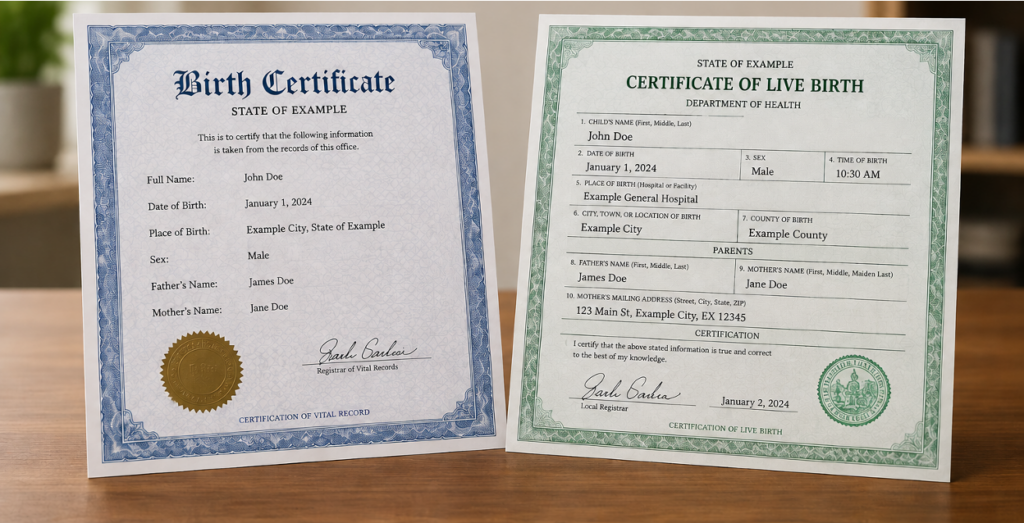
- A birth certificate and a certificate of live birth are two distinct documents: the certificate of live birth is a medical record created by hospital staff, while the birth certificate is an official legal document issued by the state’s vital records office.
- Only the official birth certificate carries legal weight; it is printed on security paper, bears a government seal and registrar’s signature, and is recognized by federal agencies, including the State Department and Social Security Administration (SSA).
- The certificate of live birth has no legal standing; it cannot be used as primary identity evidence to apply for a passport, initiate a legal name change, or establish citizenship.
- Use cases differ sharply: the official birth certificate is required for passports, Real ID, school enrollment, military service, marriage licenses, and inheritance claims, while the certificate of live birth is limited to hospital record-keeping and initiating birth registration.
- At The Freedom People, we offer a free course covering the constitutional framework for double-authenticating your birth certificate and understanding the standing that comes with it.
Birth Certificate vs Certificate of Live Birth: Are They The Same Document?
No, a birth certificate and a certificate of live birth are not the same document. A birth certificate is an official legal document issued by your state’s vital records office that establishes your legal identity, your parentage, and your citizenship. Meanwhile, a certificate of live birth is a medical record created by hospital staff to document a live birth. They record the same event, but they carry entirely different legal weight.
The confusion is understandable. Both documents reference a birth and include the child’s name, date of birth, and place of birth. But treating them as interchangeable is a mistake that causes real problems, such as rejected passport applications, denied benefits, and failed identity verification at government offices.
A birth certificate belongs to the legal world, while a certificate of live birth belongs to the medical world. They record the same event, but they serve entirely different purposes and carry completely different weight in the eyes of the law.
| The Freedom People: Reclaim Your Freedom Through Education & Structure Empowering Families & Individuals | 5★ Google Rating  Operate by Design, Not by Default: Learn how to navigate legal, financial, and administrative systems with intention—not ignorance. Understand natural law vs. statutory law, private vs. public operation, and sound money strategies. Protect your assets, identity, and decision-making through education, not evasion. What You’ll Discover: ✓ Trust structures and asset governance strategies ✓ Bitcoin and alternative payment systems for long-term wealth ✓ Status and standing clarification to reduce regulatory exposure ✓ Private domain operation while engaging public systems strategically Your freedom requires responsibility and structure. Start building both today. Book Your FREE Consultation → |
What Is a Certificate of Live Birth?
A certificate of live birth is the first document issued upon a baby’s birth, typically completed by hospital staff. It is a medical record, not a legal one.
The hospital fills it out to document a live birth, including the date, time, location, attending physician, and basic identifying information for the baby and parents. That information is then submitted to the state’s vital records office to begin the administrative process.
Think of it as the intake form that sets everything else in motion. Once the vital records office receives and processes the certificate of live birth, it uses that data to generate the official legal document, the birth certificate. The certificate of live birth is primarily a data entry and record-keeping tool. It is not designed to serve as proof of identity, and it was never intended to.

What Is a Birth Certificate?
A birth certificate is the official legal document issued by the government, specifically, the state’s vital records office, after processing the certificate of live birth. This is the document that legally establishes your identity. It carries the weight of the state, is printed on security paper, and features a raised or embossed seal that authenticates it as a government-issued record.
The original birth certificate is retained and stored permanently at the vital records office. The family receives a certified copy, which is the version used for all legal and identification purposes throughout a person’s life. That certified copy is what you need when applying for a passport, enrolling in school, claiming government benefits, or proving citizenship.
Birth Certificate vs Certificate of Live Birth: Differences in Legal Status
The single most important distinction between these two documents is legal status. The birth certificate verifies who you are, including your legal identity, your name, your parentage, and your citizenship status, while the certificate of live birth verifies that you are medically alive.
Birth Certificate
An official birth certificate derives its legal standing from characteristics that a certificate of live birth lacks. It is issued by a government vital records office, not a hospital or medical facility, and is printed on certified security paper with anti-fraud features.
A birth certificate typically bears an official raised, embossed, or multicolored seal from the issuing state and includes the registrar’s signature as an authorized government official. It is also assigned a state file number, which can be verified through official records, and is recognized by federal agencies, including the State Department, SSA, and the Department of Homeland Security.

Certificate of Live Birth
The certificate of live birth was never designed to function as a legal document. Its purpose ends the moment the vital records office receives it and begins processing the official birth certificate. After that point, the certificate of live birth becomes a background record. It is useful for medical history and data purposes, but is legally inert.
Because it lacks a government seal, official authentication, and legal standing, the certificate of live birth is not accepted by the U.S. Department of State as primary evidence of citizenship for passport applications, and is not accepted by the Social Security Administration as proof of identity. It will not satisfy the REAL ID Act requirements, and it cannot be used to initiate a legal name change, claim inheritance rights, or establish citizenship.
Use Cases For Each Document
Knowing which document to bring is where this distinction becomes completely practical. Using the wrong one does not just slow things down. In many cases, it results in an outright rejection, forcing you to start the process over.
Accepted Use Cases for an Official Birth Certificate
The official birth certificate is commonly required in many situations where you need to prove your identity to a government agency or legal institution. Common scenarios include:
- Enrolling in school or applying to universities, though schools are federally prohibited from denying enrollment solely because a birth certificate is unavailable, and most jurisdictions accept alternative proof-of-age documents.
- Applying for Social Security benefits or a Social Security card.
- Obtaining a state-issued driver’s license or ID card under REAL ID requirements.
- Applying for a passport, U.S. citizenship, or naturalization documentation.
- Filing for legal name changes through the court system.
- Claiming inheritance rights or executing a will.
- Applying for military enlistment.
- Applying for a marriage license (required in some states) or as supporting documentation in certain legal proceedings.
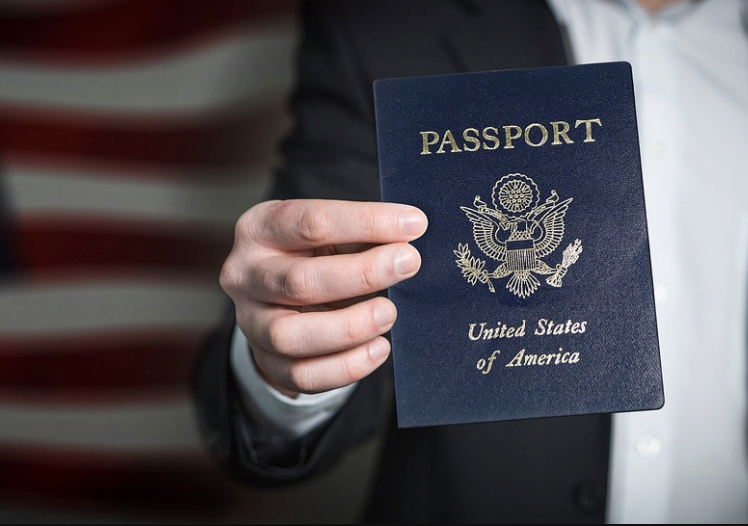
Beyond passports and IDs, legal proceedings such as probate, adoption, and custody cases frequently require an official birth certificate as foundational proof of identity and parentage.
Financial institutions may also require one when establishing trust accounts or verifying beneficiary information. In every one of these situations, a certificate of live birth will be turned away at the door.
Accepted Uses for a Certificate of Live Birth
The certificate of live birth has a narrow and specific role. Its accepted uses are limited primarily to the administrative and sentimental:
- Hospital record-keeping and internal medical documentation.
- Initiating the birth registration process with the state vital records office.
- Personal keepsake or family records.
- In some limited cases, confirming a birth occurred for non-legal, non-governmental purposes.
Beyond these uses, the certificate of live birth serves its practical purpose. It cannot serve as a substitute for the official birth certificate in any government, legal, or identity verification context.
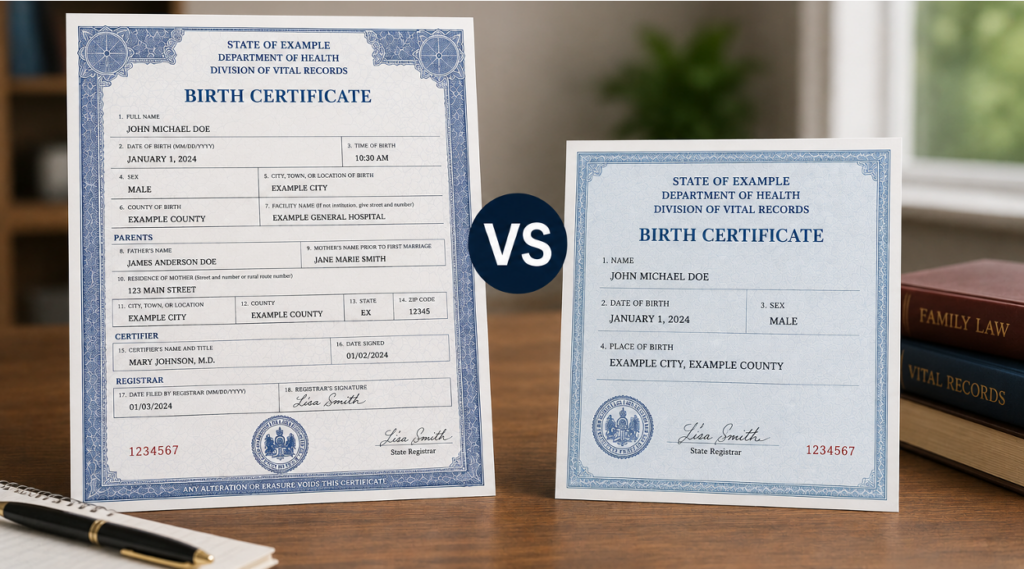
Birth Certificate vs Certificate of Live Birth: Comparison Table
| Feature | Certificate of Live Birth | Official Birth Certificate |
| Issued by | Hospital / Medical Staff | State Vital Records Office |
| Legal Status | Unofficial | Official Legal Document |
| Security Features | None | Raised seal, security paper, registrar signature |
| Primary Purpose | Medical record & data entry | Legal identity verification |
| Accepted for Passport | No | Yes |
| Accepted for REAL ID | No | Yes |
| Accepted for Social Security | No | Yes |
| Original Stored At | Administrative records | Vital Records Office |
| Government File Number | No | Yes |
Reclaim Ownership of Your Birth Certificate with The Freedom People
A certificate of live birth records a medical event, while an official birth certificate establishes your legal identity. Knowing which document to use saves you time, friction, and rejected applications.
But there’s a deeper layer most people miss: even your “official” birth certificate is just a certified copy of a record the state still owns. At The Freedom People, we offer a free course that walks you through the lawful, constitutional process for getting a double-authenticated copy of your birth certificate and reclaiming true ownership of your name, identity, and standing.
Ready to take real ownership of your legal identity? Book your FREE consultation.
Frequently Asked Questions (FAQs)
Can I use a certificate of live birth to get a passport?
No. The U.S. Department of State does not accept an unofficial hospital-issued certificate of live birth as primary evidence of citizenship for a passport application. To apply for a U.S. passport, you must submit a certified copy of your official birth certificate, issued by your state’s vital records office, printed on security paper, and bearing a raised or embossed government seal along with the registrar’s signature.
Are a birth certificate and a certificate of live birth the same thing?
No, they are not the same thing. A certificate of live birth is an unofficial medical record created by hospital staff to document a live delivery. A birth certificate is an official legal document issued by the state government that establishes your legal identity. They record the same event but serve entirely different purposes and carry completely different legal weight. One opens doors. The other does not.
Can a certificate of live birth be used as a REAL ID?
No. A certificate of live birth does not meet the REAL ID Act of 2005’s documentation standards. When you apply for a REAL ID-compliant driver’s license or state identification card, the issuing agency is required by federal law to verify your identity using documents that meet specific authenticity standards. A hospital-generated certificate of live birth does not qualify.
What happens if I only have a certificate of live birth and not a birth certificate?
If you only have a certificate of live birth, you are not without options, but you do have a gap in your official documentation that needs to be addressed before you can complete most government or legal processes. The certificate of live birth confirms that your birth was recorded in the system, indicating that the official birth certificate is on file at the vital records office. You simply need to request a certified copy.
How can The Freedom People help me get true ownership of my name and identity?
At The Freedom People, we help you close the gap between holding a certified copy of your birth certificate and actually owning the legal identity it represents. Through our free course, you learn the step-by-step process for obtaining a double-authenticated copy of your birth certificate that stands on par with the original. This puts the document that defines your legal identity back in your hands rather than leaving it stored exclusively in a state vital records office.
*Disclaimer: This article is for educational purposes only and is not intended as legal, financial, or tax advice. Always consult qualified legal or financial professionals for guidance. For details about our educational services, visit The Freedom People Services.






You must be logged in to post a comment.