


Long Form vs Short Form Birth Certificate: Differences, Uses & Requirements

Key Takeaways
- Long form and short form birth certificates differ in content, legal standing, and accepted use cases; the key areas covered are what each document contains, when each is required, and how to obtain them.
- The long form is a complete certified copy that includes parental details, hospital information, and physician records; it is required for passports, Real ID compliance, U.S. Citizenship and Immigration Services (USCIS) immigration filings, and most court proceedings.
- The short form is a condensed abstract with only basic identifying details; it is sufficient for school enrollment, youth sports, and basic I-9 Employment Eligibility Verification List C purposes, but is rejected for all federal and most legal applications.
- Both forms are requested from the state’s vital records office with proof of identity; when in doubt, always request the long form since it is accepted everywhere the short form is, but not vice versa.
- The Freedom People offer a free Birth Certificate Double Authentication course that walks you through the lawful, constitutional process for reclaiming true ownership of your name and identity beyond simply holding a certified copy.
Long Form vs Short Form Birth Certificate: What You Need To Know
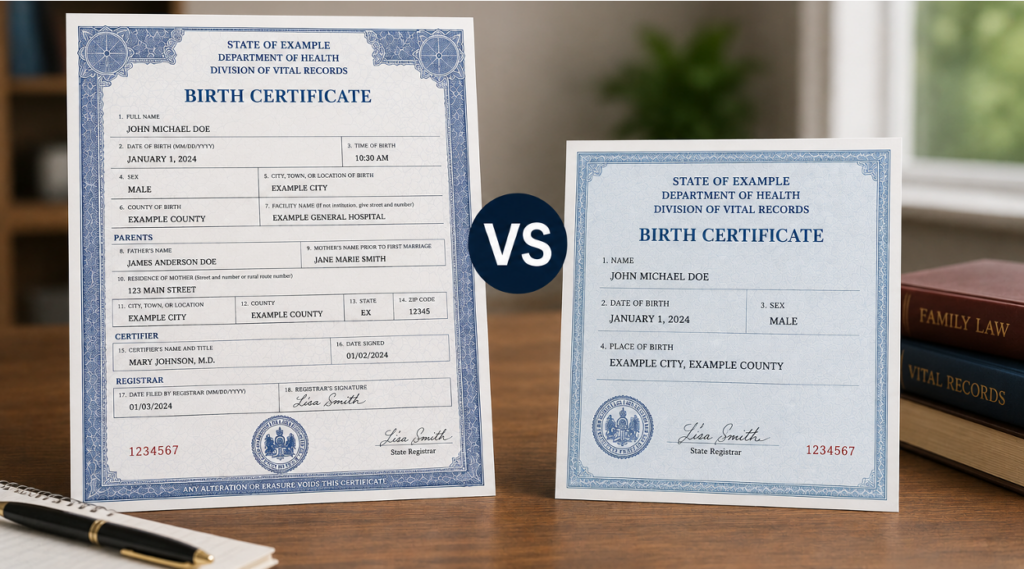
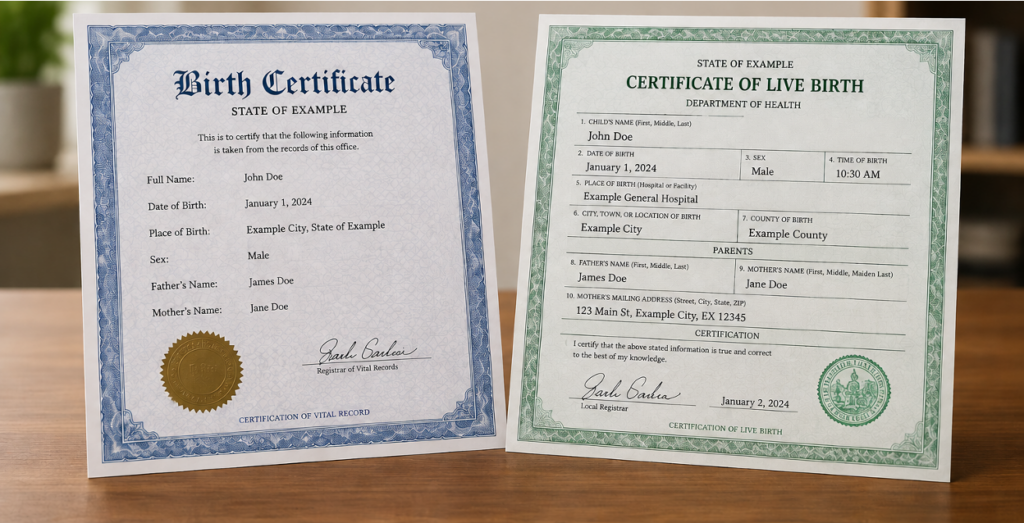
The long form is a complete certified copy of your original birth record, while the short form is a condensed abstract that omits parental information, hospital data, and physician details. They come from the same underlying registry but are not interchangeable.
Federal agencies, including the U.S. Department of State, the Department of Motor Vehicles (DMV), and U.S. Citizenship and Immigration Services (USCIS), almost always require the long form. The short form only holds up for low-stakes verification like school enrollment or basic employment checks. Using the wrong one does not just slow things down; in many cases, it results in an outright rejection.
We cover both documents in full detail below, including use cases, requirements, and a side-by-side comparison. And if you want to go beyond simply knowing which form to use, The Freedom People’s free Birth Certificate Double Authentication course teaches you the constitutional process for reclaiming true ownership of the identity record behind both documents.
| The Freedom People: Reclaim Your Freedom Through Education & Structure Empowering Families & Individuals | 5★ Google Rating  Operate by Design, Not by Default: Learn how to navigate legal, financial, and administrative systems with intention—not ignorance. Understand natural law vs. statutory law, private vs. public operation, and sound money strategies. Protect your assets, identity, and decision-making through education, not evasion. What You’ll Discover: ✓ Trust structures and asset governance strategies ✓ Bitcoin and alternative payment systems for long-term wealth ✓ Status and standing clarification to reduce regulatory exposure ✓ Private domain operation while engaging public systems strategically Your freedom requires responsibility and structure. Start building both today. Book Your FREE Consultation → |
What Is a Long Form Birth Certificate?
A long-form birth certificate, sometimes called a certified copy or full birth record, is a complete reproduction of the original entry made in the birth registry at the time of your birth. It is the most detailed and comprehensive birth certificate available.
This document typically includes the following information:
- Full legal name of the child at birth.
- Date, time, and place of birth (city, county, and state).
- Sex assigned at birth.
- Full names of both parents.
- Parents’ ages, birthplaces, and occupations at the time of birth.
- Name and signature of the attending physician or midwife.
- Hospital name and address.
- Official state registrar’s signature and seal.
- Filing date with the vital records office.
Long-form certificates are produced directly from the original birth ledger or electronic registry held by the state’s vital records office. Because the document reflects the source record in its entirety, it carries the highest level of legal authority and is accepted by federal agencies, courts, immigration authorities, and financial institutions.
What Is a Short Form Birth Certificate?
A short-form birth certificate is an officially issued abstract or extract of your birth record. It is generated from the same underlying registry data as the long form but only displays a limited subset of that information. It typically includes:
- The child’s name.
- Date of birth.
- Place of birth and sex.
- Issuing the state’s seal or certification stamp.
Short-form certificates are sometimes called abstracts or certified abstracts, depending on the state. They are designed for convenience: they are easier to carry, faster to process, and less likely to expose sensitive family information, such as parental details. However, that convenience comes at a cost in terms of where they are accepted.
Not every state even issues a short-form certificate. States like Texas and New York offer both versions, but other states issue only one standardized birth certificate format. Before requesting a copy, it is worth confirming with your state’s vital records office which formats are available to you.
Use Cases: When You Need a Long Form Birth Certificate
Passport & International Travel Applications
The U.S. Department of State requires a certified long-form birth certificate when applying for a first-time U.S. passport. The document must show full parental information and bear an official state registrar’s signature and raised or multicolored seal.
For minors applying for passports, both parents’ names appearing on the long-form certificate are often used to verify parental consent requirements, making the long form especially critical in those applications.
REAL ID & Federal Identification Requirements
The REAL ID Act of 2005 established minimum security standards for state-issued driver’s licenses and identification cards. Your state DMV requires you to present a certified birth certificate as proof of identity and lawful status. In most cases, this means the long-form version, as it contains all the required data points.
If your driver’s license is not yet REAL ID-compliant, a long-form birth certificate is one of the primary documents you will need to bring to your DMV appointment to get that compliance status. Check your state DMV’s specific document checklist in advance, as some require additional supporting documents in addition to your birth certificate.
Immigration & Citizenship Applications
U.S. Citizenship and Immigration Services (USCIS) requires certified long-form birth certificates for virtually all immigration-related petitions and naturalization applications. Documents submitted must be accompanied by a certified English translation if the original is in another language, and both the original certified copy and the translation must be submitted together.
A short-form certificate will almost certainly trigger a Request for Evidence (RFE) from USCIS, adding months to your processing timeline. The long form eliminates this risk by providing all the data points USCIS needs in a single document.
Legal Proceedings & Court Requirements
Courts handling matters such as probate, guardianship, name changes, and adoption almost universally require long-form birth certificates because the complete record establishes a traceable legal identity.
In adoption proceedings, both the original long-form birth certificate and any amended certificate issued after adoption may be required to document the legal chain of identity.

Use Cases: When a Short Form Birth Certificate Is Enough
School Enrollment & Age Verification
Most public schools and colleges accept a short-form birth certificate when enrolling a new student. The school primarily needs to confirm the student’s name, date of birth, and that they are who they claim to be, all of which appear on the short form.
Similarly, short-form certificates are useful for proving age in situations like youth sports registration or library card applications. These are low-stakes identity checks in which the abbreviated data is sufficient.
Basic Employment Verification
For the I-9 Employment Eligibility Verification form, a birth certificate can serve as a List C document to establish employment authorization.
However, a birth certificate alone only satisfies the List C requirement (proof of work authorization), not the List A requirement (combined identity and work authorization). For this specific use, a short-form birth certificate may be accepted, but employer policies vary.

Requirements for Both Document Forms
Requirements for Long Form Birth Certificates
To obtain a long-form birth certificate, you must request it directly from the vital records office of the state where you were born. Each state has its own process, but most require you to submit a formal application along with proof of identity, your relationship to the subject of the record (yourself, a child, or a legal guardian), and payment of the applicable fee.
Processing times vary by state, typically ranging from a few days for expedited requests to several weeks for standard processing.
Requirements for Short Form Birth Certificates
Short-form birth certificates are obtained through the same vital records office as the long form and require similar identification and eligibility documentation. The request process is nearly identical.
The difference is simply that you are requesting an abstract or extract rather than a full certified copy. In states that offer both formats, the short form is often slightly less expensive and may process faster.
The short form must include the name, date and place of birth, sex, and the state’s certification stamp, but is not required to display parental or medical details.
Long Form vs Short Form Birth Certificate: Comparison Table
| Feature | Long Form Birth Certificate | Short Form Birth Certificate |
| Full legal name | ✓ Yes | ✓ Yes |
| Date and place of birth | ✓ Yes | ✓ Yes |
| Sex at birth | ✓ Yes | ✓ Yes |
| Parents’ full names | ✓ Yes | ✗ No |
| Parents’ ages and birthplaces | ✓ Yes | ✗ No |
| Attending physician/midwife | ✓ Yes | ✗ No |
| Hospital name and address | ✓ Yes | ✗ No |
| Official state seal and registrar signature | ✓ Yes | ✓ Yes (varies by state) |
| Accepted for U.S. passport applications | ✓ Yes | ✗ No |
| Accepted for REAL ID | ✓ Yes | ✗ No |
| Accepted for USCIS immigration filings | ✓ Yes | ✗ No |
| Accepted for school enrollment | ✓ Yes | ✓ Yes |
| Accepted for basic employment verification | ✓ Yes | ✓ Yes (varies by employer) |
| Available in all U.S. states | ✓ Yes | ✗ Not in all states |
Reclaim Your Name & Identity with The Freedom People
Knowing whether to request a long form or a short form is the surface-level decision. The deeper question is who actually owns the record either document is copied from, and the answer, in most cases, is the state, not you.
At The Freedom People, we offer a free Birth Certificate Double Authentication course that walks you through the lawful, constitutional process for reclaiming true ownership of your name and identity. It’s the next step for anyone ready to operate by design rather than by default.
Ready to take real ownership of your legal identity? Book your FREE consultation.
Frequently Asked Questions (FAQs)
Can I use a short form birth certificate for a U.S. passport application?
No. The U.S. Department of State requires a certified long-form birth certificate for first-time passport applications submitted on Form DS-11. The document must include the applicant’s full name, date and place of birth, and parental information, along with an official state registrar’s signature and seal. A short-form abstract does not meet these requirements and will result in your application being returned unprocessed.
Does every state issue both long form and short form birth certificates?
No, not every state issues both formats. States like New York and Texas offer both long-form certified copies and short-form abstracts, but many states (such as California and Maryland) only issue one standardized certified copy format.
Is a long form birth certificate the same as a certified copy?
In most cases, yes, but the terminology can vary by state. A certified copy is a reproduction of the full original birth record that bears an official state seal and registrar signature, making it legally valid for official use. In states that issue both formats, the certified copy is typically the long-form version because it reproduces the complete original entry. However, some states issue certified copies of their abstract format, which would technically be a certified short form.
Can a short form birth certificate be used for an I-9 Employment Eligibility Verification Form?
A birth certificate, whether long form or short form, can only satisfy the List C requirement on Form I-9, which establishes employment authorization. It does not, on its own, satisfy the List A requirement. That means you would still need to present a separate List B document (such as a state driver’s license or ID) to establish identity, in addition to the birth certificate. Some employers may accept either format for this purpose, but individual employer policies vary.
What can I Learn from The Freedom People’s Birth Certificate Double Authentication Course?
The Freedom People’s Birth Certificate Double Authentication course teaches you the detailed process for obtaining a double-authenticated copy of your birth certificate that is on par with the original. Beyond the practical steps, the course provides a concise explanation of the constitutional framework through which you can lawfully reclaim your name, along with a brief history of the actions and laws that have shaped the current system.
*Disclaimer: This article is for educational purposes only and is not intended as legal, financial, or tax advice. Always consult qualified legal or financial professionals for guidance. For details about our educational services, visit The Freedom People Services.






You must be logged in to post a comment.