


The Bill of Rights Series

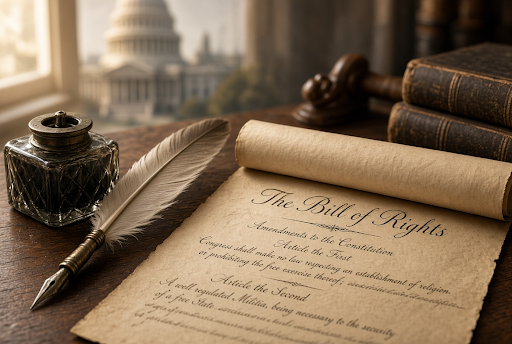
Amendment I: The Government Does Not Grant Free Speech. It Can Only Take It Away.
Part 1 of a 10-part series examining the Bill of Rights — and the federal record of violating it.
The First Amendment does not give Americans the right to free speech. It acknowledges that the right already exists and instructs the federal government to leave it alone.
That distinction is not academic. Rights that governments grant, governments can revoke. Rights that preexist government are a different problem — they must be taken, not simply withheld.
The text does not hedge:
“Congress shall make no law respecting an establishment of religion, or prohibiting the free exercise thereof; or abridging the freedom of speech, or of the press; or the right of the people peaceably to assemble, and to petition the Government for a redress of grievances.”
No law. Not few laws. Not reasonable laws. No law.
What It Actually Protects
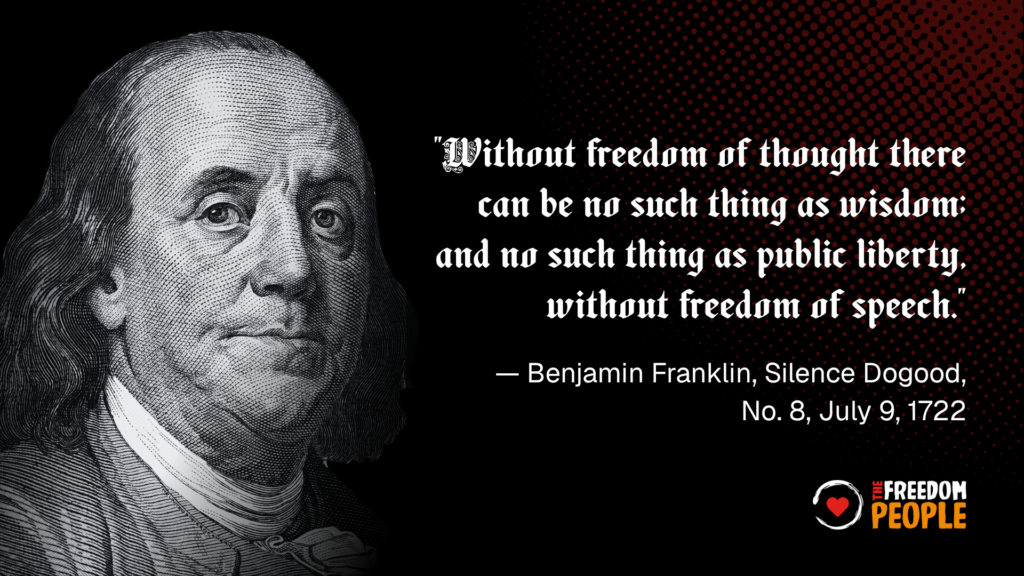
Free speech does not exist to protect popular ideas. Popular ideas need no protection — they are already cheered by majorities and reprinted without risk. The First Amendment exists for the ideas that make those majorities uncomfortable.
The same logic applies to religion. The majority faith in any society does not require a constitutional guarantee. It is the minority practice — the one bureaucrats find inconvenient — that the free exercise clause was written for.
Government-established religion does not require a state church. It requires only that government begin sorting which beliefs deserve accommodation and which do not. Once that sorting power is conceded, the establishment clause has already lost its meaning.
What the Federal Government Has Actually Done
The Sedition Act of 1798 — passed seven years after the First Amendment was ratified — made it a crime to publish criticism of the government. It was enforced almost entirely against political opponents of the Adams administration. A sitting member of Congress was prosecuted. The law expired before the Supreme Court ruled on it.
The pattern did not change. The Espionage Act of 1917 and Sedition Act of 1918 imprisoned men for distributing anti-war pamphlets and criticizing the draft. The Supreme Court upheld the convictions. It took until Brandenburg v. Ohio in 1969 — fifty-two years later — for the Court to hold that political speech could only be prosecuted when it was directed at producing imminent lawless action and was likely to do so. Fifty-two years is a long time to wait for the Constitution to mean what it says.
COINTELPRO ran from the mid-1950s through 1971. The FBI used infiltration, forged documents, and anonymous accusations against civil rights organizations, antiwar groups, and political dissidents. No statute authorized it. The Senate’s Church Committee later confirmed it was designed to undermine First Amendment rights. The absence of a law was not an oversight — operating without one meant operating without a paper trail.
Congress’s response to Texas v. Johnson (1989), which protected flag burning as symbolic speech, was to pass the Flag Protection Act — a federal statute written to accomplish through legislation what the Court had just said the Constitution forbids. The Court struck it down the following year. The sequence is instructive: a right is confirmed, Congress legislates around the ruling, the Court invalidates the legislation. This is not dysfunction. It is what happens when one branch refuses to accept that a limit is a limit.

The Modern Version
By the early 21st century, direct censorship statutes had become harder to pass and easier to challenge. The government found an indirect route.
Beginning in late 2022, internal Twitter documents showed that the FBI, Department of Homeland Security, and Office of the Director of National Intelligence held regular — often weekly — meetings with Twitter’s content moderation staff. They transmitted lists of accounts and posts for review. Topics flagged included the 2020 election, COVID-19 policy, vaccine content, and the New York Post’s pre-election reporting on Hunter Biden’s laptop. The FBI made payments to Twitter for processing the requests.
Twitter is a private company. The First Amendment, as traditionally applied, restricts government actors — not private platforms. That distinction describes precisely the mechanism these arrangements were built to exploit. If the government cannot suppress speech directly, it can tell the platforms which speech it dislikes and let the platforms act. The legal exposure is different. The practical result is not.
The Supreme Court took up related litigation in Murthy v. Missouri (2024) and dismissed it on standing grounds, leaving the constitutional question unanswered. What the case did not resolve, the documents established: sustained, taxpayer-funded coordination between federal agencies and private platforms to shape what Americans could read and say online.
The trade-off is straightforward. Agencies argued that combating misinformation required platform engagement. What that required giving up was the independence of those platforms from government preference — and with it, the independence of public discourse. That exchange was made administratively, without legislation, without a public vote, and largely without public knowledge until the documents were released.
On Intentions
Every administration that has prosecuted speech or pressured platforms believed it was acting against something genuinely dangerous. The Adams administration believed its critics were French agents. The Wilson administration believed anti-war organizers were undermining national survival. The FBI believed the groups it infiltrated were existential threats to public order.
Intentions are not the relevant variable. Results are.
When government decides what can be said, it has already decided what can be thought. It does not matter whether that decision arrives as a statute, a prosecution, or a weekly content moderation meeting. The mechanism differs. The power is the same.
The First Amendment was written for precisely the moments when restricting speech seems most justified — not for the quiet years when no one is tempted to try.
Next: The Second Amendment — what “well regulated” actually meant in 1791, and what the federal government has done with it since.




You must be logged in to post a comment.