


Self Custody Dealt a Major Blow


A firmware flaw buried inside Coldcard devices has vaporized nearly ninety million dollars of Bitcoin in the span of three days. It didn’t happen all at once. It happened in waves. Wave one hit July 31 — 594 BTC, roughly thirty-eight million dollars, drained from about five hundred wallets in a twenty-five-minute window. Two more waves followed. By today, Galaxy Research has traced the damage to 1,367 BTC — approximately eighty-eight million dollars — swept from 4,585 addresses. This is not a rumor. This is not a worst-case estimate. This is the confirmed, ongoing total, and it is still moving.
Seeds generated on affected Coinkite hardware since March 2021 carried far less entropy than the device promised. What should have been cryptographically hard became computationally trivial. Attackers reconstructed private keys and swept thousands of addresses clean. Coinkite confirmed the failure, accepted full responsibility, and shipped emergency firmware. The update protects future seeds. It does nothing for the ones already created. Those seeds are permanently compromised. Funds must move to new keys or they remain exposed.
Most people still do not understand entropy. Entropy is the measure of true unpredictability. It is the mathematical distance between order and chaos, the precise quantity of randomness required before a secret becomes unbreakable. In Bitcoin self-custody your seed is not a password you invent. It is a number so large and so random that the universe itself has not seen it before and will never see it again. Twelve or twenty-four words drawn from a proper BIP-39 list are simply a human-readable encoding of that number. The security lives entirely in the entropy that created it.
High entropy means every possible combination is equally likely. A 128-bit seed sits inside a space of roughly 340 undecillion possibilities. That is more combinations than atoms in the observable universe. Brute-forcing it is not difficult. It is impossible within the lifetime of stars. Coinkite’s own technical disclosure puts the real number in stark relief: the Coldcard Mk3 was operating with roughly 40 bits of effective entropy. The Mk4, Mk5, and Q models fared only somewhat better, at approximately 72 bits. Against the 128-bit standard a proper seed demands, that is not a small gap. It is the difference between a secret and a lookup table. The Coldcard was supposed to pull fresh, high-quality randomness from its hardware generator. A silent build error switched it to a predictable software fallback instead. The resulting seeds carried a fraction of the entropy the hardware promised. Attackers did not need to hack the device. They only needed to reconstruct the weakened number space and sweep every wallet that had been born inside it.
This is not the death of self-custody. It is the exposure of a single point of failure that too many people treated as invincible.
The Bitcoin community responded with urgency and solidarity. Coinkite’s own leadership issued a public apology and pleaded with the network to help reach affected users because the company holds no customer database. Prominent voices across the space sounded the alarm in real time, urging anyone who knows a Coldcard holder to call or text them directly rather than assume the message had already landed. Researchers tracked the ongoing waves of sweeps, shared address patterns, and offered direct assistance to victims filing reports or reconstructing what was lost. The response was not panic. It was coordinated, calm migration guidance: update to fixed firmware, generate an entirely new seed, verify the backup on the device screen, send a small test transaction, then move the balance. The community treated every remaining exposed seed as a race against time and met that race with collective action.
Here is the deeper lesson. Bitcoin’s core mantra has always been verify, don’t trust. Trusting any single wallet manufacturer with the complete security of your coins is not fundamentally different from leaving those same coins on an exchange. Both decisions outsource the critical layer of protection to a third party. Both introduce a single point of failure. Both convert sovereignty into a promise that can be broken by one unnoticed error. The Coldcard incident simply made the parallel impossible to ignore. True self-custody is not the act of buying a device and writing down words. It is the continuous verification of every assumption, the refusal to grant any vendor complete control over the entropy that protects your future, and the deliberate construction of systems that survive the failure of any one component.
Coldcard’s entropy collapse was specific to its own seed-generation path. Block, Trezor, and Ledger have all confirmed their products are unaffected. The Bitcoin network itself never blinked. The cryptography held. The protocol held. What failed was one manufacturer’s implementation of randomness on one class of device. That distinction matters. Treating every cold wallet as identical is how people end up replaying the same mistake under a different logo.
Single-signature wallets concentrate every risk into one secret. One bad firmware build. One predictable seed. One successful reconstruction. The entire stack is gone. Multisig changes the equation. Two or three independent keys must collude before value moves. A flaw in one device, one seed, or one vendor no longer equals total loss. The architecture itself becomes the defense. Mathematical redundancy replaces faith in any single manufacturer.
Bitkey ships as multisig by default. Three keys. Hardware device. Phone. Recovery key held by the service. Any two move the coins. The user always controls a majority. No single seed phrase exists to lose or leak. Lose the phone or the device and the remaining keys still recover the stack. That is the model built for the world we actually live in, not the idealized one where every firmware audit is perfect forever.
Not ready for multisig yet? Then stop concentrating everything on one vendor’s hardware. Multiple wallets. Multiple manufacturers. Separate seed generation. Geographic and operational separation. The next best defense after true multisig is deliberate diversification so that no single company’s mistake can touch the entire position.
For those building multi-vendor setups or segregating holdings, proven options include Ledger devices, Trezor hardware, Blockstream Jade, SeedSigner, and Foundation Passport. Each can serve as an independent signing device in a multisig quorum or as a separate single-sig vault for coin segregation. Combining devices from different manufacturers eliminates the single-vendor risk that just cost the network nearly ninety million dollars. Nunchuk gives users full control to construct their own multisig quorums with whatever combination of these hardware options they trust, free of KYC friction and with inheritance tools that outlive the company itself. Casa wraps professional-grade 2-of-3 or 3-of-5 vaults in an interface that removes the operational burden while still leaving the user holding the decisive keys and providing structured inheritance. Both exist because single-device reliance was never the endgame.
Coinkite’s failure will force the entire self-custody stack forward. Entropy generation will face harder scrutiny. Open-source review will intensify. Defaults will migrate toward multisig. Users who treated a single cold device as the finish line will learn that sovereignty is a system, not a product. The ones who adapt will emerge with stronger architecture than they had before the drain. Bitcoin’s fixed supply does not care about any one company’s firmware. It only rewards those who refuse to leave their future dependent on a single point of failure.
July’s Green Candle and the August Crossroads
Bitcoin closed July at $62,814. That is a clean 7.3 percent gain for the month, turning what had been a brutal June into a green monthly candle. Price recovered from the high fifty-thousands and spent the final weeks of July oscillating between the low sixties and the mid-sixties. As of early August the market sits near sixty-three thousand dollars, still roughly fifty percent below the all-time high near one hundred twenty-six thousand printed in October 2025. That is the scoreboard. The question is what the next thirty days and the next three months will write next.
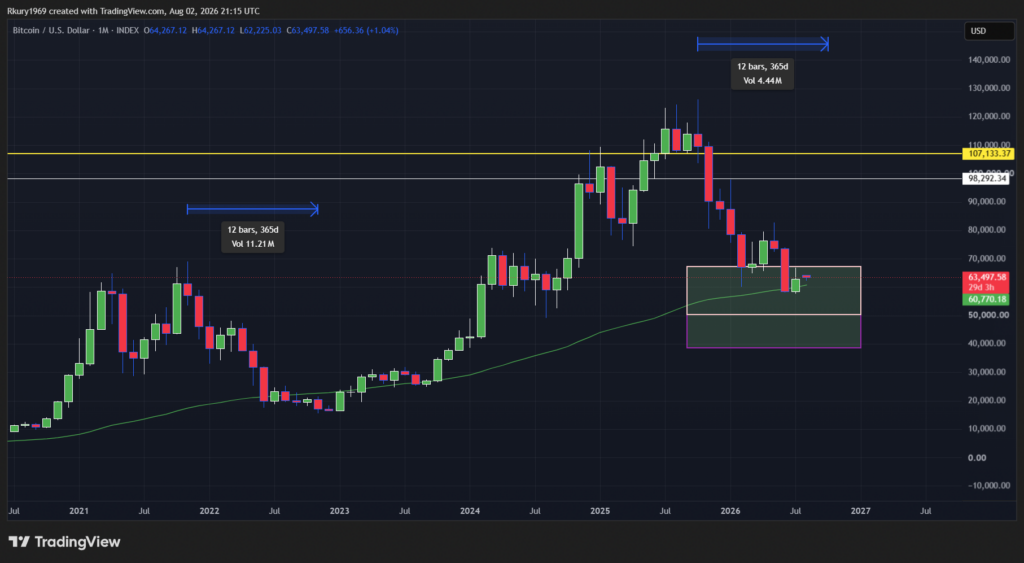
Here is where history earns its seat at the table. This is a midterm year, and Bitcoin has been through three of these before. In 2014, August delivered a 17.6 percent loss. In 2018, a 9.3 percent loss. In 2022, a 13.9 percent loss. Three midterm Augusts, three red candles, averaging out to a decline of roughly 13.6 percent. There is no ambiguity in that pattern. If it repeats exactly on schedule, the arithmetic points toward the mid-fifties before September opens. Respect that history. Do not treat it as fate.
Because the deeper pattern tells a second story, and it is the one that matters more. Each of those three cycles eventually carved out a maximum drawdown from its prior all-time high — roughly 86 percent in the 2014 cycle, 84 percent in 2018, and 77 percent in 2022. The trend across three consecutive cycles is unmistakable: the damage gets shallower every single time. Bitcoin sits at approximately 50 percent below its October 2025 peak right now. If the pattern of shrinking drawdowns holds, this cycle should not need to revisit anything close to the carnage of 2014, 2018, or 2022 to complete itself. A market that used to lose four-fifths of its value now needs to lose barely half to reach the same stage of the cycle. That is not noise. That is a maturing asset absorbing its own volatility one halving at a time.
The low near fifty-seven to fifty-eight thousand in early July has held. Multiple tests of that zone failed to produce a decisive breakdown. Long-term holders absorbed supply. On-chain distribution slowed. The structure leaves open the possibility that the cycle low already printed. The probability that fifty-seven thousand was the final bottom sits in the forty to fifty percent range right now. It is not certainty. It is a live thesis that requires price to defend the sixties and reclaim higher levels with volume. If that defense holds through August, the odds rise sharply that the worst is behind us.
There is still a meaningful chance of another leg lower, and the midterm-year record above is exactly why. Resistance clusters between sixty-five and sixty-seven thousand. A failure to clear that band, combined with continued soft ETF flows and macro pressure, keeps the door open to a retest of sixty thousand and potentially a deeper probe toward the mid-fifties. Assign that scenario a thirty to thirty-five percent probability. The remaining probability mass sits in range-bound chop that resolves higher only after more time has passed.
The four-year cycle remains the dominant framework for many serious observers. Historically the market has bottomed twelve to thirteen months after the cycle peak. That clock points to October or November 2026 as the window of highest probability for a durable low — the same window, notably, that has closed out every completed midterm cycle before it. Some models place the eventual floor between forty and fifty-five thousand if the classic pattern plays out in full. Others argue the institutional overlay and the shallower drawdown so far have already altered the amplitude. The cycle has not been invalidated. It simply has more work to do before the next expansion phase can begin with conviction.
This is the environment in which accumulation decisions must be made. Bitcoin’s supply is fixed. Every coin that changes hands at these levels is a coin that leaves weaker hands and enters stronger ones. Dollar-cost averaging through the current range is the disciplined expression of that reality. Waiting for a mythical lower low risks missing the turn entirely if the fifty-seven thousand zone proves to be the floor. Holding dry powder for a potential flush is rational only if the size of that reserve is sized as a secondary tranche rather than the primary strategy. The mathematical certainty of twenty-one million coins does not pause for perfect timing. The window for acquiring meaningful size at a fifty-percent discount from the prior peak — a discount shallower than any midterm year Bitcoin has ever traded through — will not remain open forever.
August will test whether the July rebound was the first leg of a base or merely a relief bounce inside a larger corrective structure. The answer will be written in price action around sixty thousand and sixty-seven thousand, in the persistence of fear readings, and in whether institutional capital begins to return in size. The long-term trajectory remains unchanged. Scarcity compounds. Time favors the holders who refuse to sell the asset whose supply cannot be increased.
Altcoins — The Oxygen Is Leaving the Room
Most of the altcoin market remains in liquidation mode. Capital is still flowing out of the sector as a whole, both in dollar terms and versus Bitcoin. The majority of projects continue to demonstrate exactly what they always were: speculative vehicles with no durable demand and no path to surviving a prolonged liquidity contraction. The casino phase is ending the only way it can — through attrition.
A small handful of projects are showing different behavior, and the divergence is stark. Solana continues to post record on-chain activity even while its token trades more than sixty percent below its cycle high — June alone saw the network process its busiest month ever, nearly four billion transactions, while the price sat at its lowest point of the year. That is not a coincidence worth glossing over. It is the clearest signal in this entire market: usage and price have decoupled, and usage is telling the truth. Ethereum’s layer-2 stack and real-world asset tokenization pipeline are progressing, albeit slowly, with institutions still exploring the rails even in a risk-off environment. XRP has pulled in meaningful ETF inflows relative to its size — a fourth straight month of positive flows even as the token itself kept falling, institutional buyers accumulating exposure through the wrapper while retail fled the spot price. Hyperliquid has maintained commanding trading volumes on its decentralized perpetuals exchange, regularly capturing more than a third of all on-chain perpetual futures activity, despite its own token weakness.
These are the survivors taking shape. They are not immune to the broader liquidity squeeze, but they are demonstrating real usage and product traction while everything else dies around them. That distinction matters for the next cycle. It is the difference between a project that needed the bull market to exist and one that will still be standing when the bull market returns.
The perils of regulatory silence are now compounding the problem. The CLARITY Act remains stalled in the Senate. Despite clearing the House and advancing through committee, it has not received a floor vote, and the August recess has compressed the window to almost nothing. Without clear statutory rules of the road, capital that might otherwise flow into productive infrastructure stays sidelined. Uncertainty is not neutral. It is a tax on every project that needs institutional participation to scale.
That tax is being paid in real time through the contraction of stablecoin market capitalization. Total stablecoin supply has fallen to approximately three hundred five billion dollars and continues to grind lower — the first sustained contraction the sector has seen in four years. This is the dry powder that lubricates the entire crypto market, and it is shrinking. When it withdraws, every altcoin feels the pressure first and hardest. Liquidity is the oxygen of speculation. When it is withdrawn, the weak simply asphyxiate.
None of this changes the current stance. Until Bitcoin itself stabilizes and global liquidity conditions improve in a sustained way, fresh capital deployment into altcoins remains on hold. Bitcoin first. Dry powder second. Altcoins only after they have earned their place through actual adoption rather than narrative.
The macro shortage of dollars is not a Bitcoin problem. It is the predictable consequence of a financial system built on abundant but poorly distributed fiat credit. Bitcoin’s price is reacting exactly as its design intends — measuring the stress in real time and transferring ownership to those with the conviction to hold the hardest money through the squeeze. The institutions building the rails and accumulating the supply are not waiting for permission or perfect conditions. They are acting while the crowd is still focused on the candles.
Claude AI Bitcoin Market Analysis — August 2026
Where We Stand
Bitcoin trades near $63,400, roughly fifty percent below the all-time high of $126,198 printed on October 6, 2025. July closed at $62,814, a 7.3 percent gain that snapped a two-month losing streak — May down 3.6 percent, June down a brutal 20.4 percent — and put the first green candle back on the board since March. Real progress. Not vindication. The market still has to prove July was the start of a floor, not a bounce inside a longer bleed.
Sentiment Picture
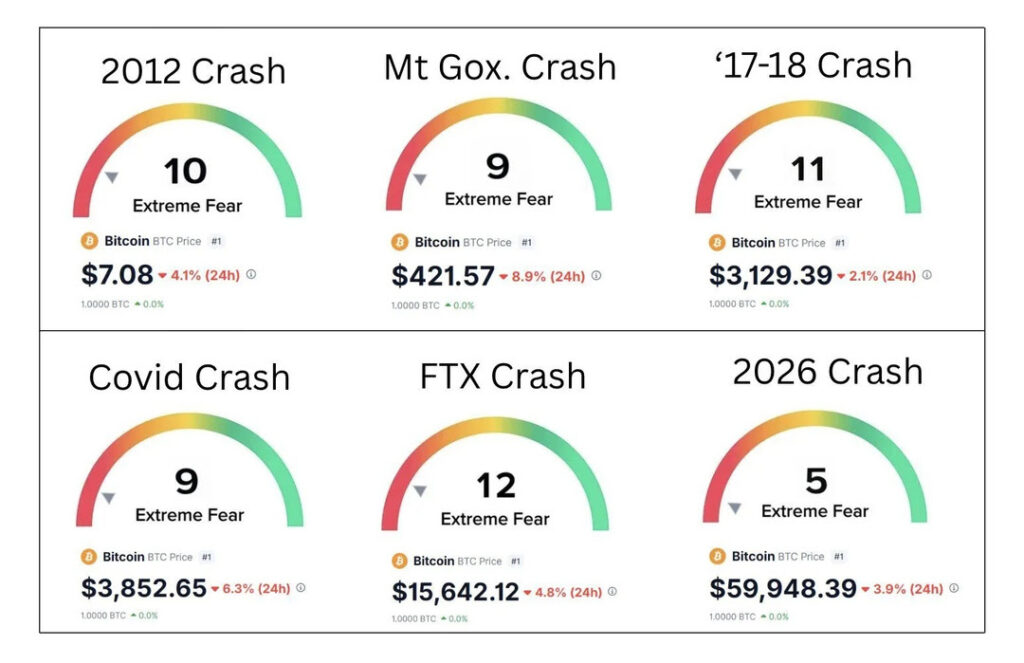
The Fear and Greed Index sits at 27 — Fear, not Neutral — and that number directly contradicts the price action underneath it. Bitcoin just closed a green July and has spent weeks defending the low sixties, while the index stayed stuck in Fear the entire time: 24 in early July, drifting to 26 and 27 by month’s end, never once crossing into Neutral. Sentiment is lagging price by weeks, the same pattern that showed up earlier this cycle. Compare that to the true extremes — an all-time-low reading of 10 in February, a fresh Extreme Fear streak in early June. Twenty-seven is not capitulation. It’s a market that doesn’t yet believe its own recovery, and that gap is exactly where Bitcoin has historically rewarded the patient.
The Critical Divergence
Retail is fearful despite a green month. Institutional behavior is more complicated on top of that. Strategy sold Bitcoin in July — 3,588 BTC, roughly $216 million, the largest single disposal in company history, executed to fund preferred-stock dividends after its cash reserve coverage collapsed from more than seven years to about fourteen months. It still holds 843,775 BTC and hasn’t bought since. The “never sell” doctrine now has an exception on the record. That doesn’t break the institutional thesis — it complicates it. ETF flows told a better story: $172 million net in July, the first positive month in three after May’s $2.43 billion and June’s record $4.51 billion outflows. Weak, but real. Long-term holders kept absorbing supply, and on-chain distribution cooled. Retail fearful, ETFs barely positive, Strategy selling for the first time — three cohorts recalibrating at once, and price quietly outrunning all of them.
Technical Structure
Bitcoin trades around $63,400 against a 52-week range of roughly $57,800 to $126,186. Daily RSI sits near 53, back above neutral after June’s washout. The weekly chart shows a modest bullish divergence against June’s low — a setup that has preceded prior recoveries this cycle, though unconfirmed. Immediate support: $60,000–$62,000, tested repeatedly since June without a break. Deeper floor: $57,000–$58,000, the level that opens a much uglier conversation if it goes. Resistance clusters at $65,000–$67,000, with the 20-week EMA near $69,445 and 200-week EMA near $68,468 forming the ceiling every recovery has hit since October. Reclaiming that band on volume is the clearest signal this market can produce right now.
Macro Overlay
The Fed held rates steady, and derivatives markets now price better than 57 percent odds of a September hike — not a cut — a full reversal from where the year began. The dollar is strong, the yen sits near a 40-year low against it, and every carry-trade squeeze this year has hit Bitcoin within hours. Capital keeps rotating into AI-adjacent equities, pulling liquidity from both Bitcoin and gold. Add the Coldcard fallout from Section 1 — a real hit to self-custody confidence, if not to Bitcoin’s own protocol — and August has more moving parts than any month this cycle.
Seasonality demands respect too. August has closed red in nine of the last thirteen years, four straight from 2022–2025 averaging roughly -10 percent. As a midterm year, the last three comparable Augusts — 2014, 2018, 2022 — averaged -13.6 percent. History isn’t fate. But a green candle, a hawkish Fed, a weak yen, and the market’s worst seasonal month all landing at once earns some humility.
Monthly Outlook: Three Scenarios
Bullish — 30%. Bitcoin defends $60,000–$62,000, ETF flows turn convincingly positive, and price clears $65,000–$67,000 on volume, opening a path through the 20-week EMA near $69,445 — the first real evidence July’s low was the cycle bottom. Requires both a macro reprieve and institutional buying beyond July’s modest inflow.
Neutral — 45%. Bitcoin chops between $58,000 and $65,000 for most of August, digesting July’s gain while the market absorbs Coldcard, the stalled CLARITY Act, and a noncommittal Fed. The least dramatic outcome, and given everything stacked against a clean breakout, the most likely one.
Bearish — 25%. Seasonality and the midterm-year pattern reassert themselves. A confirmed rate-hike signal, a fresh yen shock, or a deeper AI-trade unwind sends Bitcoin back through $60,000 to test $57,000–$58,000. A close below that opens the mid-fifties. Even here, nothing in this cycle’s drawdown — the shallowest on record — supports a repeat of the 70–86 percent collapses of 2014, 2018, and 2022.
The Number That Matters Most
843,775. That’s how many Bitcoin sit on Strategy’s balance sheet — just over four percent of every coin that will ever exist, held by one company, even after its first-ever meaningful sale. Twenty-one million is the entire universe of supply. One company holds one in twenty-five of them. That’s not a trading position. It’s a structural claim on the hardest asset in the world, and it doesn’t unwind because one quarter’s dividend math got tight.
Summary and Strategy
August arrives with a green July behind it and a real crossroads ahead. The technical structure has improved; sentiment hasn’t caught up — Fear at 27 despite a 7.3 percent monthly gain, a gap worth more than most headlines this month. The institutional story is more layered than at any point this cycle: Strategy selling for the first time, ETF flows barely positive, and a seasonal backdrop that has never been kind to Bitcoin in August. Respect all of it. None of it changes the math underneath.
Twenty-one million coins doesn’t move for a hawkish Fed, a weak yen, a stalled bill, or one company’s dividends. It didn’t move through the 86 percent collapse of 2014, the 84 percent collapse of 2018, or the 77 percent collapse of 2022 — each shallower than the last, because the market matures every cycle. This one sits at fifty percent down. If the pattern holds, the floor this time is shallower than anything before it.
Keep accumulating through the range. Size dry powder as a secondary tranche, not the primary strategy — waiting for a perfect bottom that may already be behind you is how conviction turns into regret. Watch $60,000 below and $67,000 above; those two levels will tell you more about September than any headline. Time is still the only edge that compounds for free. Spend it accumulating the asset that cannot be printed, diluted, or replaced.
Final Thoughts
Here is what July handed us on the way into August. A firmware failure at Coinkite proved, in the most expensive way possible, that self-custody is a discipline and not a device — and the community’s response, fast migration guidance instead of panic, showed exactly why this network survives every test thrown at it. Bitcoin itself closed July green for the first time since March, up 7.3 percent, and now stands at a genuine crossroads that history knows well: the last three midterm-year Augusts were all red, but the drawdowns behind them have shrunk every single cycle, from 86 percent to 84 percent to 77 percent, and this one sits at only fifty percent down with an entire month left to prove it belongs on that shrinking curve. Altcoins told the opposite story — capital draining out of the sector, stablecoin dry powder contracting for the first time in four years, a Senate that can’t get out of its own way on the CLARITY Act — while the handful of projects with real usage instead of narrative quietly separated themselves from the pack.
And our own numbers this month refused to make it easy on anyone. Sentiment sat in Fear at 27 even as price climbed, a market too scared to believe its own recovery. Strategy sold Bitcoin for the first time in its history, a real complication to a thesis that has never had to absorb one before. None of that is spin, and none of it needed to be softened to still land on the honest conclusion: the technical structure has improved, the cycle’s damage keeps getting shallower, and every one of this month’s uncomfortable facts is a market recalibrating, not a market breaking.
None of the noise changes the one number that was true in January, is true today, and will be true long after this edition is forgotten. Twenty-one million. That is all there will ever be. Not one more coin gets minted because a Senate bill stalls, not one fewer gets destroyed because a hardware wallet fails, not one satoshi cares whether the Fear and Greed Index believes the recovery yet. Every hard month this cycle has produced — the entropy failure, the stalled legislation, the institutional hesitation — is a test of conviction, not a referendum on the math. The math has never lost.
This is the part where you decide what kind of investor you are going to be. The scared kind, who needs the fear index to hit greed before believing the bottom is in — or the kind who understood, the moment Satoshi wrote twenty-one million into the code, that scarcity this absolute only ever resolves one way. History doesn’t need you to be right about the exact bottom. It only needs you to keep showing up while everyone else is waiting for permission. Keep accumulating. Keep verifying your own keys instead of trusting someone else’s firmware. Keep your eyes on the supply, not the sentiment. The window on a fifty-percent discount from the hardest money ever created will not stay open for the people who needed certainty first. It stays open for the people who already knew.
All information provided is for educational purposes only. It is essential to conduct your own research before making any financial decisions. This is not intended as financial advice.
Links & Tutorials
Bitcoin Education Resources
Hope.com – Learn more about Bitcoin and how to use BTC to protect your wealth.
The Bitcoin Standard – Book by Saifedean Ammous – a must-read!
Crypto 101 – A beginner handbook to cryptocurrency
The Bitcoin Way – Go bankless! Bitcoin education and services to help you custody your Bitcoin safely and securely.
Swan Bitcoin – Bitcoin exchange, IRAs and institutional-grade custody solutions
River Financial – Bitcoin exchange and institutional-grade custody solutions
God Bless Bitcoin – Full Length Documentary
Zero To Hero Bitcoiner – Tutorials from BTC Sessions
Freedom People Resources
People Pay – Accept Bitcoin payments for your business
Chainrecorder – Prove ownership immutably by recording your documents on the Bitcoin blockchain
Cracking the Code Educated Tax Return – Legally avoid income and capital gains taxes.
U.S. Regulated Exchanges (Fiat Onramps)
Coinbase – Using Coinbase Advance Video
Kraken – Using Kraken Pro Video
KYC Credentials Outside the U.S.
Palau ID – Foreign residence to pass KYC on foreign exchanges.
KYC Exchanges that Accept Palau ID (Must Use VPN – Costa Rica, Columbia, Mexico, Panama)
No KYC Exchanges (Must Use VPN – Costa Rica, Columbia, Mexico, Panama)
DEXs (Decentralized Exchanges) – Best Wallet To Use
Jupiter – Video Solana Ecosystem – Phantom Wallet
Whales Market – Solana OTC Trade Desk – Phantom Wallet
Thorswap – Swap native assets cross-chain (BTC for ETH etc..) and a very unique decentralized Bitcoin lending platform. Works best with the XDefi Browser Wallet.
Decentralized Bitcoin lending platform. Thorswap Overview Video Loans On Thorswap Video
Osmosis – Cosmos Ecosystem – Rabby, Metamask
Spooky Swap -Fantom – Rabby, Metamask
Trader Joe – Avalanche Ecosystem – Rabby, Metamask
Crypto Market and Portfolio Tracking
CoinGecko for portfolio tracking and up-to-date prices
CoinMarketCap – Crypto Prices
Banter Bubbles – Crypto Prices – Social Sentiment
Trading View – Chart all Markets and trading pairs Tradingview Tutorial Video
Storage – Not your keys, Not your crypto!
Cold Storage Wallets (Secure Long-Term Storage of Your Crypto)
Nunchuk – Multi Signature Wallet and Inheritance Service
Casa Custody Solutions – Multi Sig Storage and Inheritance
Hot Wallets (Lower Security – interact with DAPPS and Smart Contracts)
Bull Bitcoin Wallet – Video Bitcoin Wallet with Privacy features
XDefi Browser Wallet – Video1 Video 2
Aqua Wallet – Video – Self Custody, Lightning and Liquid Network Bitcoin & USDT
Warning-If you have a wallet and an NFT has been sent to your wallet that you did not mint or purchase.. NEVER click on it. Many have malicious code that can drain your wallet! – BE CAREFUL

Stay Free!
Kury




You must be logged in to post a comment.