


Bitcoin Is the Collateral of the Next System


Bitcoin Is the Collateral of the Next System
Washington has stopped pretending that monetary policy sits above politics. Look at the numbers, because the numbers are the confession. The United States is running a deficit near six percent of GDP — in peacetime. Total federal debt crossed forty trillion dollars in mid-August. Publicly held debt sits near one hundred percent of output. Interest already consumes a larger slice of the federal budget than defense.
Read that again. Interest on the debt now costs more than the entire United States military.
That is not a cyclical accident. That is fiscal dominance. The state will not allow a recession deep enough to clean the books, and it will not allow bond yields high enough to bankrupt the Treasury. There is only one instrument left large enough to close a gap that size. The currency itself.
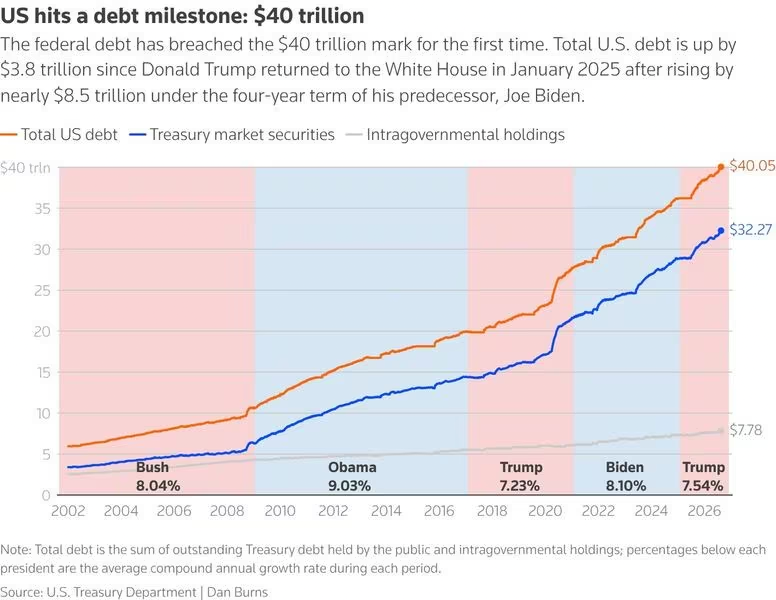
Look at the architecture of what is actually being protected here. Nominal U.S. output is roughly thirty-one point four trillion dollars a year. The finance, insurance, and real estate sector — banks, insurers, asset managers, landlords, and the entire machinery of Wall Street — generates about six point eight trillion of that, or twenty-one point seven percent. That is the single largest industrial sector in the official accounts of the United States. Larger than manufacturing. Larger than energy. Larger than agriculture. Goods-producing industry — the things you can actually touch — is fifteen point eight percent. Everything else, the sprawling category of professional services, healthcare, information, trade, and government, is sixty-two point five percent of the total. And sitting on top of that entire stack is a derivatives complex measured at approximately two hundred sixteen trillion dollars — derivatives being financial contracts whose value is tied to some other underlying asset, used everywhere from hedging currency risk to betting on interest rates, and two hundred sixteen trillion dollars of them now sit stacked on top of a thirty-one-trillion-dollar economy.
Say that number slowly. Two hundred sixteen trillion dollars.
A system that large, that leveraged, and that politically sacred does not get allowed to fail on schedule. It gets refinanced through the unit of account. That is not a prediction. That is the entire operating history of every fiat currency that has ever faced this math.
| Economic Layer | Share of U.S. GDP | Approximate Annual Output |
| Finance, insurance, and real estate — banking, insurers, landlords, asset managers | 21.7% | $6.8 trillion |
| Goods-producing — manufacturing, construction, mining, agriculture | 15.8% | ~$5.0 trillion |
| Other services and government | 62.5% | ~$19.6 trillion |
| Total nominal output | 100% | $31.4 trillion |
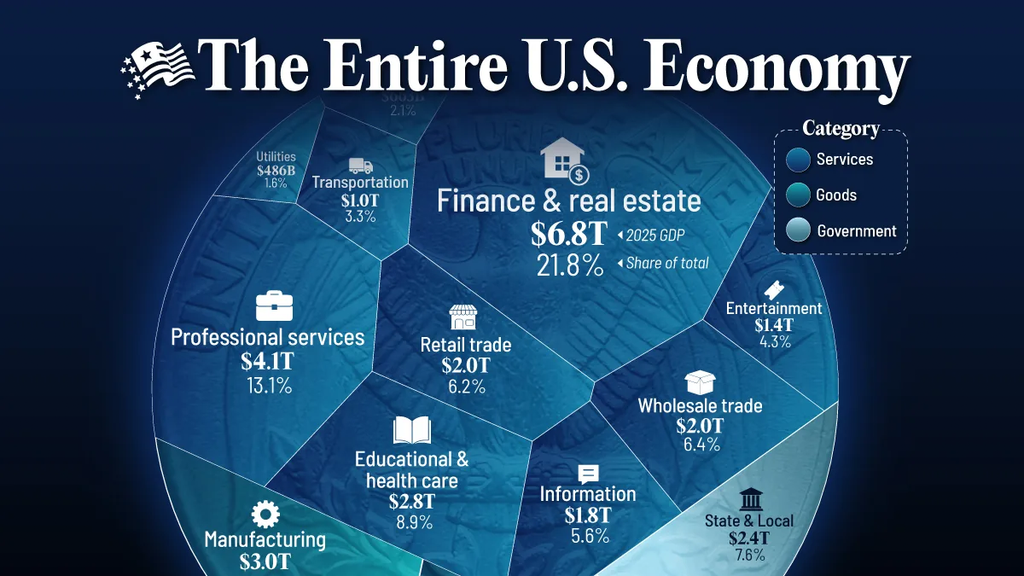
Inside the goods-producing slice, the breakdown is even more revealing. Manufacturing is nine point four percent of GDP, about two point nine trillion dollars. Construction is four point three percent. Mining is one point four percent. Agriculture and forestry are a sliver — zero point seven percent — but that sliver still produces roughly two hundred forty-eight billion dollars of value added and remains a backbone of the global grain, corn, and soy complex. The United States is not a mirage that manufactures only paper. It is still the world’s largest producer of oil and natural gas. It still designs the architecture of advanced semiconductors. It still builds the majority of the world’s commercial aviation fleets, precision defense equipment, and satellite hardware.
Here’s the thing. The risk was never that America stopped making things. The risk is that a six-point-eight-trillion-dollar financial sector and a forty-trillion-dollar sovereign debt layer have grown large enough to cannibalize the productive base sitting underneath them.
Bitcoin near seventy-eight thousand dollars, after a violent and historic rebound off the summer lows, is not a sideshow to any of this. It is the hardest measurement of it. Twenty-one million coins. No committee. No buyback. No duration extension. That is why every other asset discussed in this piece exists only in relation to it.
The Policy Moves Shaping the Economy and the Markets
The operating toolkit is now fully visible, and the contradictions built into it are the entire point. Tariffs of twenty-five to fifty percent and higher are being used simultaneously as industrial policy and as a crude tax on imported deflation. Bond buybacks and a shift toward shorter-duration issuance — meaning the government borrows more short-term and less long-term, so it isn’t locked into today’s rates for decades — are functioning as a soft form of yield-curve control. That’s a fancy phrase for one simple thing: the government managing interest rates across every timeframe, from next month’s bill to next century’s bond, so long-term borrowing costs don’t spiral out of control. Industrial subsidies and national-security procurement — the CHIPS architecture, the defense rebuild, energy and data-center siting — are pulling semiconductor, energy, aerospace, and compute capacity back onto domestic soil. Real manufacturing output grew at an annualized four point five percent earlier this year. That is not nothing. That is the fortress being poured, one concrete slab at a time.
The Federal Reserve is boxed in. Raise rates enough to defend the dollar, and the interest bill detonates. Hold rates down, and inflation stays embedded permanently in the cost of living. There is no clean exit from that box — and the market just watched it happen in real time. Fed Chair Kevin Warsh delivered a more hawkish message than expected at the Jackson Hole Economic Policy Symposium on August 28, and Bitcoin reversed off a three-month high within hours. That is not coincidence. That is the box.
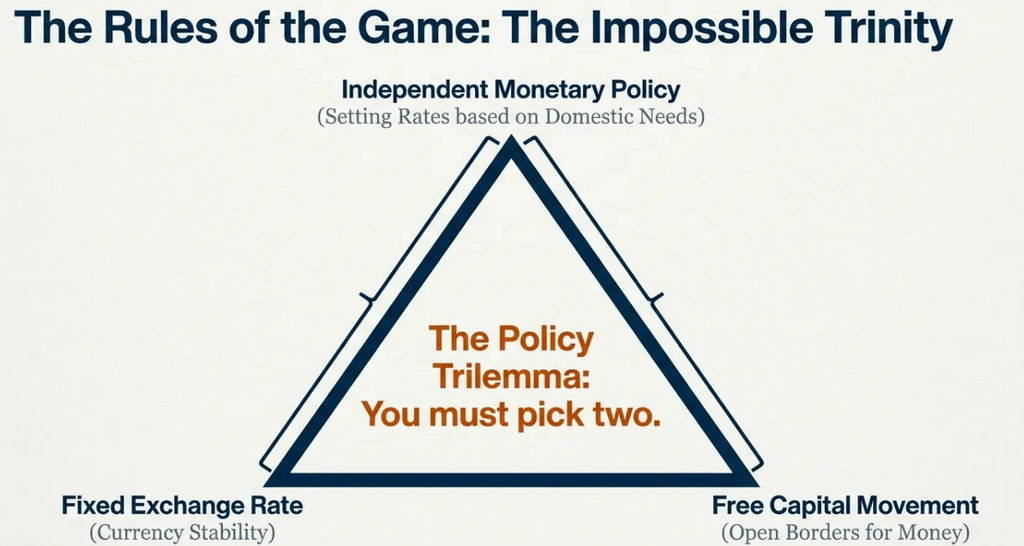
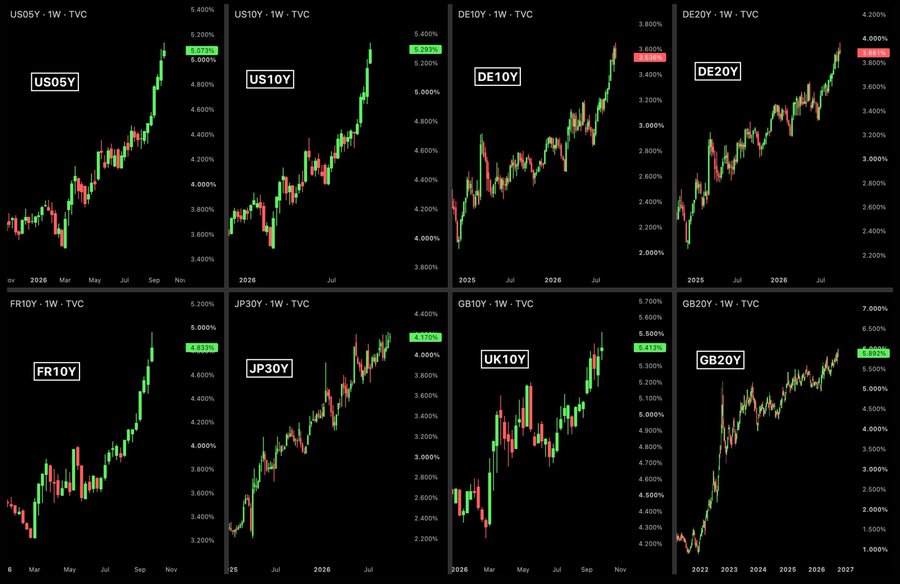
The Treasury is boxed in a second way. Japan still sits on more than one point one trillion dollars of U.S. Treasuries — U.S. government bonds Japan bought as a safe place to park money. When the yen collapses against the dollar, Tokyo’s historic response is to sell those Treasuries, raise dollars, and buy yen to defend its own currency. A disorderly sale of that size would rip through the long end of the U.S. curve — the interest rate on the longest-dated U.S. bonds — at the exact moment Washington must issue trillions more. So the workaround is coordination. Central banks quietly agree to lend each other dollars and yen directly (a “swap line”), and the Fed offers foreign central banks an emergency window to borrow dollars against their Treasury holdings instead of dumping them on the open market (the FIMA repo facility). Add more bond buybacks at home, and liquidity is being printed or redirected to protect a foreign currency so that a foreign holder doesn’t dump the domestic bond market.
That is not traditional monetary management. That is emergency balance-sheet defense. It is hidden quantitative easing — the practice of a central bank creating new money to buy bonds and keep the financial system flush with cash — and the market is already pricing it as exactly that.
Meanwhile, the private market is running the identical playbook the sovereign is running. It is stuffing future claims into structures that look liquid until the moment they aren’t. AI-linked companies have issued on the order of four hundred forty-five billion dollars of debt in 2026 alone, tracking toward six hundred billion by year-end. Across the system there is now more than a trillion dollars of debt tied to data centers, GPUs, and power contracts — roughly fifteen percent of the entire investment-grade bond market, larger than the banking sector’s own slice of that same market. Private credit — loans made directly by investment funds rather than by banks, largely outside the regulations banks have to follow — sits near one point nine to two trillion dollars. Life insurers already hold about eight hundred forty-nine billion of those private loans on their own books — roughly forty-two percent of the entire market.
Picture the structure. A hyperscaler wants a thirty-billion-dollar data center campus. It puts up twenty percent equity. An asset manager funds the rest by selling twenty-four-year bonds into pensions, endowments, and insurance general accounts. The building full of computers is somebody else’s duration problem in 2050. The same complexes that originate the paper often sit on both sides of the trade. After 2008, disclosure and risk-retention rules were written specifically for asset-backed securities like this. Recent regulatory clarification left many of these AI structures completely outside that perimeter, because a data center is legally treated as a building, not a pool of amortizing loans.
Risk migrates from a hyperscaler’s balance sheet into annuities — and if it fails, into state guarantee associations that assess surviving carriers and recover the cost through premium-tax credits. The industry does not eat the loss. The public does.
This is not a conspiracy. It is an incentive structure. And that incentive structure is exactly why Bitcoin keeps getting pulled deeper into the core of the financial system rather than left on the fringe of it.
The Potential Outcomes, Both Positive and Negative
The bull case is real, and it should not be dismissed. If artificial intelligence delivers a durable lift in labor productivity — modeled in some research at roughly two and a half percent a year through 2030 — if reshoring actually raises the goods-producing share of output, and if energy abundance keeps the physical base of the economy from cracking, the denominator of the debt-to-GDP ratio can grow fast enough to make the paper mountain look smaller without a single dramatic event. A structural jump toward four to five percent real growth would shrink the relative burden of the debt without a cinematic currency collapse. Strategic manufacturing can return. Automotive and parts lines are already being pulled back onto U.S. soil to escape tariff overhead. The United States still dominates energy production, high-value aerospace, agricultural exports, and the design layer of advanced semiconductors. That is not a hollow economy. That is a real industrial core wrapped inside a financial superstructure that has grown larger than the core itself.
The bear case is just as real, and pretending otherwise would be dishonest. Tariffs raise the cost of the very inputs required to rebuild. Closing the trade deficit removes the foreign bid for Treasuries at the exact moment the Treasury must issue more of them. The soft rate management described above suppresses the price of money and therefore accelerates the leakage of purchasing power. Wall Street’s own fund managers see the danger. Nearly forty percent of them, in a recent Bank of America survey, named the AI tech-debt binge as the single most likely trigger for the next systemic credit panic. Commercial real estate remains split down the middle — the good properties are fine, the older five-year loans from the last decade are rolling into a much higher-rate world and getting crushed. Liability insurance has hardened too, on the back of a more than three-hundred-percent surge in large litigation payouts. If private credit or commercial real estate fractures before the productivity payoff arrives, the state will not choose liquidation. It will choose liquidity. That choice is inflationary by construction, every single time it has ever been made.
The positive path is a fortress economy with a weaker currency and a rebuilt industrial core. The negative path is the same fortress with a hollowed-out middle class, chronic shortages in physical goods, and a stock market that makes people feel rich while their grocery bill, insurance premium, and power rate quietly eat the gain. In both paths, Bitcoin is not optional. In the bull path, it is the neutral collateral that rides the expansion without being diluted by it. In the bear path, it is the lifeboat.
All Roads Lead To Bitcoin

What History Shows When Governments Make This Intervention
Rome debased the denarius to fund the army and the grain dole. Revolutionary France assigned paper to confiscated church land, passed the Law of the Maximum to force acceptance at par, and discovered that farmers stop bringing grain to market the moment the paper becomes a lie. Britain left gold, then returned, then left again when the debt math would not close. The United States has already run this exact play more than once.
| Episode | The Intervention | What It Protected | What It Cost |
| U.S. wartime bond peg, 1942–1951 | Fed pinned long Treasuries at 2.5% | War finance and the Treasury market | Debt-to-GDP fell from 106% to 70%; 45%+ inflation (1946-48); funded by middle-class savings |
| London Gold Pool, 1961–1968 | Eight central banks dumped gold to hold $35/oz | Dollar’s gold peg during Vietnam/Great Society | Pool broke in ’68; Nixon closed gold window in ’71; 1970s stagflation |
| French Assignats, 1789–1796 | Paper assigned to land, price ceilings, metal bans | Revolutionary finance | Markets emptied, famine followed, paper demonetized |
| Post-2008 and post-2020 U.S. | QE (money-printing to buy bonds), suppressed rates | Banks, then the entire asset stack | A decade-plus of silent confiscation through the unit of account |
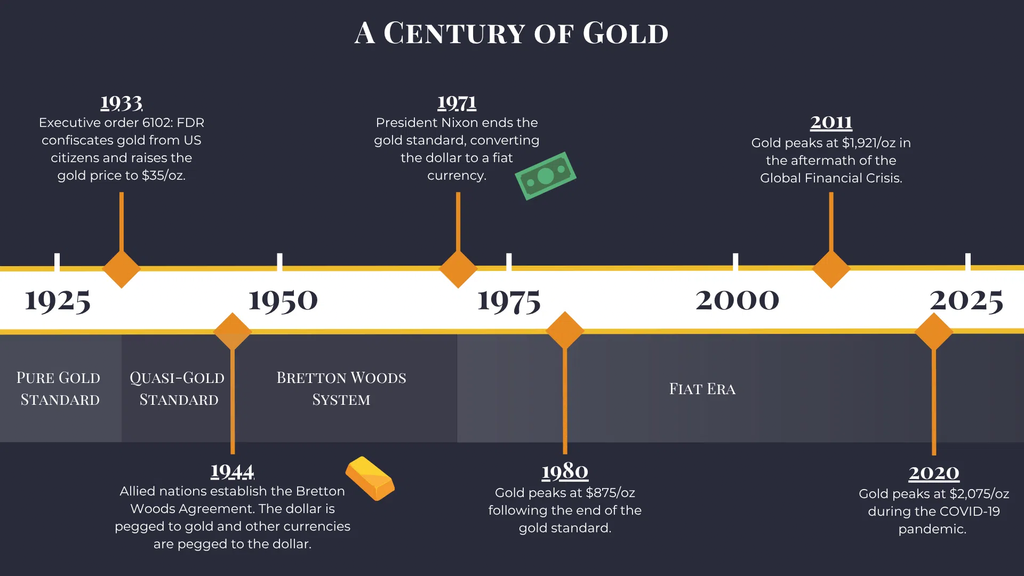
After World War II, the United States did not grow out of a 106 percent debt-to-GDP ratio through production alone. It used financial repression. Yields were capped. Inflation was allowed to run. Nominal GDP inflated faster than the stock of debt. The modern parallel is the same machine wearing better branding. Debt-to-GDP has again pushed through the wartime zone, above one hundred twenty percent on some measures. Buybacks and foreign-exchange support are the new peg. M2 — the broadest common measure of all the money in the economy, cash plus checking and savings accounts — is the new wartime money supply. The pattern does not change. When the sovereign’s survival and the currency’s integrity collide, the sovereign survives and the currency absorbs the blow.
Interventions buy years. They have never cleared a sovereign debt crisis without a massive debasement of the unit. Gold was the historical answer. Bitcoin is the modern one — because it settles globally, verifies instantly, and cannot be expanded by a vote.
What Assets Are Already Saying About Debasement
Official CPI — the Consumer Price Index, the government’s own measure of inflation — is up about twenty-nine percent since May 2020. That number is the lullaby. The grocery aisle, the power bill, and the mortgage payment are the evidence, and the evidence does not sing you to sleep.
From May 1, 2020, to today, the median U.S. home price rose from three hundred twenty-two thousand six hundred dollars to four hundred ten thousand seven hundred — a twenty-seven point three percent nominal gain that is actually a one point three percent real loss after inflation. But the monthly carrying cost tells the real story. The median mortgage payment jumped from about one thousand one hundred fourteen dollars to about two thousand two hundred ninety-five. That’s a one hundred six percent increase. The thirty-year fixed rate moved from roughly three point two three percent to about six and a half. The same dollar now buys less than half the housing footprint it bought six years ago.
| What it costs | May 2020 | Today | Up | Dollar lost |
| Regular gas, gallon | $1.87 | $4.09 | +119% | −54.3% |
| Mortgage, monthly | $1,114 | $2,295 | +106% | −51.5% |
| Eggs, dozen | $1.61 | $3.15 | +96% | −48.9% |
| Ground beef, lb | $4.13 | $6.88 | +67% | −40.0% |
| Steak, lb | $7.58 | $11.85 | +56% | −36.0% |
| White bread, lb | $1.38 | $2.02 | +46% | −31.7% |
| Electricity, kWh | $0.134 | $0.181 | +35% | −26.0% |
| Child care, daycare & preschool | 100.0 | 128.4 | +28.4% | −22.1% |
| New vehicle, avg transaction | $38,940 | $49,855 | +28% | −21.9% |
| Family medical insurance, annual | $21,342 | $26,993 | +26.5% | −20.9% |
| Asking rent, monthly | $1,385 | $1,742 | +26% | −20.5% |
| Whole milk, gal | $3.27 | $4.08 | +25% | −19.9% |
| Auto insurance, annual full coverage | $1,886 | $2,356 | +25% | −20.0% |
| Chicken breast, lb | $3.11 | $3.85 | +24% | −19.2% |
| Fresh vegetables | 100.0 | 122.9 | +23% | −18.6% |
| Fresh fruit | 100.0 | 119.4 | +19% | −16.2% |
| Bottled water, gal | $1.22 | $1.45 | +19% | −15.9% |
Nobody agrees on the exact number, and that disagreement is the tell. Seven percent used to be the textbook estimate for true annual debasement. Serious analysts now work with ten to twelve. Some, depending on the household’s actual basket of bills, use fourteen. The exact figure matters less than the direction, and the direction is not in dispute. The loss of purchasing power is accelerating, and it is not evenly distributed. Housing credit and animal protein took the heaviest hits. Rent rose less than the mortgage because a wave of multifamily supply capped landlord pricing power — that is not relief, that is a split between people who already own shelter and people who must buy it with borrowed, melting dollars.
Now look at what actually held value over the same window. Cumulative CPI of twenty-nine percent means one May 2020 dollar requires about one dollar and twenty-nine cents today just to break even.
| Asset | May 1, 2020 | Today | Nominal Gain | Multiple vs. $ | Real PP Change |
| Nvidia | $7.07 | $217.55 | +2,977.1% | 30.77× | +2,285.0% |
| Bitcoin | $8,674 | $77,839 | +797.4% | 8.97× | +595.5% |
| Tesla | $46.75 | $348.75 | +646.0% | 7.46× | +478.2% |
| Silver, oz | $14.94 | $67.79 | +353.7% | 4.54× | +251.7% |
| Apple | $72.27 | $319.70 | +342.4% | 4.42× | +242.9% |
| Nasdaq Comp | 8,605 | 26,402 | +206.8% | 3.07× | +137.8% |
| Copper, lb | $2.33 | $6.59 | +182.8% | 2.83× | +119.2% |
| S&P 500 | 2,831 | 7,712 | +172.4% | 2.72× | +111.2% |
| Gold, oz | $1,701 | $4,530 | +166.3% | 2.66× | +106.4% |
| Median US home | $322,600 | $410,700 | +27.3% | 1.27× | −1.3% |
Gold in the mid-four-thousands is not jewelry demand. Silver in the high sixties is not a hobbyist market. Copper near six dollars and sixty cents is the industrial vote on electrification, data centers, and grid rebuild. Bitcoin’s near eight-hundred-percent nominal run — nearly six hundred percent in real terms — is the market pricing a world in which the unit of account has become a policy tool. These prices can whip. They can correct. They are still all pointing in the same direction.
The monetary aggregates over that same stretch explain exactly why the hard assets won and cash lost.
| Monetary Measure | May 2020 | Today | Change |
| M2 | $17.85 trillion | $23.22 trillion | +30.05% |
| M1 | $16.31 trillion | $19.89 trillion | +21.91% |
| Fed balance sheet | $6.72 trillion | $6.73 trillion | +0.14% |
| Fed balance sheet peak (March 2022) | — | $8.97 trillion, then QT | — |
The Fed’s book looks flat only because you’re measuring from the emergency expansion to the post-tightening residue. In between, the balance sheet nearly touched nine trillion dollars. The liquidity never fully left the system. It migrated into M2, into asset prices, and into the cost of a dozen eggs. Paper claims on future cash flows are being multiplied faster than the physical world can absorb them. Hard assets are the residual claim on whatever purchasing power is left after that multiplication finishes.
How Bitcoin Gets Integrated — And Why It Is the Asset That Matters Most
Bitcoin does not replace the dollar as the everyday medium of exchange in one dramatic weekend. That is not how monetary transitions work. It gets absorbed layer by layer, until the people running the machine discover they need it more than they ever feared it.
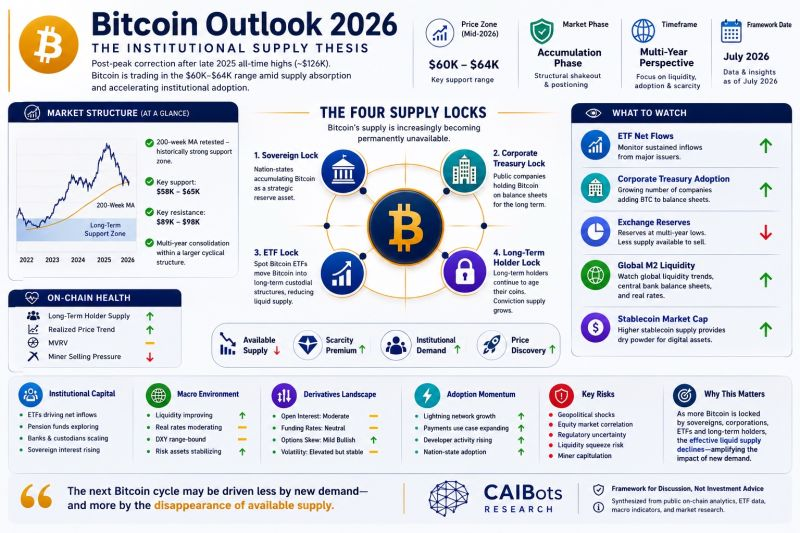
The first layer is already built: the spot ETF. Advisors can allocate. Sovereign wealth funds can hold the wrapper without ever touching a seed phrase — the string of words that acts as the master password to a Bitcoin wallet, and the single point of failure every self-custodian has to protect. BlackRock’s iShares Bitcoin Trust alone holds on the order of seven hundred sixty to seven hundred seventy thousand coins inside a roughly sixty-billion-dollar vehicle. Across every ETF and fund combined, the stack is larger still. Mubadala and the Abu Dhabi Investment Council have held multi-million-share IBIT positions straight through the drawdown without selling a single share. That is a sovereign wealth fund refusing to blink, done inside a fully regulated wrapper. Investment advisors added to IBIT quarter after quarter while hedge funds cut. The product is no longer an experiment. It is a pipe.
The second layer is collateral. Here’s what that means in plain English: banks are starting to let you borrow cash against your Bitcoin the same way they’d let you borrow against a house or a stock portfolio. You don’t sell the Bitcoin. You pledge it as security, the bank hands you dollars, and if you pay the loan back, you get the exact same Bitcoin back — untouched, un-taxed, still yours. Newly bought IBIT shares have a thirty-day waiting period before you can borrow against them. After that, major brokerages will typically let you borrow forty to fifty cents on every dollar of value, and interest rates on those loans have been running anywhere from about four and a half percent at the largest firms up to ten or eleven percent at retail-focused ones. Some private banks, including JPMorgan, will even take raw Bitcoin itself as collateral — no ETF wrapper required — for institutional clients. A client who can pledge Bitcoin at a better rate than a stock portfolio will do it every time. That is how an outlaw asset quietly becomes bank inventory.
Here’s the warning inside that opportunity. Borrowing against Bitcoin to avoid a taxable sale is smart — right up until Bitcoin’s price drops far enough that the bank calls the loan and force-sells your coins to cover it. That forced sale is the exact taxable event the loan was supposed to help you avoid. If the cash you borrowed already went out the door to buy a house, you cannot un-ring that bell. Anyone who borrows the maximum the bank will offer is volunteering to be the one who gets sold out in the next crash. Borrowing only fifteen to twenty percent of what your Bitcoin is worth, and assuming a genuinely brutal price drop could happen at any time, is how a serious holder uses this system without becoming its casualty.
The third layer is credit. Crypto-backed lending has grown into the tens of billions. Bitcoin-backed loans have been packaged into rated securities. The point of that market is not leverage for its own sake. It is liquidity without a taxable sale. Holders who refuse to surrender the scarce asset can still extract working capital. That is exactly what gold did when it matured from ornament to monetary metal.
The fourth layer is the corporate treasury. Roughly one hundred ninety-five public companies now hold about one point two three million coins combined — nearly six percent of the entire twenty-one million cap. Strategy alone holds eight hundred forty thousand four hundred forty-seven coins, roughly four percent of all Bitcoin that will ever exist. Their average purchase price across every coin they’ve ever bought works out to about seventy-five thousand three hundred eighty-five dollars, for a total of sixty-three point four billion dollars spent. Even after a 2026 program that sold coins across three separate months to fund preferred-stock buybacks and build a dollar reserve, the stack remains, by a wide margin, the largest corporate treasury on Earth. Governments already custody on the order of six hundred fifty thousand coins. Add the categories together, and a material slice of the fixed supply is no longer floating in weak hands.
The fifth layer is the sovereign reserve. The United States created a Strategic Bitcoin Reserve from seized coins and instructed that those coins not be sold. That is not maximalism shouted from a purple-haired conference stage. That is a state formally admitting that an unprintable bearer asset belongs on the same conceptual shelf as gold. Other jurisdictions are testing the same idea by accepting Bitcoin as loan collateral once their licensing regimes go live.
Read that sequence again. Wrapper. Collateral. Credit. Treasury. Reserve. That is integration. It does not require a law declaring Bitcoin the world reserve currency. It requires balance sheets that cannot tolerate another decade of silent confiscation through the unit of account.
Gold protects purchasing power. Silver and copper protect you through the industrial rebuild. A well-structured equity book captures the firms that will build the fortress. Bitcoin does something none of those can do at the same time. It is monetary. It is portable. It is a bearer instrument — meaning whoever holds the keys owns the asset outright, the same way cash in your hand or gold in your safe belongs to you with no third party’s permission required. It settles without a correspondent bank, the network of intermediary banks that normally has to pass your money along step by step, taking time and fees at every hop, whenever you send funds internationally. It is scarce by protocol rather than by mining geology or central-bank inventory. It can be held in self-custody so that no custodian, no exchange, and no pledged-asset desk can liquidate you while you sleep. It can also be held in regulated wrappers when the job is estate planning, advisor allocation, or institutional collateral. That dual life is why it wins.
This is why Bitcoin is not one holding among many. It is the core. Gold is the analog cousin. Industrial metals are the build-out. Equities are the operating businesses. Cash is inventory. Bitcoin is the savings technology of a world that has already chosen fiscal dominance. Since May 2020 it has multiplied real purchasing power nearly sevenfold, while the median house went sideways in real terms and a dollar lost a quarter to a half of its claim on food and shelter. If you want to thrive rather than merely survive, you accumulate it while the machine is still calling it volatile — while it is already treating it as collateral.
The Overdependence on Finance, Insurance, Real Estate, and Derivatives
Here is the actual reason the currency will be sacrificed. The finance and real estate sector is six point eight trillion dollars a year. A derivatives complex around two hundred sixteen trillion sits directly on top of it. Eighty-six point six percent of non-financial corporations and ninety percent of financial institutions already embed derivatives in day-to-day operations just to manage rates, currency, and cash-flow volatility. Transport, logistics, and commercial leasing are mathematically dependent on that market simply to protect their operating margins.
Of the sixty-two point five percent of GDP labeled “other services and government,” a large band is not independent of Wall Street at all. Professional, scientific, and technical services are thirteen point one percent of GDP. Information and tech are five point six. A fat share of that billing is mergers-and-acquisitions structuring, quantitative infrastructure, commercial legal work for financial entities, and fintech architecture. Wholesale, retail, and transportation — the services that actually move physical inventory — are closer to fifteen to eighteen percent of the whole economy.
| Service-Economy Driver | Estimated Share of Service Activity | What Actually Pays for It |
| Financial and derivative-dependent services | ~60–65% | Credit creation, rate swaps, asset management, debt issuance, speculative infrastructure |
| Goods-producing and tangible delivery services | ~35–40% | Moving commodities, engineering structures, extracting energy, distributing inventory |
That tilt is the whole thesis in one table. The service economy has decoupled from physical output and started behaving as an extension of the derivatives complex and the structural expansion of M2. If that layer is allowed to collapse on market terms, the reported economy does not gently reallocate toward factories. It seizes. Pensions mark down. Insurance balance sheets crack. State guarantee funds assess the surviving carriers and recover the assessment through tax credits — which means the public pays. No administration of either party will volunteer for that sequence. They will print, buy bonds, guarantee, and reclassify. They will call it stability. The cost will show up in the dollar, not in the press release. Bitcoin is the asset that sits outside that entire loop. That is the whole strategic case, in one sentence.
How to Protect Yourself — And Even Thrive
Protection is not a slogan. It is a balance-sheet redesign.
First, stop treating cash and short-duration paper as savings. They are working capital. M2 is up thirty percent since May 2020. The mortgage payment doubled. Eggs nearly doubled. A savings account that yields less than debasement is a scheduled confiscation, and it is scheduled by nobody’s malice — just arithmetic.
Second, own Bitcoin as the primary monetary reserve. Self-custody first — meaning you personally hold the private keys instead of trusting an exchange or a bank to hold them for you. A “multisig” setup, where it takes multiple separate keys held in multiple places to move the coins, is the gold standard, because no single lost or stolen key can wipe you out. If you’re not ready to run that kind of setup yourself, spread trust across more than one hardware wallet brand rather than betting everything on one manufacturer’s firmware. Verify the software. Verify the randomness the device used to generate your keys. Do not outsource the last line of defense to a single company and then pretend that’s any different from leaving coins on an exchange. Use the ETF and Bitcoin-backed loans only when the job is institutional access, estate planning, or getting cash without triggering a tax bill. Whatever you borrow against your Bitcoin, assume the price could drop forty percent overnight — because it can — and size the loan so that drop doesn’t wipe you out. Never borrow the maximum a lender will offer and assume the market will wait for you.

Third, own physical gold and silver sized to your life, not to a headline. Gold has more than doubled in real terms since 2020. Silver has more than tripled. In a full reset conversation, some work has put a theoretical official gold revaluation into the five-figure zone — twenty-two thousand dollars an ounce is the kind of number that appears when paper liabilities overwhelm the physical float. You do not need that print to justify the holding. You need the six-year evidence that’s already sitting in the table above.
Fourth, own copper and the industrial metals that must be mined, smelted, and shipped for the fortress build-out to exist at all. Copper is up one hundred eighty-three percent nominally and one hundred nineteen percent in real terms since May 2020. That is the grid, the data center, the motor, and the transmission line — all voting at once.
Fifth, hold a concentrated equity book — a small, deliberately chosen set of stocks rather than a broad index fund — in firms that produce energy, compute, food, infrastructure, and the tools of re-industrialization. Nvidia’s run is the AI building-boom expressed in one ticker, as data centers around the world buy up its chips. It is also a reminder that owning a stock is really owning a claim on a business, and that business’s earnings are still counted in dollars that keep losing value. Own the businesses. Do not confuse the index level with safety. The S&P 500 can double in nominal terms and still lose you a kitchen, once you account for how much less those dollars actually buy.
The sophisticated version of this entire stack is the same loop old money has used for decades: buy scarce assets, borrow depreciating dollars against them when you need cash, and refuse to sell the principal. Here’s why that works — money you borrow isn’t taxed the way money you earn is, because a loan isn’t income, it’s a debt you owe. So a wealthy holder can spend for years off borrowed dollars while their actual Bitcoin or gold or real estate keeps compounding untouched, and the shrinking value of the dollar itself quietly erodes the size of that debt over time. The danger is the same one already sitting inside every Bitcoin-backed loan available today — a sharp enough price drop forces a sale you didn’t choose, on a timeline you didn’t pick. Use the loop. Do not let the loop use you. Keep spare cash and unencumbered Bitcoin in reserve, so that the next crash becomes a buying opportunity instead of a forced sale.
The Most Likely Scenario Ten Years Out
The most probable path is not a Weimar-style currency collapse — the kind of runaway hyperinflation that destroyed the German mark in the 1920s — and it is not a sudden clean default either. It is a long, K-shaped grind — a split-screen economy where headline numbers and asset owners keep climbing while everyday costs and paycheck-to-paycheck households keep sinking, the two lines diverging like the top and bottom strokes of the letter K.
Nominal indices grind higher. Real median purchasing power does not. The United States becomes more closed, more militarized in its industrial policy, and more dependent on the same soft rate-management tools to keep the Treasury market orderly. AI raises measured productivity in pockets and raises power prices everywhere. Some factories return. Many households experience that return as higher costs rather than higher wages. Debt ratios stay ugly, because nobody chooses the political pain required to shrink them. Managing the entire yield curve — not just the Fed’s overnight rate, but every maturity out to thirty years — becomes a permanent feature of policy, not an emergency measure. Gold gets revalued in practice, if not by statute. Bitcoin graduates from speculative satellite to collateral, treasury reserve, and settlement asset — because twenty-one million is the one supply schedule in the world that does not convene a committee.
The dollar remains the transaction currency of a large empire and loses its status as a long-duration store of value. Foreign official buyers keep swapping paper claims for neutral assets. Corporations keep adding coins. Banks keep widening the collateral window. Sovereigns keep the coins they already seized and quietly argue about buying more. The household that understood this in 2026 will not be asking permission in 2036.
Watch for four things, because they’re already happening in real time. Money keeps chasing paper yields instead of factories, until real shortages of real goods finally force a political response. Nominal asset prices rise on all that new liquidity while the grocery basket and the power bill rise faster — a bull market that quietly loses you money even as your portfolio statement looks great. The Treasury and the Fed keep suppressing long-term interest rates because they have no other solvent choice left — they simply cannot afford for those rates to rise to what a free market would actually charge. And when paper promises finally outrun the physical goods the system can actually deliver, the world re-anchors to the floors nobody can print more of. That last step is the one Bitcoin was built for.
The tail to the downside is a private-credit or insurance accident in the next twelve to eighteen months that forces an emergency print larger and faster than the base case assumes. That print is rocket fuel for Bitcoin. The tail to the upside is a productivity miracle large enough to grow the real economy out from under the debt. Even then, Bitcoin remains the scarce collateral of a world that learned not to trust the unit. Plan for the base case. Be positioned for both tails.
The Time to Act is Now
Start now. Not next quarter. Not after the next candle closes. The research is not subtle. M2 is up thirty percent. Official inflation is up twenty-nine. The mortgage payment is up one hundred six. Eggs are up ninety-six. Ground beef is up sixty-seven. Bitcoin is up nearly eight hundred percent nominal and nearly six hundred percent real. Gold has more than doubled in real terms. Silver has more than tripled. Copper has more than doubled. The median house — the thing Americans were told was the only hard asset they’d ever need — is slightly negative after inflation.
Own Bitcoin first. Then own gold. Then own silver. Then own copper and the industrial metals the rebuild cannot fake. Own a short list of businesses that make real things and real power. Structure the equity book so it can live through volatility. Structure the Bitcoin so no single vendor, no single device, and no single signature can ever take it from you. Use the ETF when you must plug into the credit system. Use self-custody when the job is survival. Never confuse those two jobs.
The supply of dollars will rise to protect the sector that prints the statements. The six-point-eight-trillion-dollar finance and real estate complex, the two-hundred-sixteen-trillion-dollar derivatives book, the insurance companies holding eight hundred forty-nine billion in private loans made outside the regular banking system, the trillion dollars borrowed against AI data centers and packaged into thirty-year bonds that the 2008 safety rules don’t even cover — that entire machine will be refinanced through the unit of account before it is ever allowed to clear.
The supply of Bitcoin will not. Twenty-one million. That is the entire trade.
The window is the same window it has always been. The people who wait for permission will pay the next decade’s grocery bill in a thinner dollar. The people who accumulate the scarce asset while the machine is still calling it volatile will own the collateral of the next system. Start now.
All information provided is for educational purposes only. It is essential to conduct your own research before making any financial decisions. This is not intended as financial advice.
Links & Tutorials
Bitcoin Education Resources
The Freedom People – Bitcoin: Getting Out of the US Credit System Course
Hope.com – Learn more about Bitcoin and how to use BTC to protect your wealth.
The Bitcoin Standard – Book by Saifedean Ammous – a must-read!
Crypto 101 – A beginner handbook to cryptocurrency
The Bitcoin Way – Go bankless! Bitcoin education and services to help you custody your Bitcoin safely and securely.
Swan Bitcoin – Bitcoin exchange, IRAs and institutional-grade custody solutions
River Financial – Bitcoin exchange and institutional-grade custody solutions
God Bless Bitcoin – Full Length Documentary
Zero To Hero Bitcoiner – Tutorials from BTC Sessions
Freedom People Resources
People Pay – Accept Bitcoin payments for your business
Chainrecorder – Prove ownership immutably by recording your documents on the Bitcoin blockchain
Cracking the Code Educated Tax Return – Legally avoid income and capital gains taxes.
U.S. Regulated Exchanges (Fiat Onramps)
Coinbase – Using Coinbase Advance Video
Kraken – Using Kraken Pro Video
KYC Credentials Outside the U.S.
Palau ID – Foreign residence to pass KYC on foreign exchanges.
KYC Exchanges that Accept Palau ID (Must Use VPN – Costa Rica, Columbia, Mexico, Panama)
No KYC Exchanges (Must Use VPN – Costa Rica, Columbia, Mexico, Panama)
DEXs (Decentralized Exchanges) – Best Wallet To Use
Jupiter – Video Solana Ecosystem – Phantom Wallet
Whales Market – Solana OTC Trade Desk – Phantom Wallet
Thorswap – Swap native assets cross-chain (BTC for ETH etc..) and a very unique decentralized Bitcoin lending platform. Works best with the XDefi Browser Wallet.
Decentralized Bitcoin lending platform. Thorswap Overview Video Loans On Thorswap Video
Osmosis – Cosmos Ecosystem – Rabby, Metamask
Spooky Swap – Sonic – Rabby, Metamask
Trader Joe – Avalanche Ecosystem – Rabby, Metamask
Crypto Market and Portfolio Tracking
CoinGecko for portfolio tracking and up-to-date prices
CoinMarketCap – Crypto Prices
Banter Bubbles – Crypto Prices – Social Sentiment
Trading View – Chart all Markets and trading pairs Tradingview Tutorial Video
Storage – Not your keys, Not your crypto!
Cold Storage Wallets (Secure Long-Term Storage of Your Crypto)
Nunchuk – Multi Signature Wallet and Inheritance Service
Casa Custody Solutions – Multi Sig Storage and Inheritance
Hot Wallets (Lower Security – interact with DAPPS and Smart Contracts)
Bull Bitcoin Wallet – Video Bitcoin Wallet with Privacy features
XDefi Browser Wallet – Video1 Video 2
Aqua Wallet – Video – Self Custody, Lightning and Liquid Network Bitcoin & USDT
Warning-If you have a wallet and an NFT has been sent to your wallet that you did not mint or purchase.. NEVER click on it. Many have malicious code that can drain your wallet! – BE CAREFUL

Stay Free!
Kury




You must be logged in to post a comment.