


The Bill of Rights Series

Amendment V: The Government Must Earn What It Takes
Part 5 of a 10-part series examining the Bill of Rights — and the federal record of violating it.
The Fifth Amendment is five protections in one sentence. Each addresses a different method by which government can destroy a person without ever being wrong about the underlying facts.
“No person shall be held to answer for a capital, or otherwise infamous crime, unless on a presentment or indictment of a Grand Jury, except in cases arising in the land or naval forces, or in the Militia, when in actual service in time of War or public danger; nor shall any person be subject for the same offence to be twice put in jeopardy of life or limb; nor shall be compelled in any criminal case to be a witness against himself, nor be deprived of life, liberty, or property, without due process of law; nor shall private property be taken for public use, without just compensation.”
Grand jury indictment before trial. No prosecution twice for the same offense. No compelled self-incrimination. No deprivation of life, liberty, or property without due process. No taking of private property without just compensation.
These are not technicalities. They are the specific lessons the Founders drew from specific abuses — the Star Chamber’s inquisitorial oaths, the Crown’s ability to re-prosecute until it obtained a conviction, the seizure of property without process or payment. The amendment encodes what happens when government is trusted to police itself.
What the Founders Understood By Property
James Madison did not regard property narrowly. In his 1792 essay on the subject, he wrote that government is instituted to protect property of every sort — both the external things a person owns and the rights and faculties that make ownership possible. “As a man is said to have a right to his property, he may be equally said to have a property in his rights.”
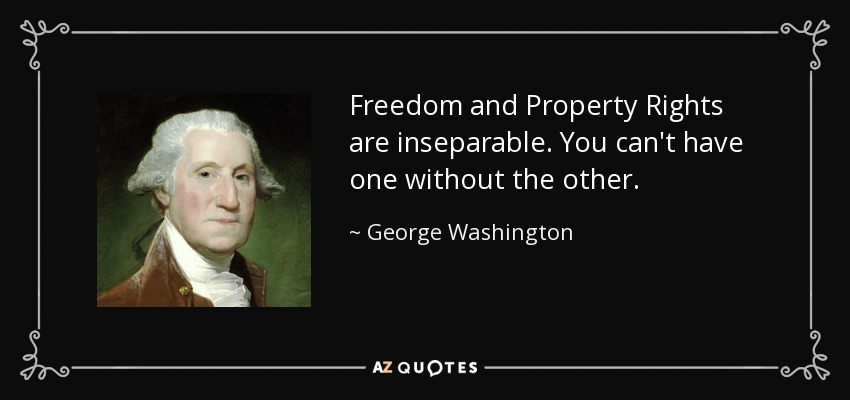
John Adams was more direct: “Property must be secured, or liberty cannot exist.”
That is not a defense of wealth. It is a statement about the relationship between secure property and individual independence from the state. A person whose property can be taken at will — without process, without compensation, without recourse — is a person whose behavior can be controlled by the threat of that taking.
Thomas Jefferson connected the same principle to labor: a wise and frugal government would not “take from the mouth of labor the bread it has earned.” What a person produces through their own effort is theirs. The government’s need for it does not change that without process and payment.
Civil Asset Forfeiture
Civil asset forfeiture allows the government to seize property alleged to be connected to a crime — without convicting, or in many cases even charging, the owner.
The legal theory is that the proceeding is against the property, not the person. This means the owner bears the burden of proving innocence to recover what was taken. The government seizes first. The owner litigates later, at their own expense, in a process that frequently costs more than the seized property is worth.
Highway interdiction units have seized cash from travelers based on the amount carried — not on evidence of a specific crime, but on the inference that carrying cash is suspicious. The seizing agency keeps a share of what it takes. The financial interest in seizure belongs to the same institution that decides whether to seize.
The Fifth Amendment states that private property shall not be taken without just compensation and that no person shall be deprived of property without due process. Civil forfeiture as practiced satisfies neither. The compensation is zero. The process requires the owner to prove a negative.
The Supreme Court held in Timbs v. Indiana (2019) that a $42,000 vehicle could not be forfeited as punishment for a crime carrying a maximum fine of $10,000. The Fifth Amendment due process question — whether forfeiture procedures are constitutionally adequate in the first place — remains heavily litigated.
Kelo and the Takings Clause
Kelo v. City of New London (2005) asked whether the government could transfer property from one private owner to another private owner for economic development.
The Fifth Amendment permits takings for “public use” with just compensation. New London condemned an established residential neighborhood and transferred the land to a private developer, on the theory that the resulting economic activity would benefit the public. The Supreme Court, five to four, held this satisfied the public use requirement.
Justice O’Connor’s dissent stated the practical consequence: under the majority’s reasoning, the government could transfer any private property to any other private owner so long as the new use would generate more taxes or jobs. The distinction between public use and private benefit had been eliminated.
Susette Kelo’s house was taken not because a road needed to go through it, but because a pharmaceutical company’s development plan would generate more tax revenue. The company later abandoned the project. The land sat vacant for years. The neighborhood no longer exists.
Self-Incrimination and Double Jeopardy
The privilege against self-incrimination exists because the government is not entitled to the accused’s assistance in building its own case. The Star Chamber required suspects to answer questions under oath before knowing the charges — to incriminate themselves or lie. The privilege was the direct answer to that procedure.
Miranda v. Arizona (1966) applied it to custodial interrogation. The warnings it requires exist because custody is inherently coercive. A statement obtained in those conditions, without those warnings, cannot be assumed voluntary.
The Double Jeopardy Clause prevents the government from retrying a defendant after acquittal. Without it, prosecution is not a proceeding with a definitive outcome. It is a resource contest the government can extend until it wins.
The dual-sovereignty doctrine creates a significant exception: the federal government and a state are considered separate sovereigns, so both can prosecute the same conduct without triggering double jeopardy. A state acquittal does not bar federal prosecution for the same acts. Whether this is consistent with the clause’s purpose — preventing prosecution from becoming attrition — courts have answered in the government’s favor.
The Pattern
Each clause of the Fifth Amendment addresses the same problem: a government unchecked in its ability to accuse, prosecute, seize, and take will use those abilities until something stops it.
Remove any one protection and the others weaken. A government that can take property without compensation has less reason to respect the procedures that protect it. A government that can compel self-incrimination has less need for the independent investigation the Fourth Amendment was designed to require.
Madison said the first object of government was protecting the diverse faculties of acquiring property. What the Fifth Amendment does is hold the government to that object — not as a suggestion, but as a condition of its legitimacy.
Next: The Sixth Amendment — the right to a speedy trial, a public trial, an impartial jury, and counsel. What happens when those guarantees exist on paper and not in practice.




You must be logged in to post a comment.