


The Bill of Rights Series

Amendment II: A Right Is Not a Privilege With Extra Steps
Part 2 of a 10-part series examining the Bill of Rights — and the federal record of violating it.
The Second Amendment contains twenty-seven words. Courts, legislatures, and law professors have spent two centuries arguing about what they mean. The text has not changed.
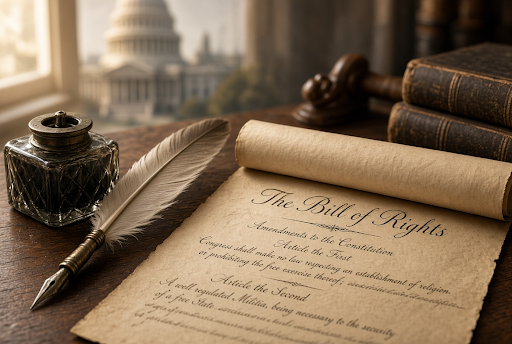
“A well regulated Militia, being necessary to the security of a free State, the right of the people to keep and bear Arms, shall not be infringed.”
The argument that this protects only a collective right tied to formal militia service requires reading “the right of the people” to mean something other than what it means everywhere else it appears in the Bill of Rights. The First Amendment protects “the right of the people” to assemble. The Fourth protects “the right of the people” against unreasonable searches. No one argues those rights belong only to organized groups. The Second Amendment uses identical language.
The Supreme Court confirmed the individual-right reading in District of Columbia v. Heller (2008). McDonald v. Chicago (2010) extended it against the states. Bruen (2022) held that the right includes public carry and that the government — not the citizen — bears the burden of justifying restrictions through historical analogy. Three decisions over fourteen years were required to establish what the text says plainly.
What “Infringed” Has Come to Mean
The National Firearms Act of 1934 imposed registration requirements and a $200 tax on machine guns, short-barreled rifles, and suppressors. Two hundred dollars in 1934 was roughly equivalent to several thousand today. A tax calibrated to make a right unaffordable is not a regulation. It is a prohibition with paperwork.
The Gun Control Act of 1968 expanded federal licensing and created prohibited categories of owners. The Brady Act added background checks in 1993. The federal assault-weapons ban ran from 1994 to 2004. Each was passed in response to a specific episode of violence, justified as narrow and necessary. Each was also permanent in structure, regardless of whether the episode that produced it recurred.
Heller acknowledged that the Second Amendment is not unlimited — prohibitions on felons, the mentally ill, and carrying in sensitive places survived the decision. What did not survive was the District of Columbia’s flat ban on handgun possession in the home. The District argued the ban was a reasonable public safety measure. The Court’s response was that the right is not contingent on whether the government finds it convenient. That is what makes it a right.
The States Did Not Learn the Lesson
McDonald v. Chicago (2010) incorporated the Second Amendment against the states specifically because Chicago had passed a handgun ban identical in effect to the one just struck down in Washington. The city’s argument was that local conditions justified local restrictions. The Fourteenth Amendment does not permit that.
New York’s public-carry licensing regime required applicants to show a “proper cause” — a special need for self-defense beyond that of an ordinary citizen. Ordinary citizens were denied. The well-connected were approved. Bruen struck it down in 2022.
After each Supreme Court decision confirming the right, legislatures have moved to test its edges — bans on semiautomatic firearms labeled “assault weapons,” magazine-capacity limits, expanded lists of sensitive places, new permitting requirements designed to accomplish through process what direct bans can no longer accomplish directly. The justification is always public safety. The result is always the same: a constitutional right converted into a regulated privilege, available to those with the resources to navigate the process and effectively denied to those without them.
A right guaranteed to everyone in principle but accessible only to some in practice is not a right.
The Post-Bruen Landscape
Bruen required that firearms restrictions be justified by historical analogues from the founding era. Modern policy preferences, however sincerely held, are not sufficient.
In United States v. Rahimi (2024), the Court upheld the prohibition on possession by persons subject to domestic-violence restraining orders, finding historical support for disarming individuals who pose a documented threat of physical violence. The decision was narrow — confined to that specific context.
Other challenges have divided the courts. The federal felon-in-possession statute, as applied to non-violent offenders, has been found unconstitutional in some circuits. The prohibition on possession by unlawful drug users has faced successful challenges in others. The restrictions that have not survived share a common feature: they were enacted to address modern concerns with no genuine historical parallel.
Reasonable and constitutional are not synonyms.
On the Argument From Safety
Every firearms restriction passed in the last ninety years was justified on public safety grounds. The people making that argument are not dishonest. They believe it.
The relevant question is not whether they believe it. It is whether it is true — and whether it would matter constitutionally if it were.
The empirical evidence on whether restrictions reduce violence is genuinely contested. That disagreement has not slowed legislation. Laws passed on contested premises, with no sunset provisions and no mechanism for correction, are not cautious policy. They are permanent restrictions justified by temporary confidence.
But the empirical question is secondary. The Second Amendment does not say the right to keep and bear arms shall not be infringed unless the government determines the tradeoff is worthwhile. It says the right shall not be infringed. A constitutional text that yields whenever legislators conclude safety requires it is not a constraint on government. It is a suggestion the government weighs against its own preferences.
That is not what a right is. It is what a right becomes when no one insists otherwise.
What This Requires
The Supreme Court has said three times, in three separate decisions, that this right belongs to individuals, applies against both federal and state governments, extends to public carry, and can only be restricted through historically grounded analogy.
The response from many legislatures has been to pass new restrictions and wait for the next round of litigation. The cost of that litigation — the years citizens spend unable to exercise a right a court will eventually confirm they have — falls entirely on the people, not on the officials who passed the law.
A government that forces citizens to spend decades in court to exercise rights it was sworn to protect has not fulfilled its constitutional obligation. It has simply made violation expensive to challenge.
The duty to question what government does with the rights it was created to protect does not belong only to lawyers and judges. It belongs to everyone who benefits from those rights — which is everyone.
Next: The Third Amendment — quartering soldiers in private homes, and what the principle behind it tells us about government’s relationship to private property.




You must be logged in to post a comment.