


The Old System Is Breaking. Bitcoin Is Not.


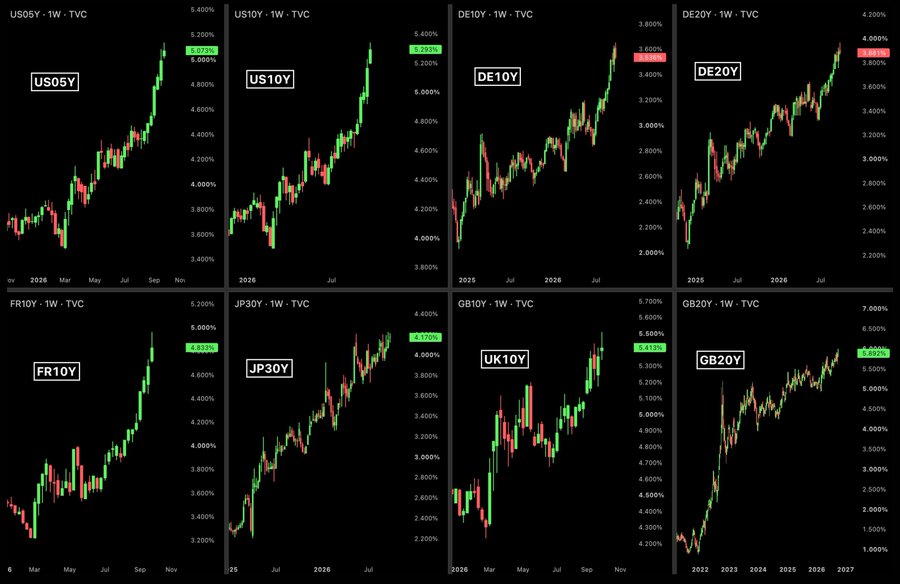
Look at what just happened to the price of a promise. The U.S. 10-year Treasury yield spiked above 5.3% in early October — a level this country had not been forced to pay since 2002 — before sliding back under 5% by month’s end. That round trip was not a normal cycle. Read that again. The world’s largest economy just had to bid up the price of its own debt to levels unseen in a generation, just to find buyers.
Here’s why. A federal debt that closed the fiscal year at $40.17 trillion. A deficit running above six percent of GDP. And now a fresh competitor for the same pool of capital: the five biggest AI hyperscalers alone issued over $150 billion in bonds this year, more than five times their 2020–2024 annual average. Everyone needs the same dollar. Nobody’s printing more of it fast enough to keep the price down. High-yield credit is showing real stress. Refinancing walls are coming due at rates nobody priced in five years ago. The cheap-money era is over. The bill for two decades of debt-financed everything is arriving all at once, and it’s arriving everywhere — Washington, Tokyo, London, Paris — at the same time.
Here’s the thing. Bitcoin does not care about any of that. It does not need a Treasury auction to clear cleanly. It does not need a central bank to suppress a rate or a finance ministry to find a buyer. Its supply is fixed at 21 million. Its issuance schedule is enforced by code and energy, not by a vote. When the dust settles on this stretch of sovereign and corporate credit stress, the asset that cannot be diluted, cannot default, and cannot be renegotiated behind closed doors will be exactly where it started. That is not a prediction. That is math.
That same lesson got written in blood on October 29. Attackers drained an estimated $6.3 to $6.4 billion from Binance’s hot wallets across roughly ten blockchains in under an hour. The largest theft in cryptocurrency’s history. Gone, in less time than it takes to watch a movie.
Here’s how. A feature built into Ethereum let one of Binance’s own wallets temporarily hand control to outside code — but only with a real signature from Binance itself. The attackers had that signature. Fifty of them, in fact, pre-signed and waiting. They pointed one of the exchange’s largest hot wallets at a sweeper contract they controlled and pulled out well over $2.5 billion in a single transaction. Ten more wallets followed within minutes. Every dollar that moved required a legitimate Binance signature.
Nobody broke Ethereum. Somebody broke into the room where Binance signs its own transactions — traced back, in the end, to a compromised engineer’s laptop.
Blockchain analytics firms have pinned the attack on North Korea’s state-linked TraderTraitor group, the same operation behind last year’s $1.5 billion Bybit theft. Roughly three billion dollars of what moved — mostly stablecoins — has already been frozen by issuers. Binance says it has reserved more than $6.34 billion of its own funds to make every customer whole. The money still sitting in the attacker’s wallets, bitcoin included, sits there permanently. No executive order, no court injunction, and no begging phone call claws it back. It is gone, on-chain, forever — which is precisely the point.
This is not a failure of Bitcoin, and it is not a failure of Ethereum. It is a failure of centralized custody. Every major exchange hack in history rhymes the same way: the chain keeps producing blocks on schedule, the coins that were never sitting on someone else’s balance sheet stay exactly where their owners left them, and the damage is confined entirely to whoever was holding the keys for you. Bitcoin didn’t freeze. It didn’t issue a statement. It didn’t need North Korea’s permission to keep validating blocks every ten minutes while a nation-state siphoned billions out of a centralized signing server a few miles away. The people who held their own keys felt none of this. The people who trusted an intermediary felt all of it. That is the whole argument, delivered twice in one month, in two completely different markets.
The legacy financial system — bonds, banks, custodians, the entire apparatus — runs on trust. Trust that a government manages its debt responsibly. Trust that a central bank keeps the system liquid. Trust that the people holding your assets have locked the door. Every one of those trust assumptions took a visible hit in October. Sovereign credit got repriced by a market that no longer assumes the promise holds at the old price. The world’s largest exchange got walked into by a state actor who didn’t need to break any cryptography — just one laptop. Bitcoin’s entire design exists to remove that trust requirement at the base layer, and for one month, the universe ran both halves of the experiment at once.
The window stays open exactly as long as the old system is busy explaining itself. Twenty-one million coins. No CEO to compromise, no signing server to breach, no debt ceiling to raise. The people who can tell the difference between a security failure at a company and a property of the protocol itself are the ones who end up owning more of that fixed supply by the time the dust clears.
Absorption, Not Abandonment
Here’s the number. Bitcoin closed October at approximately $77,430, down 7.3% from September’s close near $83,550. Read that again. Down 7.3%. Not down 70%. Not a crash. A pullback.
From the local high above $87,000 early in the month, the market has given back roughly 10 to 11 percent. That is a measured retreat. A crash is a cascade — forced liquidations stacking on top of forced liquidations until the market finds a price nobody wants to sell below. This was not that.
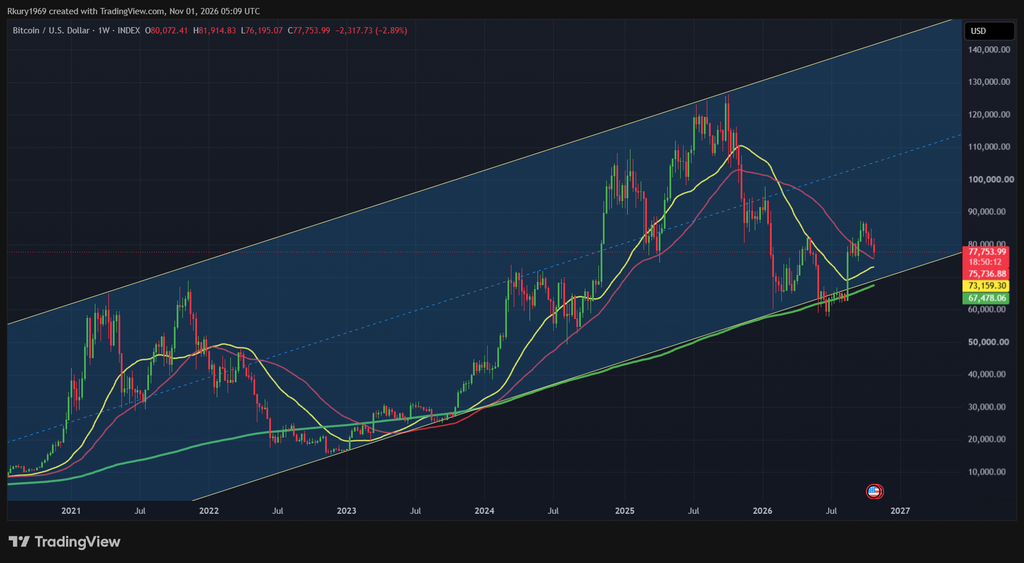
Here’s what actually happened at the line that matters. Bitcoin held above its 50-week moving average — the single level that has marked the ceiling of every prior bear market — for the entire month, right up until the final days. Then, in the same 72 hours as the Binance shock, it touched that average and briefly slipped under it. That is not a level nobody tested. That is the exact level the whole cycle hinges on, getting tested in real time, under the worst conditions October had to offer. The 200-day moving average around $73,000 and the 200-week moving average near $67,000 are both still sitting untouched beneath current price, with the well-tested zone around $65,000 waiting as the next major support if the retest fails. These are not the averages that mark the end of a cycle. They are the averages that have contained the deepest parts of every prior bear market and then become the launch points for the next one. In three weeks, this market absorbed more bad news than most assets see in three years.
The Binance incident pulled more than six billion dollars out of hot wallets across multiple chains — and the Bitcoin protocol never paused, never needed an emergency patch, and never put a single self-custodied coin at risk. At the same time, bond yields stayed elevated after testing multi-decade highs, liquidity kept tightening, and risk assets everywhere took the hit. Bitcoin closed below its 50-day moving average on October 24 for the first time in over two months. It was not immune to any of it. But it did not break structure. The decline off the local high has been orderly — no panic volume on the down days, none of the forced-selling signature that marks a cycle low. Price is still more than 14 percent above its 200-week average, the long-term floor Bitcoin has never lost for any extended stretch in its history. This is investor caution. Not the start of a new leg lower in a bear market that already bottomed earlier this year.
The all-time high near $126,200 from October 2025 sits roughly 39 percent above current levels. That is a real drawdown. It is also the shallowest drawdown Bitcoin has ever produced after a cycle high. Price touched the one weekly average that, in prior cycles, has marked the exact transition from distribution into accumulation — and it’s still fighting to hold it. A market still searching for its bottom does not absorb a multi-billion-dollar exchange collapse, a multi-decade spike in sovereign yields, and tightening liquidity all at once — and come out the other side still sitting on top of its 200-day and 200-week trendlines, with the 50-week line still in play rather than broken outright. Markets that are still falling don’t fight that hard to hold a line. They break clean through it. The bottom is in.
What’s left is the grind — transferring coins from weak hands to strong ones while the legacy system keeps pricing its own debt and its own liquidity constraints in real time. Every time Bitcoin holds these moving averages, every time it defends the $65,000 zone under stress, it’s confirming the same thing: this supply is being absorbed, not distributed. The fixed 21 million units do not care about the next headline or the next bond auction. They do not negotiate. They simply stay scarce while the market decides how much of that scarcity it’s willing to own at these prices.
The people who can tell the difference between absorption and abandonment are the ones accumulating supply that will not be available at these levels once the caution lifts.
Bitcoin is bottoming and forming an accumulation pattern similar to the end of 2022 and the beginning of 2023
The Short List Held. The Rest Kept Leaking.
The pattern held in October. A short list of names kept showing relative strength. Everything else kept leaking against Bitcoin, under liquidity that never loosened up.
Bitcoin itself closed the month down roughly 7 percent, near $77,430. Here’s what matters: almost everything else gave back more. Ethereum fell about 16 percent to roughly $2,250. XRP declined around 16 percent to $1.25. Solana dropped approximately 19 percent to the mid-$95 range. BNB held up better — down about 8 to 9 percent, near $705. Hyperliquid was the clear outlier, finishing the month near $88, down only a few percent after trading as high as the mid-$90s late in the month. NEAR gave back roughly 17 percent from its September close near $5.34, ending around $4.43 after the sharp run that followed its spot fund listing. Read that as what it is. That is not a broad recovery. That is selective absorption in a market that still has no depth.
Hyperliquid is trading on real volume and a token that routes activity straight back to holders. That is why it stayed closer to its September high near $98 while the rest of the board did not. Solana still carries the institutional ticker and the on-chain usage that drove it through the prior month — and it still gave back a meaningful chunk of the run that had carried it toward $120. NEAR still carries the AI-agent narrative and the Bitwise spot product that listed in late September. October showed exactly how fast profit-taking returns once the initial allocation is done. Zcash and Monero have stayed on the short list for months on privacy-related demand. Neither escaped the same liquidity constraint pressing on everything else.
Capital has not come back to the long tail of altcoins. When it comes back at all, it goes to a handful of names with clear usage, a regulated wrapper, or both. Most tokens are still trending toward zero measured in Bitcoin — because the incremental buyer is a committee allocating to the largest, most liquid vehicles, not a crowd chasing the next narrative. Elevated yields. The Binance aftershocks. Risk appetite is still tight. Under those three conditions at once, that committee has no reason to expand the roster. October produced exactly what you’d expect: a few names that can still attract a bid on their own merits, and a broad market still underperforming the one asset with fixed supply and the deepest liquidity in the room.
Until breadth improves and the altcoin season gauge turns decisively higher, this stays a short list. Bitcoin absorbs the stress and holds its structure. The names that earned their spot through real usage or a real product can still find support. Everything else is waiting on liquidity that has not shown up — and under these constraints, is not showing up soon.
The market is not rewarding the casino. It is rewarding the handful of pipes that still move volume while the rest of the board sits quiet.
Claude AI Bitcoin Market Analysis — November 2026
Where We Stand
Bitcoin closed October at approximately $77,430. Down 7.3% on the month. Down 39% from the all-time high of $126,210 set on October 6, 2025.
Read that again. Thirteen months off the peak, and the worst this cycle has done is lose a third of its value. That is not a collapse. That is the shallowest drawdown after a cycle top in Bitcoin’s history, and it just absorbed the largest exchange theft ever recorded on top of it.
October ended a three-month run — July, August, and September all closed green, and August and September closing green together had never happened before in thirteen years of data. October broke the streak. One red month, after a stretch nobody saw coming and nobody had modeled. That is not a trend reversing. That is a market taking a breath.
Sentiment Picture
The Fear and Greed Index sits at 34 today. Fear. Yesterday it was 30. Two weeks ago, on October 4, it was 70 — Greed, bordering on Extreme Greed.
That is a 36-point collapse in under a month, one of the fastest drops the index has ever recorded. Most of that move happened in the final 72 hours of October, when the Binance theft landed on top of an already-cooling market and triggered more than a billion and a half dollars in leveraged liquidations in a single session. This is not a market that spent months grinding into fear. This is a market that got hit with a sledgehammer in the last three days of the month and is still finding its footing.
Fear this fresh, this fast, off a base this healthy, is not the same signal as fear that has been building for a quarter. One is capitulation. The other is a single bad week getting priced in all at once.
The Critical Divergence
Here is where it gets interesting. Leveraged traders got wiped out. Long-term holders did not blink.
Strategy bought bitcoin in three straight weeks to start October — 334 BTC, then 250, then 267 — before going quiet for the week of October 19 to 25, its first skipped week in over a month. That is not retreat. That is discipline, not panic in either direction: no selling, no forced buying to defend a narrative. The company’s holdings stood at 848,517 BTC as of October 25, at an average cost basis of $75,446 — which means the entire treasury, built over years and through two separate drawdowns, was still sitting on roughly $1.7 billion in unrealized gains even before accounting for whatever it did in the Binance-shock final week, which won’t be disclosed until early November.
Spot ETF flows tell a similar story once you look past the headline. October closed with roughly $515 million in net outflows for the complex — real money, not nothing. But BlackRock’s IBIT alone finished the month with $932 million in net inflows. The outflow was concentrated in smaller, more retail-driven products. The single largest vehicle institutions actually use kept taking in money through a month that included a nation-state hacking the world’s biggest exchange. That is not what capitulation looks like. That is a market where the money that moves slowly did not move at all.
Technical Structure
Price closed October at $77,430, with the 52-week range running from the June low near $57,750 to the prior cycle high above $111,000. The 50-day moving average sits at $81,857, well above current price — a real overhead level, not a formality. The 200-day moving average sits at $73,059, and price has stayed above it through the entire correction. The 50-week moving average, sitting near $76,000 to $77,600, is the level that mattered most all month: Bitcoin held above it for the first three weeks, then touched it and briefly slipped under it in the same 72 hours as the Binance shock. That line is still live, not broken clean. Below it, the 200-week moving average near $67,000 has never been lost for any extended stretch in Bitcoin’s history, and the well-tested zone near $65,000 sits as the backstop beneath that. RSI(14) reads around 36 — weak, but nowhere near the washed-out extremes that have marked actual cycle bottoms.
Macro Overlay
The Federal Reserve held rates at 3.75% to 4.00% on October 28, in a 10-2 vote, with the dissents coming from members who wanted a hike, not a cut. Markets are now pricing a real chance of exactly that in December. The 10-year Treasury yield, which spiked above 5.3% earlier in the fall, has since cooled back under 5% — real relief, but relief sitting on top of a federal debt that just closed the books above $40 trillion. Then, on October 29, the largest theft in cryptocurrency’s history hit Binance for an estimated $6.3 to $6.4 billion, an event blockchain analysts have tied to North Korea’s state-linked TraderTraitor group. None of this is calm. All of it landed in the same ten days.
Monthly Outlook: Three Scenarios
Bullish, 25% probability: Bitcoin reclaims the 50-week moving average decisively, holds above $80,000 on a weekly close, and ETF flows swing back to net positive as the Binance story fades from headlines. Price works back toward the $85,000 supply zone that capped October’s early rally.
Neutral, 40% probability: price chops between the 200-day moving average near $73,000 and the 50-day moving average near $82,000 for most of November, digesting both the hack fallout and the wait for the December Fed decision. Sentiment recovers from Fear toward Neutral without a clean break in either direction.
Bearish, 35% probability: the 50-week moving average breaks clean, a hawkish December Fed hike compounds the pressure, and price tests the 200-day moving average in earnest — with the $67,000 to $65,000 zone coming into play if that level fails to hold.
The Number That Matters Most
Through a nation-state hack that stole more money in one hour than most companies make in a decade, and the fastest sentiment collapse in months, Strategy’s entire 848,517 BTC treasury — the single largest concentrated bitcoin position on the planet — closed October still sitting on a gain. Cost basis $75,446. Spot price $77,430. That is the whole argument in two numbers.
Summary and Strategy
October gave this market everything it could throw at it in one month, and the fixed-supply asset is still standing. A record-breaking green streak ended. Fine — streaks end. A $6.3 billion theft hit the largest exchange on earth. Bitcoin did not notice, because it was never Bitcoin’s problem to begin with. Leveraged traders got liquidated for a billion and a half dollars in a single session. The largest corporate holder on the planet, sitting on a treasury built over years, did not sell a single coin.
That is the pattern worth remembering heading into November. The panic lives in the hands that borrowed to be here. The conviction lives in the hands that didn’t. Twenty-one million coins, a little over twenty million of them already mined, and not one more getting created no matter how bad the headline is. The scarcity does not care about Binance’s signing infrastructure, the Fed’s December dot plot, or how fast the Fear and Greed Index can fall. It just keeps being scarce.
The window for this kind of accumulation does not stay open because the market is calm. It stays open because most people can’t tell the difference between a security failure a thousand miles away and a flaw in the thing they actually own. The ones who can are the ones who end up holding more of it.
Final Thoughts
Here’s the honest version of October: the old system cracked in public, the new one kept working.
The 10-year Treasury yield spiked above 5.3 percent, unseen since 2002, atop a federal debt above $40 trillion and a deficit north of six percent of GDP. That stress moved. On October 29 it hit Binance, where attackers took $6.3 to $6.4 billion — the largest theft cryptocurrency has ever recorded. Compromised signing infrastructure, not broken code. A company failed. The protocol didn’t. Bitcoin kept producing blocks every ten minutes through all of it, because it was never anyone’s permission to ask for.
Bitcoin closed October down 7.3 percent, near $77,430, ending a three-month green streak in which August and September closed green together for the first time in thirteen years. The streak ending isn’t the story. What held on the way down is. Price touched its 50-week moving average — the level that’s capped every prior bear market — and held everything beneath it: the 200-day, the 200-week, the floor near $65,000. A market actually breaking down doesn’t absorb a bond shock, a nation-state hack, and a billion and a half in liquidations, and land standing on every trendline that matters. This one did.
The rest of the board told the same story smaller. A short list with real usage or a regulated wrapper held its ground. Everything else leaked harder than Bitcoin, because real capital keeps choosing the deepest liquidity and the hardest supply over the next narrative.
Sentiment cracked fast — Fear and Greed fell from 70 to 34 in four weeks, most of it in the final 72 hours. The hands that don’t trade on sentiment didn’t move. Strategy bought three of October’s four weeks, paused for one, sold nothing, and closed the month with its 848,000-plus-coin treasury still sitting on a gain. ETF flows went slightly negative; BlackRock’s IBIT, the vehicle institutions actually use, still finished positive. The panic lived in the leveraged accounts. The conviction lived in the ones that don’t check the price hourly.
None of this makes November easy. The 50-week average is a live test, not a settled win. The Fed just held rates in a split vote, with hawks pushing a December hike. Respect that. Anyone selling you zero risk here isn’t being straight with you.
Here’s what’s certain: twenty-one million coins. A little over twenty million already mined, not for sale unless their owner says so. No signing server to compromise. No debt ceiling to raise. No committee that votes to issue more. Every shock like October just re-teaches the same lesson: the fixed-supply asset doesn’t need the old system’s permission to keep working.
That’s the window. It’s open now, while the headlines are loud and the fear is fresh. It stays open because most people can’t tell a company’s bad month from a protocol’s unbreakable math. Figure that out before the crowd does, and November is just the next chapter in the story this asset has told since 2009: scarcity wins, every time.
All information provided is for educational purposes only. It is essential to conduct your own research before making any financial decisions. This is not intended as financial advice.

Stay Free!
Kury




You must be logged in to post a comment.